
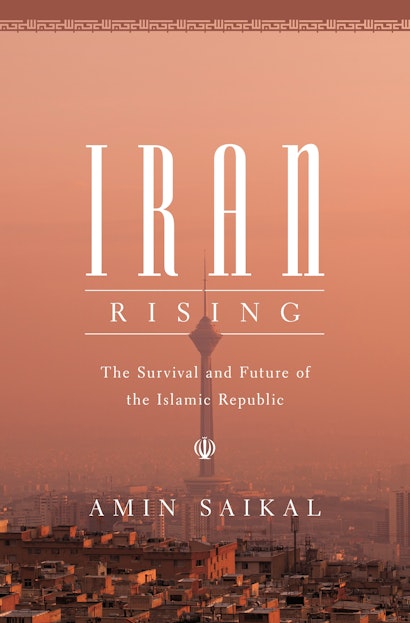
When Iranians overthrew their monarchy, rejecting a pro-Western shah in favor of an Islamic regime, many observers predicted that revolutionary turmoil would paralyze the country for decades to come. Yet forty years after the 1978鈥�79 revolution, Iran has emerged as a critical player in the Middle East and the wider world, as demonstrated in part by the 2015 international nuclear agreement. In Iran Rising, renowned Iran specialist Amin Saikal describes how the country has managed to survive despite ongoing domestic struggles, Western sanctions, and countless other serious challenges.
What did international observers predict would happen in Iran after the 1978-79 revolution? Why did things turn out differently?
AS: The Iranian revolution marked a momentous development in world politics, challenging the regional order and America鈥檚 dominant position in the Middle East. A new Islamic Republic of Iran, under the theo-political leadership of Ayatollah Ruhollah Khomeini, replaced the Shah鈥檚 pro-Western monarchy. It condemned the US for supporting the Shah鈥檚 autocratic rule and disparaged America鈥檚 regional allies, including Israel. It locked horns with Washington鈥攕omething that has continued to date, though in different intensity from time to time. Khomeini established a unique Shia-based system of Islamic governance. In a bloody power struggle following the overthrow of the Shah, Khomeini swiftly and forcefully eliminated or marginalised groups and individuals who had actively participated in the revolution, but did not agree with his brand of Islamism. The resultant post-revolutionary turmoil, and the Islamic regime鈥檚 unorthodox theocratic behaviour on both domestic and foreign policy fronts, led some analysts to conclude that the regime was an aberration and could not possibly endure. However, the regime has now lasted for forty years, surviving numerous domestic and foreign policy challenges. Three key variables account for this. First, the internal elasticity and external flexibility of the regime鈥檚 system of governance enable it to both claim religious legitimacy and act pragmatically to survive. Over time, it has become less ideological and more pragmatic. Second, changing conditions within Iran and internationally have enabled the regime and its supporters to take advantage of American policy failures in the region鈥攊ncluding, most importantly, in Iraq, Afghanistan, Syria, and on the Israeli-Palestinian front鈥攖o expand its regional influence. Third, it has built up hard and soft power capability in support of an asymmetrical defensive strategy.
How has Iran鈥檚 Islamic regime weathered the international sanctions against it?
AS: The Islamic regime has been under American sanctions since the 鈥渉ostage crisis.鈥� On 4 November 1979, a group of militant student supporters of Khomeini overran the US embassy in Tehran and took 52 of the embassy鈥檚 diplomatic and non-diplomatic personnel hostage. The episode lasted until President Ronald Reagan鈥檚 inauguration on 20 January 1981. The Islamic regime used the crisis to consolidate power, humiliate the United States, and pierce Pax Americana in the Middle East. Washington severed all ties and imposed sanctions on Iran. The regime coped with this鈥� along a bloody, and costly war with Iraqi dictator Saddam Hussein鈥攂y extracting more from the Iranian people and by pragmatically strengthening ties with the Soviet Union (and subsequently its successor, Russia) and China, despite the regime鈥檚 serious aversion to godless communism. It also entered closer cooperation with India. It engaged in processes of self-sufficiency and took steps to circumvent the sanctions. When the UN later imposed sanctions, and the US and its European allies ratcheted up their sanctions over Iran鈥檚 nuclear program, the regime pursued the same approach. It is now forced to act in a similar fashion once again, to counter President Donald Trump鈥檚 efforts to tame the regime in line with American interests. Trump鈥檚 sanctions imposed following his withdrawal in May 2018 from the July 2015 multilateral nuclear agreement known as the Joint Comprehensive Plan of Action (JCPOA) are indeed very severe. Targeting the core elements of the Iranian economy, they are designed to strangle the regime economically and force it to change behaviour that Trump has branded as destructive and destabilising in the region鈥攁nd therefore contrary to America鈥檚 interests. Trump鈥檚 actions will seriously hurt Iran鈥檚 already fragile economy, causing more hardship for ordinary Iranians. But they are unlikely to affect the regime to the point of submission, given its theocratic nature and the Iranian people鈥檚 tradition of fierce nationalism in the face of an outside threat or assault. After all, it was not the US-led international sanctions鈥攊mposed on Iraq following the February 1991 US-led liberation of Kuwait from Iraqi occupation鈥攖hat ended Saddam Hussein鈥檚 rule, but rather the March 2003 US invasion of Iraq.
How would domestic policy changes lead to foreign policy changes?
AS: A majority of the Iranian people are crying out for improved living standards. Economic mismanagement, rampant corruption, international sanctions, and the residual effects of war with Iraq have led to high unemployment, inflation, and declining living conditions. As public pressure has built, the clerical leadership has responded by allowing occasional economic and social reforms. At the same time, it has been able to blame the US and its allies for Iran鈥檚 economic woes and keep most Iranians on their toes in a conflated Shia and nationalistic posture. President Trump鈥檚 blatant support for public protests鈥攑rimarily over the economic situation, and also the clerical domination of power鈥攈as conveniently enabled the regime to attribute Iran鈥檚 problems to America鈥檚 hegemonic and imperialist designs on the Iranian people. As the regime has defied the US, it has sought good relations with countries that have not shared Trump鈥檚 hostile attitude. These include, prominently, the other signatories to the JCPOA (Britain, France, Germany, Russia and China), which have remained committed to the nuclear agreement, with a promise to override America鈥檚 ban on third party鈥檚 business dealings with Iran.
Can the history of the Islamic Republic help us understand Islamic governments in other countries?
AS: Not necessarily. Iran鈥檚 system is heavily informed by Khomeini鈥檚 Shia version of Islam and is linked to Iran鈥檚 peculiar traditions. Neither the three other Shia-majority countries (Iraq, Azerbaijan and Bahrain) nor any of the Sunni-majority states, whose citizens form the bulk of the world鈥檚 1.7 billion Muslims, have emulated Iran鈥檚 system of governance. For a combination of sectarian and geopolitical reasons, only Bashar al-Assad鈥檚 Syrian regime and some Shia sub-national groups, such as Hezbollah in Lebanon and the Houthis in Yemen鈥攏ot to mention certain Iraqi Shia militias鈥攈ave sought close relationships with Tehran.
What about US-Iran relations?
AS: The United States has tried everything short of direct military confrontation to contain the Iranian Islamic regime since its advent鈥攁nd so far has failed. President Trump has promised that his latest round of sanctions will debase the regime economically and politically. But the likelihood of this happening seems remote. Realising this, President Obama pursued a policy of engagement rather than confrontation toward the regime. This led to the JCPOA, a landmark diplomatic achievement and a shot in the arm of the reformist and pragmatic factions in Iranian politics, led by President Hassan Rouhani, to strengthen their position in the power structure. Trump鈥檚 actions have once again energised the hardline clerics and their supporters, associated with the Supreme Leader Ayatollah Ali Khamenei, to maintain their centrality in governing Iran and beef up their stance against any form of rapprochement with the United States or reformation of the Iranian system. The main question is: If his present measures fail and his own presidency survives, given the magnitude of his domestic problems, will Trump move toward military confrontation? War would be disastrous for all sides, as Iran has invested heavily in an asymmetrical fighting strategy to make an attack on it as costly as possible for its perpetrator.
Amin Saikal is Distinguished Professor of Political Science, Public Policy Fellow, and Director of the Centre for Arab and Islamic Studies (the Middle East and Central Asia) at the Australian National University. He is the author of The Rise and Fall of the Shah (快色直播) and Modern Afghanistan. He lives in Canberra.