
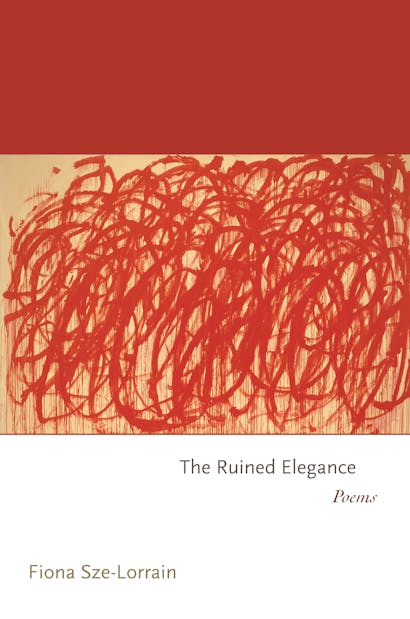
Fiona Sze-Lorrain is a poet, literary translator, editor, and zheng harpist. In her new collection鈥攁n intercultural journey that traces lives, encounters, exiles, and memories from France, America, and Asia鈥攕he offers a nuanced yet dynamic vision of humanity marked by perils, surprises, and transcendence. Recently she took the time to answer some questions about The Ruined Elegance.
Can you speak a little about your writing process or how these poems came about?
FS: Almost every poem in this collection behaved like a beast. I lost whenever I tried to fight it, until I realized how far I missed the mark. 鈥淭o question the options of elegy, I鈥檝e probably chosen the wrong epic.鈥� [from the poem 鈥淏ack from the Aegean Sea鈥漖 Several verses and their poetic narratives were deviating at the start, in part because I had tried to be clever about a 鈥渓yric/anti-lyric.鈥� I wanted silence and music. What better paradox could there be? It did feel like a crisis when I could only pick these poems up from their 鈥渞uins.鈥� I censored words and images even before saying them out loud or putting them down on the page. Part of my illusion had to do with my folly of 鈥渨riting to tame vulnerability and speechlessness鈥� on the page. While finding ways to cope, I felt drawn to reading poems that were gentle yet could sustain a certain emotional rawness and moral jolt. To recenter myself, I walked 鈥� from one arrondissement to another.
What colors come to mind when you revisit the poems in The Ruined Elegance?
FS: Violet, vermilion, and shades of gray-green. No vintage 鈥渂lack and white.鈥�
Why not?
FS: Because I hope to have the poems operate beyond witnessing, documenting or commenting about their socio-historical sources, even if some of the thematic concerns relate to specific political events 鈥� these poems believe in history, but they don鈥檛 live in the past.
Why poetry? What would you like to be if you weren鈥檛 a poet, literary translator, or zheng harpist?
FS: I didn鈥檛 plan to 鈥渂e a poet.鈥� Poems and Bach bring me as much joy as doubt, though sometimes not as much company as would horses and trees. Why poetry 鈥� because it can still resist greed and social constructs. Were I not a poet or musician, I would like to play bridge professionally or practice herbology and phytotherapy.
What are some of your poetic influences?
FS: Dickinson, Lowell, Rimbaud, Milosz, Lorca, Bia艂oszewski, Montale鈥� as well as translations of Buddhist scriptures and Latin texts.
Please offer some reading recommendations for our readers.
FS: 笔谤辞耻蝉迟鈥檚 脌 la recherche du temps perdu: it is my perennial 鈥渄rug鈥� or ritual. I also recommend C.G. Jung鈥檚 The Red Book, Aesop鈥檚 Fables, photography catalogues of Tina Modotti, Susan Stewart鈥檚 On Longing, Pico Iyer鈥檚 The Open Road, Mark Strand鈥檚 Collected Poems, Simone de Beauvoir鈥檚 Une mort tr猫s douce [A Very Easy Death], and photographs of the Baudelairian Paris by Eug猫ne Atget. An excerpt from The Ruined Elegance. Note, the first line is after the last verse of her translation 鈥淢irror,鈥� by contemporary Chinese poet Zhang Zao, forthcoming from Zephyr Press.
More information about The Ruined Elegance and Chapter one is available here.
Fiona Sze-Lorrain is a poet, translator, editor, and zheng harpist. She is the author of three previous poetry collections, including The Ruined Elegance (快色直播), which was a finalist for the Los Angeles Times Book Prize. She has also translated more than a dozen books of contemporary Chinese, French, and American poetry. She lives in Paris.