
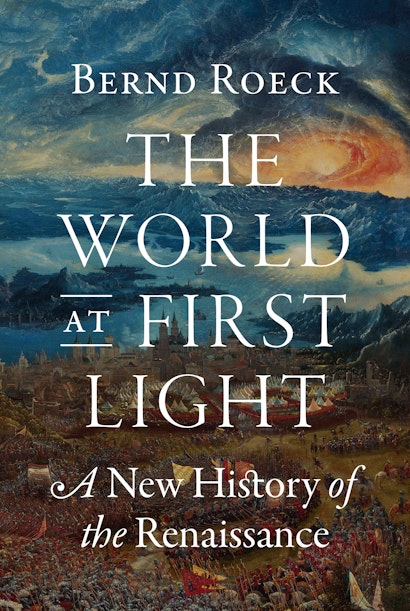
The cultural epoch we know as the Renaissance emerged at a certain time and in a certain place. Why then and not earlier? Why there and not elsewhere? In The World at First Light, historian Bernd Roeck explores the cultural and historical preconditions that enabled the European Renaissance. Roeck shows that the rediscovery of ancient knowledge, including the science of the medieval Arab world, played a critical role in shaping the beginnings of Western modernity. He explains that the Renaissance emerged in a part of Europe where competing states and cities formed relatively open societies. Most of the era鈥檚 creative minds鈥攆rom Leonardo da Vinci and Michelangelo to Copernicus and Galileo鈥攃ame from the middle classes. The art of arguing flowered, the basso continuo to intellectual and cultural breakthroughs.
What does 鈥淩enaissance鈥� mean?
Literally it means 鈥渞ebirth.鈥� The scholars, writers and artists of the Renaissance opened up the ancient tradition, applied their methods and critically examined it. Criticism and self-criticism, questions, more questions and doubts are the key renaissance features, and the model for this questioning was provided two and a half millennia ago by ancient Greece with the 鈥淪ocratic dialog.鈥� The Renaissance embraced the pattern and passed it on to modern Europe where it has persisted into the modern age. It seems that in other cultures, respect for the old and for authorities of all kinds in general remained much more powerful, and in some societies this remains true today.
What were the most significant achievements of the Renaissance?
The Renaissance is known as an era of great art and literature, as the time of the humanists, of Leonardo da Vinci, Michelangelo and Raphael. The book tells of them, of great poets, of Dante, Petrarch, Erasmus of Rotterdam and Montaigne. It speaks about the first media revolution, triggered by Gutenberg; printing with movable types and screw press was perhaps the most momentous invention in a thousand years. It deals with Copernicus鈥� new astronomy and Galileo鈥檚 new physics. Without them and others, there would be no satellites, no navigation systems, no mobile phones. We should also mention Machiavelli, the inventor of a new theory of politics: he saw the world as it was, and not as it should be.
The Renaissance invented new worlds, most famously in the form of Thomas More鈥檚 鈥淯topia.鈥� Europe learned via Columbus of a quite large continent to the west. The Portuguese Magellan circumnavigated the globe for the first time. And Giordano Bruno conceived an infinite universe. In one sentence: The beginnings of Western modernity were formed during the Renaissance.
A central theme of the book is the question of the prerequisites for scientific and technical progress. Can you comment on this?
The Renaissance was unique. There was no comparable culture in the world that dealt with scientific problems in a similarly critical way. The most interesting question that the book attempts to answer is: Why was the 鈥淲est鈥� more successful in the scientific and technical fields, economically and unfortunately also militarily, than the rest of the world until the 19th century? Why did the Scientific Revolution and then ultimately, the Industrial Revolution, take place in Europe?
The book takes a critical look at the power of religion. Can you elaborate?
It was of great importance that a separation of church and state, religion and politics began to emerge relatively early in the 鈥淲est.鈥� This development was good for the openness of the academic discussion. In societies in which religious institutions dominated鈥�this was the case in Byzantium and Spain, for example, but not in the Arab world of the Middle Ages鈥�there was hardly any scientific progress.
In some respects, the Renaissance was a 鈥渇irst Enlightenment.鈥� This was most evident in Italy. Its intellectual elites were interested in ancient philosophy and literature, and discussed aesthetic problems鈥�theological questions were of far less interest than in Germany. As a result, the religious controversy in Italy was also less explosive. The Reformation took place in Germany, not in the south.
Couldn鈥檛 your book be critizised as 鈥渆urocentric鈥�?
Considering the question why modern science first saw the light of day in Europe and not elsewhere means that we have to understand first what happened in Europe. And that is why I am trying to describe as precisely as possible the conditions for the new, for the scientific and technological progresses in Europe. The comparisons are intended to show which of these conditions were not present in other cultures.
By the way, World at First Light never makes the claim that any scientific development or technical progress necessarily had to occur. Instead, it aims to reconstruct the 鈥渞ealm of possibility鈥� in which the 鈥渞ise of the West鈥� was able to take shape. In other words, I ask what was possible. What could be invented and discovered, and what were the societies like in which it was invented or discovered?
You call this a hymn to democracy. Can you explain?
Yes. The long and complicated history of the Renaissance also teaches us that, in the long term, it is above all liberal democracies and not authoritarian states that promote most effectively scientific, technological, and economic success. A global comparison shows that it was democratic countries that developed the most effective medicine. They produced the best systems of social welfare, and in them the 鈥淐orruption Perception Index鈥� is by far the most favorable. Open societies in which social advancement is possible are of paramount importance. Another significant factor is the existence of middle classes. Almost all creative minds of the Renaissance, artists, inventors and scholars emerged from them.
This is a tremendously thick book, over 1,100 pages.
In order to understand the beginnings of our modern industrial world, according to one thesis of my book, it is not enough to look only to the 17th and 18th centuries. The precursors lie deeper, more precisely in Greek and Roman antiquity and in their renascence. So the book looks far back into the past and also attempts a global historical perspective.
The causes of Europe鈥檚 successes were much more complex than is suggested by a simple formula like 鈥渁scendance by exploitation.鈥� Of central importance was the exchange with other cultures鈥�the Europeans learned how to make paper from the Chinese, the decimal numbering system came from India and was transmitted to Italy via Baghdad and North Africa. The culture of the Renaissance owed much to the work of Arab scholars. A Muslim, the great philosopher and physician Ibn Rushd鈥�or Averroes鈥�even found his way into a fresco by Raphael in the center of Christianity, the apostolic palace in the Vatican.
Do you describe the 鈥渄ark side鈥� of the Renaissance?
The book does not simply describe a 鈥淓uropean miracle,鈥� as the economist and historian Eric Jones called the way of the West. Themes also include the life and suffering of the common people. Plague and the Little Ice Age, wars, witch hunts and stakes for heretics are topics, as are many horrible consequences of the so-called 鈥渄iscovery鈥� of America. The Europeans themselves paid dearly for the rise of the West, for example, in the wars of religion, on the battlefields of their struggles for independence, and on the barricades of their revolutions.
You worked on this book for a good decade. What readership did you write for?
For people who are interested in history. I simply wanted to tell a long, but fascinating story, and I didn't want to do so without describing people and scenes. Readers visit the Florence of the Medici, the Urbino of Federico da Montefeltro; they visit Rome, the Augsburg of the Fuggers, Prague and Shakespeare鈥檚 London, Athens, Moscow and Beijing, Great Zimbabwe, Tenochtitlan...
I would add that the translation of The World at First Light by Patrick Baker is brilliant. We had a very close and very pleasant collaboration.
Bernd Roeck has been professor of modern history at the University of Zurich and director of the German Centre for Venetian Studies in Venice. He is the author of Florence 1900: The Quest for Arcadia, Civic Culture and Everyday Life in Early Modern Germany, and other books.