
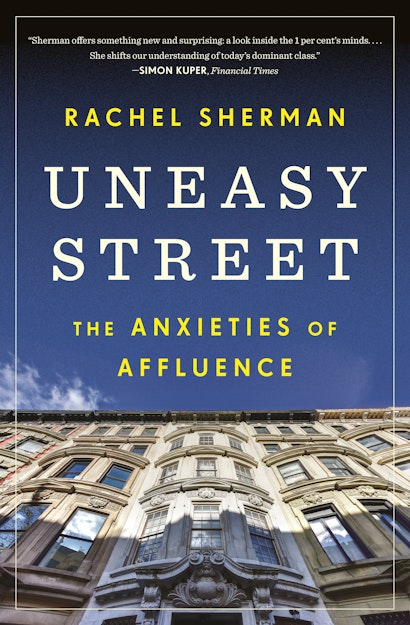
This month鈥檚 Book Club Pick is Uneasy Street by Rachel Sherman. This is an excellent non-fiction summer book club selection for readers who are curious about the lives of the 1%. From TV鈥檚 鈥渞eal housewives鈥� to Succession, our popular culture portrays wealthy people as materialistic and entitled. But what do we really know about how these people live? In this book, Sherman draws on rare in-depth interviews that she conducted with fifty affluent New Yorkers鈥攆rom hedge fund financiers and artists to stay-at-home mothers鈥攖o examine their lifestyle choices and understanding of privilege. Writing about the book in the New York Times Book Review, John Williams notes, 鈥淪herman takes a dispassionate approach to find out how those who are 鈥榖enefitting from rising economic inequality鈥� experience 鈥榯heir own social advantages.鈥� She elicits her subjects鈥� thoughts about work and productivity, charitable giving, marital discord and more. Worthwhile humanizing ensues, as do plenty of squirm-inducing moments.鈥� It鈥檚 an absorbing and illuminating read that is sure to lead to animated discussion. It鈥檚 a great choice for fans of Wednesday Martin鈥檚 Primates of Park Avenue or Michael Gross鈥檚 740 Park.
The discussion questions below are meant to guide your conversations, and we encourage you to share highlights from your discussion鈥攁nd pictures!鈥攙ia social media, using hashtag #ReadPUPforBookClub.
Discussion Questions
- Sherman discusses the challenges of defining 鈥渢he elite,鈥� and she developed a set of criteria for choosing her participants. Who counts as 鈥渆lite鈥� to you? Is it based on income, wealth, education, or job? In what ways do public figures such as politicians and celebrities seem 鈥渆lite鈥� or not?
- Sherman notes that there is an American cultural taboo against discussing money and class. Some of her respondents even suggested that they would not tell their partners that they had shared details with her. How do you feel about discussing your own financial situation? With whom are you comfortable discussing it? Are there other topics that are similarly 鈥渙ff limits鈥�?
- Sherman conducted her interviews in New York City, one of the most unequal cities in the United States, at a time when economic disparities were especially prominent. How might the story have changed if she interviewed people in a different city?
- Sherman identifies 鈥渦pward-oriented鈥� and 鈥渄ownward oriented鈥� people in her sample. Do you tend to compare yourself to people who have as much or more than you, or to those who have less? Do you think of yourself as privileged? Why or why not?
- Do the criteria Sherman identifies for being a morally worthy wealthy person鈥攚orking hard, consuming prudently, giving back, and in general trying to be 鈥渘ormal鈥濃�攔esonate with you? Do you make these distinctions or see them in the culture at large?
- In explaining their success, Sherman鈥檚 respondents often refer to how hard they have worked. They often emphasize the role of luck, too. Sherman suggests that this obscures other advantages, such as elite educations, lack of debt, financial support from their parents, etc. Do you agree? What is the difference between 鈥榟ard work鈥� and 鈥榣uck鈥� as explanations for having wealth?
- When asked what 鈥榞iving back鈥� meant, Sherman鈥檚 interviewees talked about charitable giving, volunteering, and having awareness of privilege. How do you define giving back? What do you think the purpose of 鈥済iving back鈥� is?
- Sherman鈥檚 respondents had mixed feelings about the value of teenagers working for pay in high school and college. Some felt it was a necessary experience. Others felt that a job would take away from other activities, including schoolwork. Do you think it is important for teenagers to hold paying jobs? Why or why not?
- In the appendix, Sherman notes that she comes from a privileged background, which was useful in connecting with some of her interviewees. How might her interviewees have responded differently if she had a different background?
- Have your perceptions of wealthy Americans changed after reading Uneasy Street? In what ways?
About the Author
Rachel Sherman teaches sociology at the New School for Social Research and Eugene Lang College. She is the author of Class Acts: Service and Inequality in Luxury Hotels.