
On a damp dreary day鈥�was it January or February 1546?鈥�Giorgio Vasari stepped over a fresh pile of dung to knock on Michelangelo鈥檚 door. The street, Macel de鈥� Corvi鈥�slaughterhouse of crows鈥�was crowded with market stalls selling whole or pieces of small birds and rodents, fowl and foul meats. Over the busy activity loomed a gleaming marble pillar, said to be part of the Roman Emperor鈥檚 palace.
The seventy-year old Michelangelo greeted young Giorgio familiarly, noted his fine clothes, and smiled at the thought of dandyish Vasari making his perfumed way through the smelly neighborhood. Michelangelo sardonically complained about 鈥減iles of excrement around my door, as if there was nowhere else to shit. Dead cats, carrion, filth and slop are my constant companions,鈥� he wrote. Michelangelo pulled on his soft leather boots, laced his jerkin, and mounted his small nag. He and Vasari set off at an ambling pace toward St. Peter鈥檚, a thirty minute ride across wintry Rome. They were to pay a courtesy visit to the Venetian artist, Tiziano Vecellio, recently arrived from Venice.
In 1545-46 Titian, in his sixties, made his first visit to Rome. As a client of Pope Paul III, he was lodged in rooms in the Vatican guesthouse, the 鈥淏elvedere,鈥� and commissioned to paint portraits of the Farnese Pope and his famiglia. When Michelangelo and Vasari paid their courtesy visit, Titian had a number of paintings underway, including a ravishing picture of 顿补苍盲别 impregnated by Zeus who had transformed himself into a shower of gold coins. Among general murmurs of praise, Michelangelo admired the color and professed, 鈥淚t pleases me very much.鈥� Was Michelangelo merely being polite? Only after he and Vasari left the Belvedere did Michelangelo remark, 鈥渋t鈥檚 a shame that in Venice one did not learn to draw from the beginning.鈥�
The relations between these two artists will forever be colored by Michelangelo鈥檚 barbed criticism. The story, as with any history between two individuals, is more complex and much more interesting, especially as it evolved over forty years. Thus, the famous meeting in Rome occurred in the approximate middle of a four-decades-long acquaintance. There is much to tell before and after that awkward afternoon in the Belvedere studio.
A longue dur茅e view of this history relates a compelling tale of the two most famous artists of their day, and, almost of all time. Each was supremely gifted and hugely ambitious. At first, they began and forged careers unaware of one another, each focused on achieving individual success in their respective worlds of Florence and Venice. As Michelangelo鈥檚 populist father reminded him, 鈥渉onor is worth more in your own country and at home.鈥� To the elder Buonarroti, fame only mattered in Florence. So too, Venetians measured status by a citizen鈥檚 position in the 鈥淢ost Serene Republic.鈥�
After years of early triumphs in their respective cities (including Michelangelo鈥檚 17-foot marble statue of David in Florence, and Titian鈥檚 giant altarpiece of Mary鈥檚 Assumption, the Assunta, in the church of I Frari, Venice), their accomplishments and outsized ambitions eventually led to an awareness of one another. When did this happen? At what point did either artist learn about the other? How and why, and what came of it?
As with most stories, it is best to start at the beginning.
Titian and Michelangelo were already famous by the time they first met in 1529, and they were extravagantly famous by the time they met again in Rome in 1546. They did not need to compete, but they did鈥�sometimes admiring and emulating, sometimes criticizing and correcting. They are the Picasso/Matisse rivalry of their time: two artists who were friendly but not friends, constantly regarding the other and often challenged to new invention and sometimes open competition.
The relationship of the two artists has been mostly described as one-sided: what did the younger Titian poach from Michelangelo? But, in turn, Titian provoked, stimulated, and inspired Michelangelo. Not to be outdone, for example, Michelangelo created his first and most salacious painted nude鈥�Leda blissfully copulating with a Swan鈥�directly after seeing Titian鈥檚 sexy mythological paintings in Ferrara. Thus, over more than 40 years, half their respective long-lifetimes, the relationship proved to be reciprocal and mutually beneficial with the inventions of one inspiring genius in the other.
Despite living in different cities, the two artists shared the acquaintance, patronage and sometimes friendship of the most important rulers of their time, including Pope Paul III; Francis I, King of France; Andrea Gritti, Doge of Venice; Alfonso d鈥橝valos, General of the Holy Roman Emperor Charles V; Federigo Gonzaga, Duke of Mantua; Alfonso and Isabella d鈥橢ste, respectively a Duke of Ferrara and Duchess of Mantua. And many others.
Titian painted portraits of more than a dozen persons who played significant parts in Michelangelo鈥檚 life, including illustrious members of the Este, Medici, Della Rovere, and Farnese families. He painted the Florentine pedant Benedetto Varchi who discoursed at length on Michelangelo鈥檚 poetry, and he twice portrayed Alfonso d鈥橝valos, the kinsman of Vittoria Colonna for whom Michelangelo designed a Noli me Tangere. What鈥檚 more, Titian painted portraits of some of Michelangelo鈥檚 dear friends, including Ippolito de鈥� Medici, Pope Paul III, and Lodovico Beccadelli. And, he portrayed many persons who touched Michelangelo鈥檚 life in some fashion, including the brilliant man of letters, Cardinal Pietro Bembo, and Pietro Aretino, the literary 鈥渟courge of princes,鈥� and to Michelangelo, a persistent and irritating gadfly.
Titian knew his sitters mainly via his brilliant brush; Michelangelo knew most as long-time friends, and they all belonged to the same tight-knit, overlapping, and geographically compact world of sixteenth-century Florence, Venice, and Rome.
Toward the end of their careers, both Michelangelo and Titian sought solace in creating a 笔颈别迟脿 as their grave memorial鈥�a last will and testament. In the end, Titian outlived his rival by a dozen years and relished having the last word. His astonishing painting of the Annunciation in the Venetian church of San Salvador, a little-known painting of Judith and the Decapitated Holofernes in the Detroit Institute of Arts, and his final masterpiece, the 笔颈别迟脿 in the Accademia, Venice, were all, in different ways, self-declarations of Titian鈥檚 preeminence. But, while Titian had his brush, Michelangelo had his biographers, and ultimately print proved more powerful than paint. It was Giorgio Vasari鈥�not Titian鈥檚 paladins鈥�Pietro Aretino or Lodovico Dolce鈥�who wrote a best-selling book enshrining Michelangelo as 鈥渋l Divino鈥� and slighting Titian.
In the end, Michelangelo and Titian were more attentive and admiring of one another than either would ever admit. They were the stars on an international stage in which many of the impresarios, actors, stage-hands, and members of the audience were well-known to both.
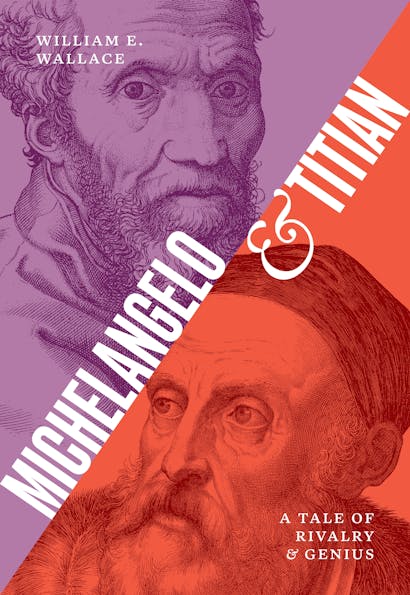
Michelangelo and Titian relates the compelling story of the two most famous artists of their day, and, almost of all time鈥�a story of their long-term mutual regard and creative one-upmanship鈥�a tale of genius and rivalry among titans.
William E. Wallace is the Barbara Murphy Bryant Distinguished Professor of Art History at Washington University in St. Louis. His books include Michelangelo, God鈥檚 Architect: The Story of His Final Years and Greatest Masterpiece (快色直播); Discovering Michelangelo: The Art Lover鈥檚 Guide to Understanding Michelangelo鈥檚 Masterpieces; and Michelangelo: The Artist, the Man, and His Times.