
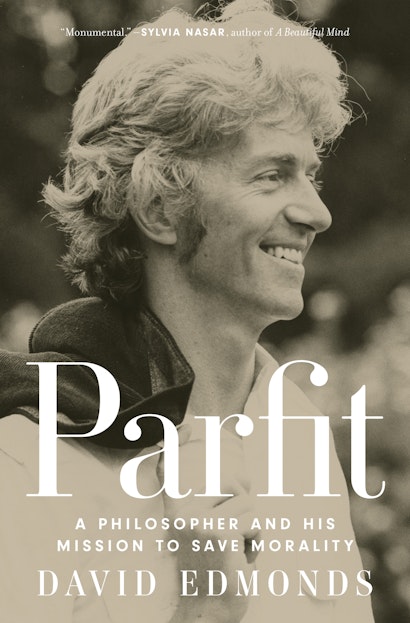
Derek Parfit was an obsessive. For much of his adult life he had two obsessions. Philosophy was one, photography another. Every year, for many years, he would travel to Venice and St. Petersburg and photograph the same buildings, trying to take the perfect shot.
Then he gave up photography, which only left philosophy. In fact, he wasn鈥檛 interested in philosophy generally. There was a single philosophical question that began to preoccupy him. Was morality objective?
Parfit was desperate to believe that it was. But many philosophers believed that it was not, at least not in the sense that Parfit meant.
Take a simple case. Your friend has neighbors who are mildly irritating and she tells you she is going round to punch them on the nose.
Suppose you try to dissuade your friend. It鈥檚 wrong to hurt people, you might say. Or you might point out that her aggression will only escalate tensions. But your friend remains unconvinced鈥攁nd off she goes to thump the neighbors.
The brilliant English philosopher Bernard Williams argued that reasons had to be grounded in motivation. It made no sense to insist that we had a reason to do something whether or not we wanted to. Parfit adored Williams, but this claim brought him to the edge of despair. He thought, in the example above, that the friend has a reason not to punch the neighbor independent of her desires. Equally, if you see a child drowning in a pond, you have a reason to save her, whether or not you want to.
Over the years, scores of people would be on the receiving end of a tormented conversation with Parfit鈥斺�榟ow could Bernard not see this?鈥� Bernard, Bernard, of all people.
But can we really make sense of our having a reason to do something that we have no desire to do鈥攐r, conversely, having a reason not to do something that we do desire? Yes, argued Parfit. And he conjured up a gloriously ludicrous individual with Future Tuesday Indifference. This person is indifferent to what happens to him on any future Tuesday. He would prefer agony on a future Tuesday to the mildest of pains on a Monday. We can all agree, said Parfit, that Future Tuesday Indifference man is irrational. Despite his desires, he has a reason to choose the mild Monday pain rather than the agonising Tuesday one.
There are moral facts, claimed Parfit. These don鈥檛 exist in the way tables and chairs existed, but they are real nonetheless. For not everything that exists in the world is physical. Not everything can be seen or touched, prodded or measured. Numbers can鈥檛 be touched. But if we can acknowledge the truth of 2 + 2 = 4鈥攅ven if it is not a truth 鈥榠n the world鈥� in the same way as tables and chairs are in the world鈥攖hen, surely, we can also concede the possibility that moral truths exist. Numbers are not physical. Morality is not physical. That it is wrong to kill innocent children is a fact.
As Parfit immersed himself in ideas that would eventually be published in his gargantuan three volume On What Matters, he began to cut himself off from almost all social life, declining non-philosophical invites. His social awkwardness, which had long been evident, grew more debilitating. If there was a dinner after a philosophy talk, he would fret about seating arrangements and whom he鈥檇 have to converse with.
He grew increasingly troubled by philosophical disagreement. He came to believe that dissent about ethics鈥攅specially dissent between leading philosophers鈥攚as evidence for the relativism of ethics. And he thought relativism essentially collapsed into nihilism. If your moral truth conflicted with, but was no less valid than, my moral truth, then this showed that, ultimately, nothing mattered.
Most moral philosophers can engage in metaethical debates without this bleeding into the rest of their life鈥攖hey still have hobbies and projects, they support certain political parties, they believe in and promote certain values, they care about the flourishing of their friends and family. But for Parfit, the thought that moral values might be something we project onto the world, caused him almost existential anguish. If moral values were relative, then he believed that he must conclude that almost everything in his life was pointless.
As for Bernard Williams, Parfit never gave up trying to sway him. He would tell people that Williams was 鈥榳onderful,鈥� that he loved Williams, but then shake his head as he explained how Williams was mistaken about moral reasons. Williams died in 2003 and about a month after his death, his widow, Patricia, had a dinner invitation at Parfit鈥檚 Oxford college, All Souls. She was placed next to Parfit, and when talk turned to Bernard, Parfit immediately burst into tears. 鈥淚 ended up comforting him,鈥� she says, 鈥淥nly afterwards did I realise how strange this was.鈥�
No doubt one reason Parfit was so upset was that Williams had gone to his grave still holding what Parfit believed was a mistaken view about moral reasons.
David Edmonds is a writer and philosopher whose many critically acclaimed books have been translated into more than two dozen languages. He is the author of The Murder of Professor Schlick and Would You Kill the Fat Man? (both 快色直播) and the coauthor, with John Eidinow, of the international bestseller Wittgenstein鈥檚 Poker. He and Nigel Warburton cohost the popular Philosophy Bites podcast.