
People say knowledge is power, and it is. But having just enough knowledge to sound smart and convincing without actually being accurate at all is a very special form of misconduct, and I’m reaching saturation on that form of misconduct from the sheer fact that I live in a self-cannibalizing imperial superpower. I’ve been thinking a lot about having the wrong amount of knowledge lately, as horror films have become increasingly a research-based form of mass art, while also having become increasingly politically ambitious in their scope. I’m all for political horror—Jordan Peele’s Get Out is on my short list of the most influential political films of the 2010s—but not all of the “elevated” horror coming out right now is doing right by us, nor even by cultural history. Drag Me to Hell (2009) is a film animated by exactly the wrong amount of research.
It opens with a young family rushing their possessed child to the home of a powerful medium. Evidently, the child has stolen a silver necklace from a “gypsy” woman, and she has now come for his soul. The medium fails; the boy winds up being “dragged to hell” by the gypsy woman’s curse. Already, I was feeling put-out by this storyline, because I really am exasperated by horror films that target and demonize historically persecuted groups like the Romani people. I would have thought Hollywood, too, would have become exasperated with it by 2009, but I was wrong. Second, the medium is a Mexican-American woman living in a mansion in Pasadena, California in 1969, helping another Hispanophone person—the boy—who’s had the misfortune to run into the Romani woman. While there were Romani people living in So Cal in the 1960s, as well as Romani people featured in Mexican-American lore, the opening of the film moves so gracelessly across cultural differences that it winds up feeling both racist and clunky. Research into the texture of the social relationships between Romani and Hispanophone people in the American 1960s would have been illuminating, and would have helped to ground the supernatural horror of the film in historical fact. Which, of course, would only have made it scarier and more effective.
We then telegraph forward to the present day, 2009, where we meet Christine, the tragically milk-toasty white heroine of the film, whose name overtly signals Christianness, and whose demeanor is unstintingly meek and naive. She works at a bank, where she is treated like trash by her employer and co-worker, both of whom are male. Eager for a promotion, she decides to try to look tougher in front of them than she feels. As a result, she deliberately turns down a loan extension to an “elderly” “gypsy” woman who comes into the bank. The woman is depicted as so physically disgusting, it’s quite offensive off the bat, either as a characterization of post-menopausal human women or as a characterization of a Romani person. This old hag pulls out her false teeth and leaves them on Christine’s desk. She hocks up heaven knows what putrid matter from her raspy throat, spits it into a handkerchief, and then fingers it absent-mindedly, also on Christine’s desk. She old woman also has gross, dirty fingernails, putrefying teeth, and a hacking cough. Everything about her body overflows its own boundaries, thus activating all manner of racist tropologies and ideologies, as well as impugning the female body as dysregulated and revolting as it ages.
Once Christine turns down this woman’s bid for a loan extension on her home, she attacks Christine physically and puts a curse on her. Eventually, she is overpowered by the bank’s armed security guards, and she gets dragged out of the bank. This could have been an interesting scene, with the alliance between the white, meek young “Christian” woman and the police being ironized or critiqued in some way, but the film isn’t interested in doing that. The old woman, deepening our sense of her intractable monstrosity, then stalks Christine to her parking place in the garage after work, where she attacks her viciously again, in outrageously disgusting ways. Eventually, Christine saves herself, but not before the gypsy woman rips a button from her jacket and uses it as part of her hex on Christine.
Everything about this film is training us to have sympathy for Christine, and antipathy toward her elderly assailant.
Christine quickly realizes that she’s been seriously cursed. Mysterious winds fly through her apartment. She has terrible dreams. Eventually, she consults a psychic, who tells her that the woman was a lamia.
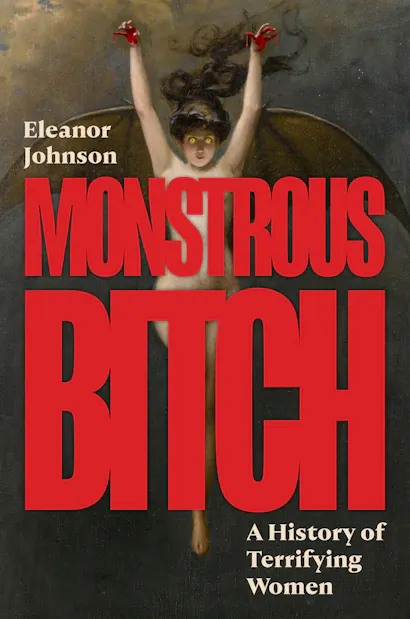
What, ho! I thought to myself, This might get interesting, despite its racist flavoring! Because lamia are very important to me and to my research; in fact, my newest book Monstrous Bitch (¿ìɫֱ²¥, 2026) centers on the lamia tradition, in its full glorious monstrosity, as it reaches from ancient Mesopotamia to right now. But alas for this film, tere’s a big, big difference between knowing the word lamia—which I’ll still give director Sam Raimi credit for—and knowing what a lamia actually is. A lamia is not a raging, vengeful, disgusting old caricature of a Romani woman. In fact, a lamia is a seductive, blood-sucking, baby-eating spellcaster. She is also often part animal, usually either dog or serpent, and often both. But crucially, the lamia’s power lies in her sex appeal; a mucus-flinging woman with false teeth misses the core threat of the lamia, which is that people desire her. As the Biblical proverb goes: He who trafficketh in misogynist stereotypes doth well to shewen them in historically accurate terms.
Unsurprisingly, throughout the rest of the movie, the depiction of the lamia remains as problematically wrong as it starts, culminating in the utterly meritless idea that the lamia’s goal is to physically drag human people into the burning inferno of hell. Nope. No. Pre-Christian lamiae didn’t even believe in Hell, much less drag people there. And Post-Christian lamiae, while understood to be under diabolical influence, didn’t have the power to drag anyone to hell. What they were infamous for was tormenting people while they were still on earth: seducing men, stealing and murdering babies, causing infertility.
So, Christine (the white, Christian, innocent, pretty, blond girl) spends the whole movie fighting off this (non-)lamia caricature of Romani women (non-white, non-Christian, non-innocent, unclean, repugnant), helped by a psychic she meets and, eventually, his friend, the Mexican-American medium from the opening scene of the film. This now elderly woman immediately realizes that Christine’s “lamia” is the same monster she failed to rescue the little boy from, 40 years earlier. We think the medium is going to succeed in ridding Christine of her “lamia” problem, but she fails again, and this time she dies. So, the surviving psychic tells Christine, her only option is to give the button—which is the epicenter of her curse—to someone else, thereby transferring the curse to them.
This is what the film should’ve been built around, not some underpowered chimera of female monstrosity. The film should have been a moral horror film, where Christine—cursed and rapidly approaching her subsumption into hell—wrestles with the dilemma of whether to save herself at the cost of the soul of another person, or whether to accept her fate as the inevitable result of her having failed to extend fiduciary grace to a poor, old woman. And the film does dwell in that very interesting space for a few scenes: Christine sits at a diner, debating on whom she could give the button to, but she keeps discarding people concluding it’s just not fair to them. So she decides the exhume the old woman’s body—she has died in the interim even though her curse lives on—and give the cursed button back to her. Needless to say, this effort fails, and in the final shots of the film, Christine is absorbed into the gaping maw of a fiery inferno, just as the little boy was in the opening scene of the film.
Now, I want to move on from the film itself, to talk a little bit about best practices in horror script design, especially when the horror is about a monster.
- You can invent a new monster. That’s hard to do, and the resultant film often bombs. But when it works, it works very well. Barbarian is a great example of this, as is the Jordan Peele triple threat of Get Out, Us, and Nope.
- You can dial into a tradition of monstrosity that’s typical of a particular religious tradition. Demons, dybbuks, djinn; there are loads of examples, and they’re well attested and evergreen. Some of my very favorite horror movies use these hyperfamiliar tropes: The Exorcist, Rosemary’s Baby, and The Omen are great examples of how to use Christian doctrine as a driver of monster horror.
- You can resurrect a historical version of monstrosity: vampires, Frankensteins, werewolves, witches, mythological monsters, zombies, draugrs, or ghosts. This, to be honest, is my favorite option, because I am a die-hard fan of that particular joyful experience of reencountering cultural material in a new way. Poor Things (2023) and The Witch (2015) are my absolute favorites of these, but I also quite like The Northman (2022), Ginger Snaps (2000), Jennifer’s Body (2009), Teeth (2007), and Hereditary (2018). When this is done well, it absolutely slays. But doing it well requires a massive amount of real, serious research. As Robert Eggers, who made The Witch, well recognized: the man did a crazy amount of archival research on 17th century language, culture, religiosity, colonialism, and the history of actual witch persecution. And the film is all the stronger for that.
Modern American culture, as I often find myself saying to my students, has become confused about what creativity means and looks like, in that we tend to overfetishize “originality.” Now, don’t get me wrong: great art does require innovation and originality. But not to the elision or exclusion of riffing on prior culture and prior past art. That is, the most creative artworks out there require a certain amount of legwork and scholarship to pull off. I know William Wordsworth’s famous dictum, and I’m sure you do, too, whether consciously or not: he says that poetry is “the spontaneous overflow of powerful feelings…recollected in tranquility.” Say what you will about Wordsworth, but I think his dictum has probably done more damage to creativity than anything AI will ever produce.
Because here’s the thing. Wordsworth wants to insist that art—and yes, he’s primarily talking about poetry—is a “spontaneous overflow.” But that’s not right. Great art—including great poetry—requires work, revision, study. Look at Chaucer, Shakespeare, Virginia Woolf, T.S. Eliot, Toni Morrison, Ibn Araby, or Mary Shelley: they were all committed mega-nerds who did their damn homework. Art may begin in spontaneously overflowing feeling, but it sure as shit doesn’t end there. That’s why poets, novelists, filmmakers, and musicians make drafts. Art takes time, reflection, and, in most cases, some amount of careful, committed research.
If you do the wrong amount of research—like we see in painful real-time in Drag Me to Hell—you wind up not with art, but with anemic, soulless drivel. And this is why we should not be relying on AI to do our work: AI does, in every case in which I’ve tried to test it out, exactly the wrong amount of research. Yeah, I get it: it’s fast, it’s more accurate than it was even a year ago, and it’s really good at lining up evidence. But what it can’t do—yet—is engage critically and reinventively with a past that it understands through deep, sustained study and exploration. For that you still need a human mind. You need a genuine curiosity about the past, which promotes a kind of research whose goal is not paraphrase or overview, but riffing, revision, and reenvisioning. The kind of work, again, that Robert Eggers is so effing good at in The Witch, or that Jordan Peele so ably accomplishes in Get Out (yes, I know, I categorized that as a “new monster” film, but if you watch it carefully, you’ll see that it is also utterly imbricated with prior art, as well as with the history of race-based slavery in the United States.) Or Ari Aster in Hereditary.
So, a post that began as a tirade will end with a plea. All of you wonderful readers who are aspiring and/or actual filmmakers, do not be afraid of history. Learning, research, the cultural past, these are your best friends in creating solid horror for the 21st century that feels fresh and new and powerful precisely because it is in conversation with our collective cultural unconscious.
This is essay is adapted from a piece that originally published on .
Eleanor Johnson is professor of English and comparative literature at Columbia University. Her books include Scream with Me: Horror Films and the Rise of American Feminism (1968–1980); Waste and the Wasters: Poetry and Ecosystemic Thought in Medieval England; Staging Contemplation: Participatory Theology in Middle English Prose, Verse, and Drama; and Practicing Literary Theory in the Middle Ages: Ethics and the Mixed Form in Chaucer, Gower, Usk, and Hoccleve.