
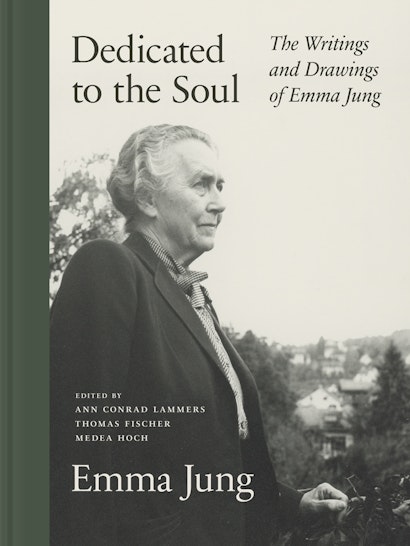
Two days before Christmas in 1916, a young mother of five wrote a poem about the warlike behavior of the archetypes. Using the psychological symbology that she shared with her already-famous husband, Emma Jung wrote of the merciless aggression of the warring gods, ripping open the ground of the human soul. Her metaphors were taken from European battlefields, then in the daily news. Closer to home at the time, her marriage had put her into a state of painful internal conflict. Her poem, 鈥淪treite鈥� (鈥淐onflicts鈥�), commented on a universal psychic dynamic and also bore witness to her belief that, in time, the battlefield would yield a divine harvest. Her poem鈥檚 conclusion might be mistaken for sentimentality, if it were not borne out in life by the poet鈥檚 staying power.
Emma Jung鈥檚 creative life is recorded in numerous handwritten notebooks and art portfolios, all of which lay undisturbed, after her death in 1955, carefully preserved in the basement of the family home. Starting in 2012, thanks primarily to the work of Emma鈥檚 great-grandchildren, the writings and paintings of the matriarch began to be studied and catalogued. What came to light was eye-opening. Emma Jung had always been beloved as Mama and Groma. She had been acknowledged as a gifted analyst and鈥攂y default鈥攁s one of the leading women surrounding Carl Gustav Jung. But until her documents in the family archive were systematically studied, she had not been thought of as a real contributor to the movement of analytical psychology, or as a full partner in her husband鈥檚 ground-breaking work.
From the time of their engagement, Carl Jung encouraged Emma Rauschenbach to educate herself fully and use all her gifts. She was intellectually equal to university study; but her father, following old-fashioned customs, had not allowed her to apply. Then came her marriage to Carl, followed by the births of their five children and the management of a large household. Early in her marriage, Emma Jung did all she could to fill the gaps in her education, even hiring a tutor in Greek. She devoted her free hours to writing and painting. She revised and polished; but she was challenged for time, and it was hard to finish her work as she wanted to. As an introverted personality, and innately modest, she chose to keep most of her creative work private.
With her marriage, too, Emma Jung鈥檚 psychological education began. She assisted Carl in his early experimental studies. She served as the main research assistant for his work, Wandlungen und Symbole der Libido (Transformations and symbols of the libido), which established Jung on his theoretical path and effectively ended his partnership with Sigmund Freud. While Emma and Carl Jung were still in Freud鈥檚 professional circle, however, Freud addressed Emma Jung in letters as a colleague and even offered someday to publish her writing.
Emma Jung鈥檚 personal analysis focused, naturally, on her dreams. One of her notebooks shows that she began recording major dreams in 1911. In 1913, she temporarily stopped recording dreams, in order to prepare her inaugural lecture for the Association for Analytical Psychology. This long lecture, analyzing a fairytale, established her as a serious contributor to her husband鈥檚 movement and enabled her in 1916 to join the newly formed Psychology Club in Zurich. She was elected its first president.
In close conversation with her husband, Emma Jung worked with him on his evolving psychological theory. This was a true collaboration, flowing in both directions. One of her contributions seems to have come from her independent study of the animus. In 1921 Carl published his first discussion of the anima, the powerful feminine archetype operating in the unconscious lives of men; but here he only briefly mentioned the parallel archetype operating in the unconscious lives of women.
In contrast, Emma had begun studying the animus several years earlier. Her first reference to 鈥渕y masculine aspect鈥� appears in a dream text of 1914. Various animus-figures are described and analyzed in her dream journals of 1916-1917. In 1934, when Carl called on his wife to contribute a chapter on the animus to his book, Wirklichkeit der Seele (The reality of the psyche), it may have been a tacit acknowledgement that she deserved recognition for her independent work on this piece of Jungian theory.
In another important strand of Emma Jung鈥檚 early work, her writings about God, the gods, and 骋枚迟迟别谤诲盲尘尘别谤耻苍驳, she stood slightly apart from her husband. Unlike Carl, she never used the term das Selbst (the Self) to explicate the symbols of God in the psyche. Several of Emma鈥檚 poems and fantasies illustrate that she was influenced by Nietzsche鈥檚 theme of 骋枚迟迟别谤诲盲尘尘别谤耻苍驳 (the twilight of the gods). In an early epigrammatic poem, she describes a mouse visiting Jerusalem:
The labor is long and far the climb,
The cross won鈥檛 fall before its time.
Her commentary announces the theme: 鈥渢hat the old gods may fall and new ones arise 鈥� 骋枚迟迟别谤诲盲尘尘别谤耻苍驳.鈥�&苍产蝉辫;
From one perspective, visions of falling gods might portend a general disaster; but for Emma, as an individual, they signified a desperately needed liberation. The gods included her personal god-image, Aran没. This figure had first appeared to her in mid-1916 as a flaming star, holding in his hand a blue bird, which she recognized at once as her soul. She was compelled to follow Aran没 into the depths of hell. Less than three years later, in January 1919, she witnessed Aran没鈥檚 splendid death:
Bend thy knee, mortal,
Thy head uncover.
A god is dying.
Aran没 sinks down, the blazing one,
His day is spent. But my blue bird, the one
he once protected,
Where might it be?
Her poem tells the answer: In the midst of the conflagration, a lance pierces Aran没鈥檚 heart, and the blue bird flies home to her. She greets her returning soul:
Thou art the one, I know, the long-held captive;
the setting of the god has set thee free.
This poem is part of a long fantasy, which includes several scenes of liberation. In one, a voice tells the poet she must use her own power to break out of her stone carapace: 鈥渢hen of divinity thou art free.鈥� In another, she sees 鈥渢he eye of God, the great rogue jester.鈥� After many visions, she finds herself singing Bach鈥檚 Passion Chorale, 鈥淥 sacred head, sore wounded.鈥� But these words no longer mean what Emma learned in childhood; for she writes, 鈥渋t is not Christ鈥檚 head to whom these tones apply.鈥� Finally, she sees a head carried by ocean waves and recognizes 鈥渁 human head, perhaps divine, but not the head of Christ.鈥�&苍产蝉辫;
Emma鈥檚 entire creative work comes down to the task of individuation, in which鈥攆or her鈥攖he soul is more sacred than the psyche鈥檚 god-images. It is amazing to reflect that, so soon after her poem of December 1916, depicting the gods鈥� assaults, she emerges whole from the struggle. It鈥檚 also amazing to realize that in January 1919 Emma Jung was still only thirty-six. Her writings also tell us that she was not alone in the work. An inner voice accompanied her, encouraging her to use her own power to break free of 鈥渄ivinity,鈥� her pious deference to the dying gods.
Ann Conrad Lammers is a former Jungian psychotherapist and the editor of Erich Neumann鈥檚 The Roots of Jewish Consciousness.