
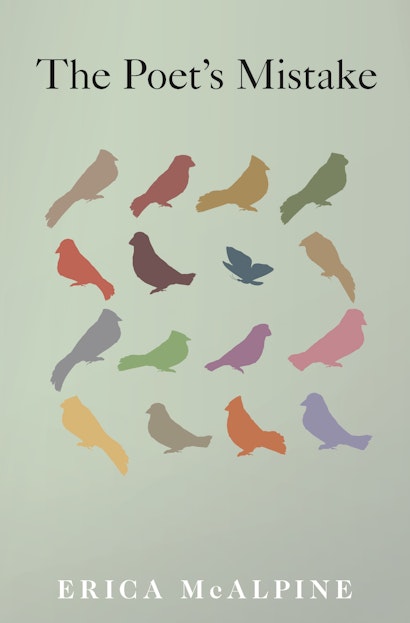
Keats mixed up Cortez and Balboa. Heaney misremembered the name of one of Wordsworth鈥檚 lakes. Poetry鈥攅ven by the greats鈥攊s rife with mistakes. In The Poet鈥檚 Mistake, critic and poet Erica McAlpine gathers together for the first time numerous instances of these errors, from well-known historical gaffes to never-before-noticed grammatical incongruities, misspellings, and solecisms. But unlike the many critics and other readers who consider such errors felicitous or essential to the work itself, she makes a compelling case for calling a mistake a mistake, arguing that denying the possibility of error does a disservice to poets and their poems.
This book sets itself the task of pointing out mistakes in poems鈥攂ut is it really possible for poets to be wrong? Doesn鈥檛 鈥減oetic license鈥� mean that the poem is always right?
EMcA: Poets get things wrong all the time! Just like people (since that鈥檚 what they are, after all). One of the premises of this book is that the notion that poems are never wrong is itself wrong-headed. There is an important difference between poetic license, which is a form of compositional freedom, and mistakes, which happen involuntarily. When poets decide to break the rules, either by telling untruths or messing up their grammar or using words incorrectly (either through dialect or slang or to create an effect of some kind), they are enacting poetic license. But when they try to get things right (factually, grammatically, orthographically) but 诲辞苍鈥檛 quite manage鈥攖hat鈥檚 mistake.
How can you tell the difference between when poets are trying to get things right and failing versus when they are deliberately using license for artistic effect?
EMcA: Getting to the bottom of a poet鈥檚 intent can be difficult (some say impossible)鈥攂ut attempting to do so has always been a rewarding aspect of reading poetry for me. In each of the chapters of this book, I try very hard to disentangle accident from intent in order to make a guess about what the poet may have wished his or her poem to do or be. I do this by thinking about how, when, under what conditions the poem was writte鈥攁nd by thinking about poets鈥� styles and interests and habits. Some poets are notoriously careless; others are scrupulous crafters. Mistake means different things for different poets, and thinking through these distinctions and how they relate to intent can be part of the fun. Guessing at intended meaning has always been part of our reading practices to some extent; one difference here is that I am zeroing in on moments when poets 诲辞苍鈥檛 appear to mean what they have written as opposed to when they do. My examples aren鈥檛 meant to seem like accusations; rather, I鈥檓 interested in freeing poems from the kinds of well-meaning but overly-sympathetic readings that critics occasionally impose on them. When we encounter accidental mistakes in grammar, historical fact, or spelling in poems and then graciously chalk these up to 鈥渓icense鈥� on the part of the poet, aren鈥檛 we imposing our own wish for perfection onto the poem rather than understanding it for the human-made thing that it is?
How did you come up with the idea for this book?
EMcA: The initial spark came to me in the middle of the night. I was obsessing about an article I鈥檇 written on the nineteenth-century British poet John Clare鈥攚ho was a famously bad speller. In that essay, I spent two pages examining a sonnet in which he misspells the word 鈥渨ander鈥� as 鈥渨onder.鈥� Wasn鈥檛 Clare being clever in mixing up these two words? Isn鈥檛 wondering the mental form of wandering? After all, the Latin verb for 鈥渢o wander鈥� is erro, errare鈥攚hich forms the root of 鈥渆rror鈥� itself! Something didn鈥檛 sit right with me about this close reading as I pondered it while trying to go back to sleep. Clare was a self-educated peasant poet who misspelled word鈥攅ven words he knew well鈥攁ll the time. Why was I so keen to turn his mistake into something more meaningful? Can鈥檛 poets make mistakes without our feeling the need to rescue them? Isn鈥檛 it better to register the mistake as something unintended and enjoy it for what it is? I decided it would be fun to see how many other mistakes I could find in poems and to think about what it would mean for scholars to call them mistakes rather than to try and justify them creatively, as I had done with Clare. And I found that nearly every mistake in the history of poetry was accompanied by scholarship that attempted to rescue the poet by claiming that his or her mistake was purposeful and had some use. The better the scholar, the more creative and ingenious the justification. So the book grew out of these stories of mistakes and their redeemers and what it all says about our ways of reading poetry.
What do you think is the most embarrassing blooper in the history of poetry?
EMcA: I guess Robert Browning鈥檚 mistake in Pippa Passes probably wins that distinction鈥攖hough how embarrassed he was when a reader pointed it out to him many years later in a letter remains a question. Browning erroneously uses the word 鈥渢wat鈥� to refer to part of a nun鈥檚 habit (he equates it to a monk鈥檚 cowl). He must not have known many nuns!
As a poet yourself, did you ever feel uneasy about calling out the flaws of other writers?
EMcA: No鈥攋ust the opposite. The more I wrote about mistakes in poems, the closer I felt to the poets I was writing about. I think poets generally want to get things right鈥攖o have their facts straight, to use language artfully but also rigorously, to make careful, well-crafted things. I think the flaws I write about in my book are the sorts of mistakes these poets would have wished to correct, had they been discovered in time. The process of sorting through errors, naming them as such, and thinking about authorial intention felt more liberating than using mistakes as a jumping off point for my own creative interpretations. Mistakes can be like windows: you find one, you peer in, and you get to see the poet in the very act of writing.
So do you think it is possible for mistakes in poems to be a good thing?
EMcA: Mistakes are always unintended (by definition), but that doesn鈥檛 mean we can鈥檛 enjoy them. I like it when I catch poets in the act of erring; it makes them human. And in writing this book, which catalogs mistakes of different kinds, by very different kinds of poets, I found that mistakes can tell us a lot about what poets do mean to do. Freud taught us that mistakes often betray unconscious wishes; and even in the instances when mistakes are less volitional than that (when they occur as a result of faulty knowledge or a lack of education rather than repressed desire), they can tell us something about poets鈥� preoccupations and needs within the writing process. Mistakes can be clues to help us understand how poems get made; that has to be a good thing.
Erica McAlpine is associate professor of English at the University of Oxford and a tutorial fellow at St Edmund Hall. She is the author of the poetry collection The Country Gambler.