
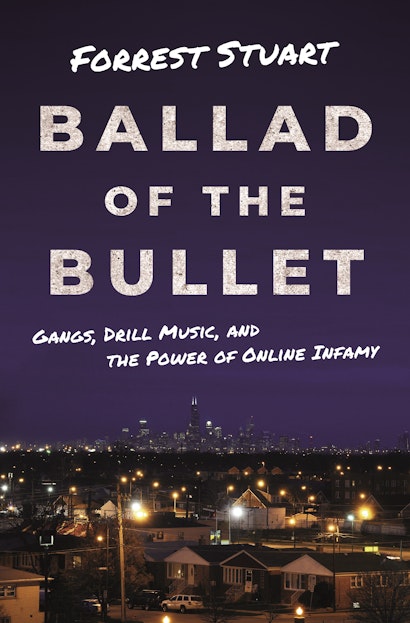
Amid increasing hardship and limited employment options, poor urban youth are developing creative online strategies to make ends meet. Using such social media platforms as YouTube, Twitter, and Instagram, they鈥檙e capitalizing on the public鈥檚 fascination with the ghetto and gang violence. But with what consequences? Ballad of the Bullet follows the Corner Boys, a group of thirty or so young men on Chicago鈥檚 South Side who have hitched their dreams of success to the creation of 鈥渄rill music鈥� (slang for 鈥渟hooting music鈥�). Drillers disseminate this competitive genre of hyperviolent, hyperlocal, DIY-style gangsta rap digitally, hoping to amass millions of clicks, views, and followers鈥攁nd a ticket out of poverty. But in this perverse system of benefits, where online popularity can convert into offline rewards, the risks can be too great.
What motivated you to write this book?
FS: This book started in conversations with community leaders, police officers, and other adults trying to reduce gun violence on Chicago鈥檚 South Side. In a city widely known as the 鈥渕urder capital of America,鈥� there was a panicked narrative that gangs had taken their warfare and violence online, to social media platforms like Facebook, Twitter, and YouTube. Adults pointed to one online video another of young men waving guns, drugs, and cash while bragging about crimes. When Chicago鈥檚 violent crime rate spiked unexpectedly in 2016, the Chicago Police Department, the Crime Commission, and even the mayor blamed social media. There was this taken-for-granted notion that young people were picking up guns and shooting each other over something as minor as an insult on Twitter, or a meme on Instagram.
Like a lot of people in Chicago and around globe, this new development really caught my attention, but for a different reason. I was skeptical. As someone who studies poverty, crime, and race relations for a living, this sounded eerily similar to the 1990s, when the news media and powerful politicians labeled young black men as 鈥渟uper-predators.鈥� America demonized them as callous and cold-hearted criminals with no regard for human life. It was a sentiment that swelled our prison system and fueled racism. Then, as now, a key voice was missing from the public discourse. None of these so-called experts had actually spent any time whatsoever talking to the youngsters who were making this social media content causing so much panic.
So I took up the task myself. I started hanging out with gang-affiliated teens on the South Side who were making social media content. I knew I had to hear their stories in their own words and shadow them throughout their daily lives. Only then could I understand why were they making such startling content. Was it really inciting violence? What were cops, politicians, and the general public missing when we they talked about their online activity?
What do you mean you 鈥渉ung out鈥� with gangs? Can you describe how you developed relationships with these young people? How did that work?
FS: Gaining the trust of gang-associated youth took some real time and energy. Luckily, I was able to build on some of the work I was already doing on the South Side. I had been helping to run an afterschool musical arts and violence prevention program for young teens. Gang violence, social media, and trauma were constant topics of conversation. During one of these conversations, a young man offered volunteered to introduce me to the members his older brother鈥檚 gang.
Within a few months, I was spending virtually every day, all day with them. Mostly we鈥檇 sit around their neighborhood as they fought boredom. We鈥檇 scroll social media together, listen to music, and watch YouTube videos for hours on end. We鈥檇 play dice and walk laps around the four-block turf that they controlled. I was their go-to option for getting to court, medical appointments, family gatherings, and funerals. My passenger seat turned into a kind of confessional, where they shared their aspirations and emotional struggles that they otherwise hid from their online audiences. They reflected on how are it was that an adult was willing to listen to them without lecturing or passing judgement. It was the opposite treatment they tended to get from the teachers, probation officers, and social workers in their lives. At the end of the day, these are some incredibly scarred young people, dealing with an immense amount of trauma and demonization.
These relationships helped me understand their underlying motivations. I got a rare window not just into how central their digital production routines were for their own offline lives, but also how central they were for the entire surrounding community, and for how we think about race and inequality in the digital age.
Tell us more about that. What was the main lesson you learned while spending so much time with these young people?
FS: As I started digging deeper into these so-called senseless and violent social media posts, they started to make total sense. I learned that these uploads were really just the newest response to the poverty, desperation, and societal neglect that has ravaged communities of color for generations. Over the last couple decades, the old ways of making ends meet and building self-worth have dried up. In the 1990s a young man coming of age on the South Side had the option of joining one of the 鈥渟upergangs鈥� that controlled vast drug turf, where he could make a living in the crack economy, gradually rising up into the ranks of a gang officer. But since then, crack markets have eroded with the influx of new and different illegal drugs. Gang leadership fell under the hammer of new prosecution strategies, which make becoming an officer a risky proposition. The demolition of public housing fractured the old gang alliances and dispersed their members across the city. Today鈥檚 gangs are smaller, younger, and are far less central to the illegal drug economy.
But now, the digital economy is booming. Teens are turning to it as a replacement. At a time when social media influencers can earn serious money, when so many of us are glued to our smartphones looking for the next viral sensation, urban youth have found a way to capitalize on longstanding public fascination with the ghetto, gangs, and gun violence. They鈥檙e doing so in large part through the creation of 鈥渄rill music,鈥� which in slang terms translates to 鈥渟hooting music.鈥� Drill music is a style of hyperviolent, hyperlocal, DIY-style brand of gangsta rap where artists essentially compete to appear more ruthless, more delinquent, and more authentic than their competitors. These 鈥渄rillers鈥� upload music videos on YouTube filled with guns and drugs, and then use other social media platforms鈥擣acebook, Twitter, Instagram, Snapchat鈥攖o convince audiences that these music videos aren鈥檛 just art, but rather genuine glimpses into their everyday lives. It鈥檚 remarkable just how many people have joined this online competition. In some neighborhoods on the South Side, for every two blocks, there is a different group of young men making drill music videos!
In this competition, a good amount of the stuff that ends up online is exaggerated. Sometimes it鈥檚 completely fake. I met quite a few young men who appear on social media like they鈥檙e heavily armed and regularly engaging in drive-by shootings. But when I got to know them offline, I learned that they didn鈥檛 own any guns and, in a few occasions, had never shot at anyone in their lives.
Nevertheless, cultivating violent online personas鈥攐r 鈥渃lout鈥� as Chicagoans refer to it鈥攖ranslates into a lot of rewards. Some of the most successful young men are able to monetize their social media pages through the Google AdSense program, which cuts them a monthly check for the clicks they generate. A few have converted their online reputations into multimillion dollar recording contracts. More often, young people leverage their popularity for cash, housing, guns, sex, and other resources they desperately need for surviving poverty. But maybe the most significant reward is emotional. By essentially crowd sourcing their self-esteem, they鈥檝e created an avenue for finally feeling worthwhile, special, and valued. Time after time, we鈥檇 be out in public and someone would recognize them from their music videos or Instagram, and beg for a selfie and a hug. You can imagine how amazing that feels, especially for teens surrounded by so much hardship.
You鈥檝e talked about some of the benefits. Surely there are costs for making this kind of social media content?
FS: A violent online persona is a double-edged sword. If your followers and fans are able to recognize you out in public, so can your rivals. One of the most effective ways of building your own reputation for toughness is to steal someone else鈥檚 clout. Enemies try to catch each other out in the streets, at school, or at the store with family members. They pull out their camera phones, record themselves humiliating their rivals, and post these to social media. I met several young people who have been shot and, sometimes killed, in opportunistic assaults. Their fears of being recognized and attacked sometimes led them to quit their jobs and drop out of school.
These violent personas also following young people into court. Whereas rivals try to cast doubt on the authenticity of social media toughness, cops, prosecutors, and judges tend to take social media on face value. I鈥檝e seen young men face additional charges and lengthier prison sentences because of the guns, drugs, and talk of violence that appear on their Facebook pages鈥攅ven when those online displays were completely fake. It鈥檚 terrifying鈥攕ocial media is being used by the criminal legal system in ways that are intensifying racial disparities and fueling mass incarceration.
Could it be true, then, that drill music and other gang-related social media are causing violence?
FS: This question is on everyone鈥檚 mind right now. Unfortunately, there isn鈥檛 very good data out there. Consider this: the Chicago Police Department isn鈥檛 even able to identify the suspect in roughly 95% of shootings. If they don鈥檛 even know who pulled the trigger, it鈥檚 hard to know precisely why they did it. We don鈥檛 know whether the conflict had anything to do with social media, or whether the shooter was acting on some other motive.
The limited data that we do have leads me to reject the idea that social media is causing or increasing violence. All we have to do is look at the broader crime rates over the last decade. Violent crime has actually decreased at the same time that gang-associated youth have increased their social media use. In fact, this is one of the safest times in recent American history. So the data just don鈥檛 support the popular narrative about social media increasing violence. In fact, if anything, the proliferation of social media might actually be giving young people new tools for de-escalating or avoiding violence. Two decades ago, if you wanted to build a reputation, or if you wanted to defend your honor, there weren鈥檛 many options besides physical conflict. Today, young people can accomplish those goals with a witty tweet or menacing photo on Instagram, without ever engaging in offline violence.
What is one thing you鈥檇 like readers to take away from this book?
FS: I want us to realize is that these young people are using social media in the some of the same way that everyone else is. We all use these platforms to present idealized (often exaggerated) pictures of ourselves. We鈥檙e all performing, trying to convince people that we embody the traits they value and respect. I see it every time one of my academic friends boasts about their new research on Twitter. I see it when my students upload graduation pictures and their families shower them with praise. We see it from our politicians. Even the pope does it. The big question is: What do people with very few resources do? How do they gain praise and adoration?
Asking this question helps to rethink our assumptions about why young people are making this kind of content. It also helps us recognize their innovation and creativity, using social media to help them survive deplorable conditions. Perhaps, instead of demonizing them a menaces, we might see them as valuable assets. I close the book with some concrete suggestions for doing this. For example, these young people are clearly skilled at creating viral content and catching the public eye. It鈥檚 not easy to amass millions of views, likes, and followers like they have. What if we gave them an alternative outlet for their creativity? How could we enlist them to promote the public good? We鈥檙e currently facing a global pandemic where residents of marginalized urban communities lack accurate public health information and guidelines. What if we employed these youngsters as part of a new public health digital messaging campaign? We should offer them a new outlet for their ingenuity鈥攁 healthier, safer opportunity to build status and self-worth while improving all of our lives in the process.
Forrest Stuart is associate professor of sociology and director of the Ethnography Lab at Stanford University. He is the author of Down, Out, and Under Arrest. Twitter @ForrestDStuart