
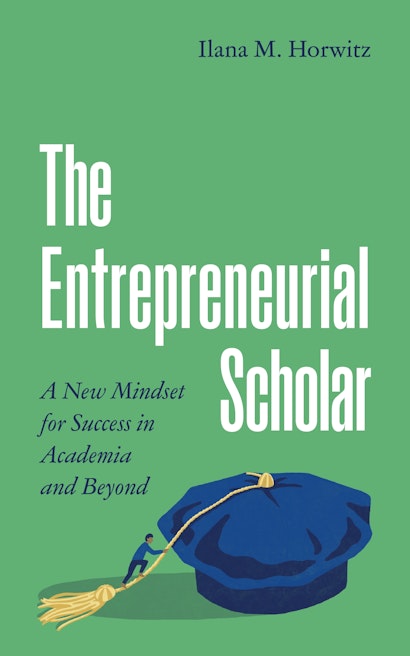
In the increasingly competitive world of academia, simply mastering your discipline is no longer enough to guarantee career success or personal fulfillment. The Entrepreneurial Scholar challenges scholars at all stages鈥攆rom doctoral students to tenured professors鈥攖o break free from conventional academic pathways by adopting an entrepreneurial mindset. What opportunities can you create based on who you are, what you know, and who you know?
What inspired you to write The Entrepreneurial Scholar? Was there a specific moment that sparked the idea?
This book grew out of an op-ed I wrote for Inside Higher Ed titled 鈥淲hy PhD Students Should Think More Like Entrepreneurs.鈥� At the time, I was reflecting on why my PhD journey felt different from many of my peers鈥攚hy I found it fulfilling when so many others felt disillusioned. I realized that my mindset had been shaped by something much deeper than just my experiences in graduate school: it had been ingrained in me long before, through my upbringing as an immigrant.
I was born in the former Soviet Union and immigrated to the United States with my family when I was seven. We arrived with very little鈥攋ust a few suitcases, no English skills, and almost no financial resources. My parents, both engineers in the Soviet Union, had to start over in low-wage jobs. But they didn鈥檛 wait for opportunities to come to them鈥攖hey created them. They learned new skills, saved money, and eventually bought and renovated houses to rent out, all while working multiple jobs. Watching them, I absorbed the mindset that shaped their survival: Given who you are, what you know, and who you know, what opportunities can you create for yourself?
That question鈥攐ne I had seen my parents live out daily鈥攕tuck with me. I didn鈥檛 always think of it as entrepreneurialism, but it was. It was about making something out of limited resources in an uncertain world. And when I entered academia, I realized that this same way of thinking helped me thrive. Instead of waiting for my advisors or the institution to define my career path, I sought out mentors beyond my department, experimented with different types of research and writing, and actively shaped my own scholarly trajectory.
When Inside Higher Ed published my op-ed, I received emails from graduate students, faculty members, and even a therapist who works with PhD students, all saying they wished they had heard this perspective sooner. Then, an editor from 快色直播 reached out, asking if I鈥檇 consider expanding it into a book. That was the moment I knew this idea needed to reach a broader audience. Academia has become increasingly precarious, and I believe that an entrepreneurial mindset is one of the most valuable tools scholars can develop鈥攏ot just to survive, but to create meaningful, fulfilling careers.
You mention that this book isn鈥檛 a traditional academic career guide. How does it differ from other books about navigating academia?
Most books about academia focus on the mechanics of getting a PhD, securing an academic job, or surviving the tenure track. They provide step-by-step advice on publishing, job applications, and networking鈥攁ll of which are important. But The Entrepreneurial Scholar takes a different approach. Instead of offering a checklist for academic survival, I encourage scholars to rethink their relationship with academia entirely.
This book is about mindset, agency, and adaptability. It鈥檚 for people who want to carve out meaningful scholarly careers, whether inside or outside the academy. Rather than teaching readers how to follow a traditional path, it helps them develop the skills to create their own opportunities. Thinking like an entrepreneur in the context of this book doesn鈥檛 mean starting a business or making money鈥攊t means being resourceful, embracing uncertainty, and recognizing that you have more power over your career than you might think.
What do you mean by 鈥渢hinking like an entrepreneur鈥� in the context of academia?
When people hear the word 鈥渆ntrepreneur,鈥� they often think of tech start-ups, venture capital, and making a profit. But at its core, entrepreneurship is about solving problems creatively and making something new with limited resources.
In academia, this means shifting from a passive consumer of knowledge to an active producer of knowledge. It means asking yourself: Given who I am, what I know, and who I know, what opportunities can I create? How can I make my research matter beyond the walls of the university? How can I build relationships that will help me grow as a scholar?
Thinking entrepreneurially also means embracing uncertainty. Academia is unpredictable鈥攚hether it鈥檚 the job market, the funding landscape, or institutional politics. Scholars who adopt an entrepreneurial mindset don鈥檛 just react to challenges; they find ways to navigate them strategically, leveraging what they have to create new possibilities.
Many academics resist the idea of entrepreneurial thinking because they associate it with commercialization. How do you address those concerns?
Entrepreneurial thinking isn鈥檛 about turning scholarship into a commodity or chasing profit. It鈥檚 about maximizing the impact of your work.
Academics already do this in many ways鈥攚hether it鈥檚 crafting research projects, securing funding, or engaging with public audiences. Thinking entrepreneurially simply means being more intentional about how you position your work, build relationships, and create opportunities.
Scholars don鈥檛 have to choose between intellectual integrity and practical impact. They can鈥攁nd should鈥攄o both.
You had a non-traditional path to academia, having worked in consulting and start-ups. How did those experiences shape your approach to scholarship?
My experiences outside academia profoundly shaped how I approached my PhD and my career as a scholar. In consulting and start-ups, you quickly learn that success isn鈥檛 about following a fixed path鈥攊t鈥檚 about identifying problems, generating solutions, and adapting when things don鈥檛 go as planned.
That mindset helped me during my PhD because I never assumed that there was only one way to be an academic. I sought out opportunities beyond my department, collaborated with scholars in different fields, and experimented with different forms of writing and public engagement. I also didn鈥檛 see academia as the only valid career option鈥擨 viewed it as one of many possible paths where I could do meaningful work.
Many graduate students struggle because they鈥檝e spent their entire lives succeeding in structured environments with clear expectations. But academia鈥攁nd life鈥攊sn鈥檛 structured that way. My time in the private sector prepared me for that reality. It taught me to be proactive, to seek out mentors and collaborators, and to take ownership of my intellectual journey rather than wait for someone else to tell me what to do.
You talk about shifting from being a consumer to a producer of knowledge. Why is that mindset shift so important for academics?
This shift is crucial because it transforms how scholars engage with their work. Many graduate students enter their programs thinking that their job is to read, absorb information, and become experts in a field. But the real task of a scholar is to generate new knowledge鈥攖o contribute something original to their discipline and beyond.
When you start seeing yourself as a producer of knowledge, everything changes. Your reading becomes more purposeful because you鈥檙e looking for ways to build on or challenge existing ideas. Your writing becomes more than just an academic requirement鈥攊t becomes a way to shape conversations and influence thinking.
This shift also empowers scholars to take charge of their careers. Instead of waiting for external validation (a job offer, a publication, tenure), they can actively shape their trajectory by putting their work out into the world, engaging with different audiences, and seeking out opportunities to make an impact.
The book also discusses issues of inequality in academia, particularly for first-generation, low-income (FLI), and BIPOC scholars. How does an entrepreneurial mindset help these groups specifically?
FLI and BIPOC scholars often face structural barriers in academia, from limited mentorship to financial constraints. But these scholars also tend to have lived experiences that make them naturally entrepreneurial鈥攖hey鈥檝e had to navigate uncertainty, advocate for themselves, and find creative ways to succeed.
An entrepreneurial mindset helps these scholars see their backgrounds as strengths rather than deficits. It encourages them to leverage their unique perspectives, build supportive networks, and create opportunities that align with their values.
What do you hope readers will take away from The Entrepreneurial Scholar?
I hope readers come away feeling empowered to take ownership of their academic journeys. Academia can feel rigid and confining, but there is always room for creativity, agency, and innovation.
I want scholars鈥攚hether they are PhD students, postdocs, or faculty鈥攖o recognize that they have more control over their careers than they think. By embracing an entrepreneurial mindset, they can navigate uncertainty, create opportunities, and make meaningful contributions both inside and outside the academy.
At its core, this book is about reimagining what it means to be a scholar in the 21st century. I hope it helps readers see that scholarship isn鈥檛 just about following rules鈥攊t鈥檚 about creating something valuable and putting it into the world.
Ilana M. Horwitz is assistant professor of Jewish studies and sociology and the Fields-Rayant Chair in Contemporary Jewish Life at Tulane University. She is the author of God, Grades, and Graduation: Religion鈥檚 Surprising Impact on Academic Success.