
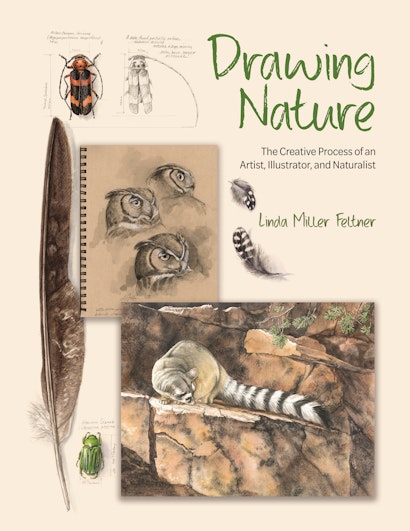
Drawing Nature presents the creative process of an acclaimed nature artist, guiding readers from field sketches to finished art and demonstrating how science and the close observation of nature can be integrated into the artist鈥檚 work to create dynamic, meaningful images. With chapters that flow from drawing basics to more advanced methods and concepts, this beautifully illustrated book is like a look inside the artist鈥檚 sketchbooks to discover their secrets.
Linda Miller Feltner demonstrates how observation and recording are sparks to creativity. Her journey from loose sketches and drawings to a completed work begins with observing a natural process, object, or interaction between organisms. Her curiosity generates scientific inquiry that, when researched, helps her to answer a question or make broad, often surprising connections.
What is the focus of Drawing Nature?
Linda Miller Feltner: 鈥淒rawing Nature鈥� demonstrates my creative process from spark to finish. I invite the viewer to look through my artist’s eyes and observe how my artwork is created. My curiosity may be sparked by finding an interesting subject or found object that leads to developing sketches and finishing an image while integrating art and science. Many iterations demonstrate how I build an image. The book celebrates curiosity and illustrates by example how sketching, painting, and the importance of accuracy are crucial from my perspective.
Like a trail through the forest, curiosity can take me down a path with many side trails to grab my interest in related subjects. All diversions eventually merge back to form the single pathway that becomes the story I depict. There is no straight route to the finished painting. I may get distracted by a bug or plant, but it might be the key to revealing an exciting story.
My creative process starts with observation. I am a curious wanderer in nature and find countless subjects, natural processes, and organisms interacting that are eye-catching or fascinating. My curiosity generates questions that, when researched, may help me solve a mystery or make larger connections. While in the field, drawing an animal gesture is one skill. Drawing to analyze or record is another. Both are firmly grounded in the ability to observe. My career combines the best of art and science. This book is a chronicle of how I blend the two.
How does the book demonstrate your efforts to blend the two?
LMF: This book offers sketches and gesture drawings where I experiment with various poses and techniques. The pages include discoveries, fun facts and scientific concepts which are then developed through more detailed, measured drawings. The completed artwork often depicts a visual story that interprets an animal or plant’s lifestyle or habitat.
I advise students and artists to embrace the sketchbook and use it as a guide to develop their observation skills and artistic process, without worrying about producing a perfect final product. The method of observing and recording is valuable to spark curiosity and creativity.
What inspired me to write the book?
LMF: As an educator, encouragement from both beginning students and professional artists and illustrators are particularly interested in my process. For novices, questions arise about where to start or how to simplify the cacophony of a landscape into a paintable scene. Professional illustrators show interest in how another professional solves an issue and how to structure the development.
I applaud the many guides on how to draw and paint and highly recommend them. This book complements these guides and demonstrates how I incorporate those time-honored techniques with the current interpretation of a story.
Nature journaling鈥檚 popularity is growing while encouraging enthusiasm for nature, investigation, and engaging people who never thought about being creative through art or writing. It focuses on the same curiosity and observational skills I encourage in my readers.
I am inspired by the published work of renowned wildlife artists that enchants me with spontaneous sketches, color studies, and exquisite final art. Whether their art is similar to what I do or entirely different, they provide immense motivation. Studying their sketches is like peering over their shoulder and watching them draw.
Who might enjoy this book?
LMF: Readers might include all who are observant and curious about the natural world. Likely readers will want to note the things around them, draw inspiration from a place, remember a moment, and portray its beauty. The book may inspire adults to encourage children to be curious and ask questions. Other readers may wonder, where do I and other artists get ideas? What influences our decisions about how to portray what we see? I think most readers will be fascinated to peek behind the scenes and see how my art is generated.
The book is inspirational and thought-provoking for both beginning and advanced artists. It encourages those who have never laid a pencil to paper to draw or write. It reassures hesitant sketchers that they do not have to create perfect drawings the first time without erasing them. Problem-solving for a challenging subject comes early in my process, and I consider planning and composition long before actual painting begins.
You teach bird drawing workshops, what advice do you provide?
LMF: Birds lead fascinating lives, and it’s important to understand their visible and hidden adaptations that benefit their lifestyle. Their beaks and feet are easily seen and crucial to their survival. Their body structure hidden beneath their cloak of feathers is equally important. To uncover some of its mysteries, I introduce anatomy which I find useful to the artist. Eventually, we draw live birds in the classroom, starting with large and calm raptors, not hummingbirds. Drawing a moving animal takes a bit of training for eye/hand/brain coordination to depict it on paper. It’s a skill that just takes practice.
What is a scientific illustrator and educational interpreter?
LMF: Scientific illustration is art that serves science. It plays a vital role in conveying information. It includes various forms of visual science communication, such as two-dimensional artwork, sculpture, and animation, and more. My career can be described as a nature artist, scientific illustrator, educator, and interpretive specialist. The use of illustrations and text to inform the public about natural or cultural history is called educational interpretation. It could refer to visitor center murals, museum displays, trail signs, or brochures specific to a location.
My specialty combines the creativity of artistic design with strict standards of scientific accuracy. An educational interpreter is a visual storyteller. All of my artwork is science-based; therein lies the accuracy. Placing them in their habitat develops a narrative of their lifestyle. Projects for natural areas and zoos provide a never-ending selection of interesting animals, plants, geology, wetlands, volcanoes, forests and jungles.
How does your varied background guide your career?
LMF: I have been fascinated by nature since I was introduced to the national parks in the western US as a child. I was struck by the grandeur of high mountains, deep canyons, wild prairies, and dense forests of magnificent trees. We watched beavers building dens and moose in quiet wet meadows. At the vista overlooks, we watched marmots nibbling wildflowers and Gray Jays hop on the picnic tables before us. I even stuffed treasured rocks under the front car seat, hoping my parents wouldn’t mind. All of my interests grew into the perfect career.
I graduated with degrees in Fine Art and teaching. My first science was geology and I still love rocks and landscapes. After graduating, my light-bulb moment was the realization that I loved both art and animals, so why not paint animals? I then took classes in biology and ornithology. I was fortunate to spend several years traveling from the tropics to the arctic while guiding birding and natural history tours with my husband’s company. Immersion in various habitats showed me how environments thrived through biodiversity. Again, I was deeply impressed with the complexity of the natural world. My field experience greatly expanded my knowledge of habitat and interdependency within the environment. This firsthand knowledge brought depth to my artwork.
My first job was as a zoo illustrator which introduced me to interpretive graphics. My career extended thirty-five years as an independent contractor in educational interpretive graphics and scientific illustration. My specialty was creating engaging visual artwork that combined science and art to depict nature in action. I collaborated with scientists, natural resource managers, and educators to create images and designs for interpretive graphics and visitor center murals. Some favorite projects included wetlands, salmon stream restoration, old-growth forests, desert and coastal habitats, and geologic wonders such as Mount St. Helens.
At the same time as these great projects, I exhibited with international wildlife art organizations supporting conservation and served as President of the Guild of Natural Science Illustrators. I also blended teaching into the mix and instructed both novice and professional artists.
As an artist, illustrator, educator and naturalist, the blending of my interests and skills enhances an immensely fulfilling career.
Linda Miller Feltner is an award-winning artist, naturalist, and educator. Her books include A Haven in the Sun: Five Stories of Bird Life and Its Future on the Texas Coast, Brittle Stars and Mudbugs: An Uncommon Field Guide to Northwest Shorelines and Wetlands, and Alaska: The Ecotravellers鈥� Wildlife Guide.