
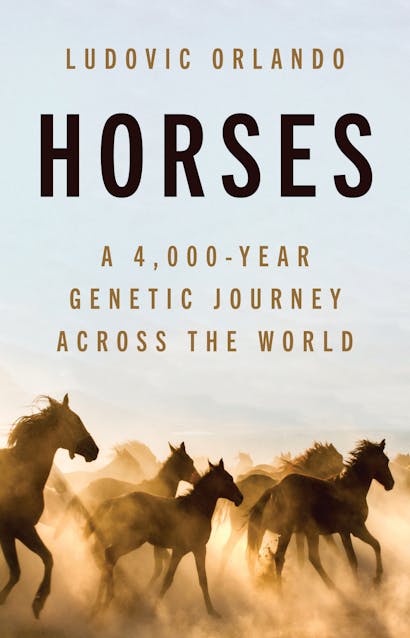
Ludovic Orlando garnered world acclaim for helping to rewrite the genomic history of horse domestication. Horses takes you behind the scenes of this ambitious genealogical investigation, revealing how he and an international team of scientists discovered the elusive origins of modern horses. Along the way, he shows how the domestication of the horse changed the trajectory of civilization鈥攚ith benefits and unforeseen consequences for the animals themselves.
What made you focus your research on horses?
Ludovic Orlando: The horse is perhaps the animal that most transformed human history. Its strength revolutionized warfare, and its speed made the world feel smaller: suddenly, people, ideas, cultures, and even diseases could spread across vast territories with unprecedented pace. Today, in the age of combustion engines, we tend to forget how much we once owed to horses. But even in the early twentieth century, major cities like New York, London, or Paris could not function without them. And of course, the great empires of the past, whether Genghis Khan鈥檚, the Comanche, or Alexander the Great鈥檚, were built on horseback. Without horses, world history would look very different. Studying their millennia-long story became, for me, a way to better understand our own.
Why use DNA to study history?
LO: Historians rely on primary sources such as texts, artifacts, and art. DNA is simply another kind of source, one that happens to be biological. Passed down across generations, it records the history of lineages, making it possible to trace connections between horses from different times and places. DNA also preserves information that rarely survives in the archaeological record. Because we now understand how genetic changes influence traits, we can infer coat color, speed, gait, and other characteristics of ancient horses. Thanks to modern DNA sequencing, we can even recover genetic information from skeletal remains thousands of years old. In that sense, DNA offers us a time machine, allowing us to glimpse the kinds of animals people bred and relied upon, especially in eras with no written records.
When and where were horses domesticated?
LO: The short answer: around 4,500 years ago, in the Pontic steppes of southwestern Russia. Getting to that answer, however, took me and my team nearly a decade of research. And it came with many surprises, which I recount in the book. What is striking is how late this happened in human history. Our species emerged some 300,000 years ago. Dogs were domesticated no later than 15,000 years ago. Sheep, goats and cows around 10,000 years ago. Even donkeys, another equid, were domesticated about 7,000 years ago. Horses came much later, suggesting that, for a long time, humans did not really 鈥渘eed鈥� them. But once domesticated, horses spread across Eurasia with astonishing speed, unleashing an entirely new era in human history.
How much did horses change through domestication?
LO: Perhaps the most striking change is size. Early domestic horses were pony-sized, around 130 centimeters at the withers. By Antiquity and the Roman period, horses had gained roughly ten centimeters on average. The most dramatic changes, however, came in the last two centuries with the development of formal breeds. Today, horses range from the tiny Falabella, no taller than a large dog at 70 centimeters, to the towering Shire, which can approach two meters. Beyond size, domestication altered coat color, speed, and even gait. And now, with modern gene-editing and cloning, our ability to shape horse biology has reached an entirely new stage.
Are you a rider yourself?
LO: Not really. I only began taking lessons a few years ago. In fact, in high school I had the chance to ride as part of a weekly sports program, but I chose sailing instead. Horses and I did not truly meet until my wife gave me riding lessons as a present for my 43rd birthday. She felt it made no sense to study horses without experiencing the unique bond between rider and animal, a deep kind of communication beyond words. She was right. I remain a poor rider, but horses have become central to my life. If human history owes much to horses, my personal history now owes them just as much.
About the Author
Ludovic Orlando is a CNRS Silver Medal鈥搘inning research director and founding director of the Centre for Anthropobiology and Genomics of Toulouse at the University of Toulouse in France. His work has appeared in leading publications such as Nature, Science, and Cell. He is a recipient of the American Association for the Advancement of Science鈥檚 Newcomb Cleveland Prize.