
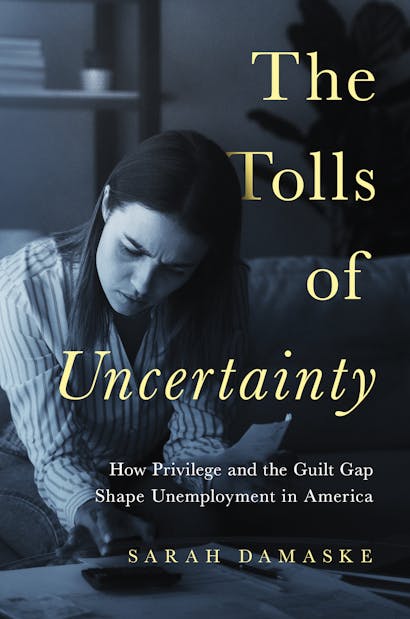
This month鈥檚 Office Hours is a conversation with Sarah Damaske, author of The Tolls of Uncertainty (now available in paperback). Damaske is a professor of sociology and labor and employment relations at Pennsylvania State University. She shares some good reasons to be hopeful about the future of sociology and also reminds us of the potential for profound and surprising moments during interviews.
鈥�Meagan Levinson, Executive Editor
ML: What are you reading now?
SD: I am reading two books right now more for leisure.
I鈥檝e just picked up When the Moon Was Ours by Anna-Marie McLemore. I鈥檓 really looking forward to reading it, as several people recommended it to me. I just finished Take My Hand by Dolen Perkins-Valdez, which is a spectacular book inspired by a real legal case in which two Black girls in Alabama (with the Southern Poverty Law Center) sued the government after having been sterilized without consent. It tells this awful truth about the history of forced sterilization that was happening during the Civil Rights era and makes very explicit connections between these sterilizations and eugenics and structural racism in the United States. It鈥檚 also a beautifully written story about the life of a Black nurse who starts to work for a reproduction clinic in her hometown and how this tragedy unfolds in her life and in the lives of the people around her.
ML: What book has had the most impact on your career?
SD: Trick question! I鈥檓 not sure I can pick just one. Julie Bettie鈥檚 Women Without Class left a profoundly influential mark on my career, as did Leslie McCall鈥檚 Complex Inequality. They are really different books鈥攐ne is an ethnography of White and Mexican-American girls at a high school in California and the other uses 鈥渕esocomparative鈥� statistical analyses to examine wage gaps in local labor markets. But both take explicitly intersectional and feminist perspectives to understanding inequalities. These frameworks have guided my own research and I continue to be inspired by both books to this day (my copies of each are worn on the edges from so many re-readings).
ML: What is your favorite book to teach?
SD: One of the benefits of teaching a Qualitative Methods graduate course, is that I can sneak many of my favorites鈥攐r at least parts of my favorites鈥攊nto the curriculum (and that I can read a lot of terrific new work). If I have to pick, I will say that it鈥檚 Miliann Kang鈥檚 The Managed Hand. It鈥檚 deeply theoretical and also highly accessible. I鈥檝e been teaching it at the undergraduate and graduate levels since it was first published and it鈥檚 a book that does a terrific job of sparking students鈥� sociological imaginations.
ML: What first sparked your interest in sociology?
SD: I took several classes in Sociology as an undergraduate at Hamilton College, but I didn鈥檛 major in Sociology, although I really enjoyed my classes. After college, I started working and realized that I was reading sociology books on the subway (the F train) into work every day. I asked Mitchell Stevens (who is at Stanford now but had first introduced Sociology to me when I was an undergrad at Hamilton) if he would have time to chat about the possibility of my returning to grad school. During our conversation, he encouraged me to take a chance and apply to doctoral programs. I鈥檓 lucky that he gave me that push, as I never looked back.
ML: Do you have a favorite moment as a researcher, maybe an encounter that unexpectedly changed your way of thinking or the direction of a project?
SD: One of my favorite moments as a researcher was also one of my most challenging. At the end of one of the interviews that I did for my dissertation (which was the foundation of my first book, For the Family?), a participant revealed a secret to me about her life. It was very upsetting news for her that she had not yet shared with any of her family or friends. She was visibly shaken by the news, and I was not entirely sure about what to say or do for her. Her news was not related to the interview topic (which was women鈥檚 decisions about work and family). But we talked for a while longer, and I learned that she had agreed to participate in the interview because she had wanted to share this secret with someone. I try to carry this experience with me when I go into any interview鈥攖hat we can鈥檛 know someone鈥檚 motivation for participating in our research and that it may not even be related to why we are doing the research. It reminds me to be as generous with them as they are being with me and to honor the trust that they are putting into me.
ML: What is the best career advice you ever received?
SD: To take chances and be persistent. And to do so in a way that allows me to have the life (both professionally and personally) that I want to have. I think taking chances is an important part of academic life鈥攚orking with new people, trying out new methods, reading new literatures. Being persistent is also key, because most of us fail way more than we succeed (it鈥檚 just that we don鈥檛 often put the failures on social media). It鈥檚 also important to prioritize your life from the beginning of your career. There is an idolatry of hours in the academy that starts in graduate school (with competitions about who spent the most time in the computer lab). I urge our Penn State graduate students not to play this game鈥攊t鈥檚 a losing one for everyone who plays, and it makes our discipline less inclusive.
ML: What subject do you wish more sociologists would study and write about?
SD: I am not sure I need to wish鈥擨 just need to look around and see what people are doing. Jason Park, a PSU graduate student that I work with, did a really cool MA thesis on the roles of institutional and cultural contexts in shaping the occupational segregation of sexual minorities. This past semester in my Qualitative Methods class, students worked on proposals that ranged from climate change induced migration, to incel subculture, to queer joy and substance use, and to Holocaust survivors鈥� narratives about sexual trauma. There is so much amazing work being done.
ML: If you could have dinner with two sociologists, living or passed, who would you choose, and why?
SD: I would love to have dinner with Anita Garey and Suzanne Bianchi. They both were both important family scholars who we lost way too early. And while I had gotten to know each a tiny bit when I was a graduate student, I didn鈥檛 know them well and I would have loved the opportunity to do so.
ML: What makes you feel hopeful about the future of sociology?
SD: Students, conference sessions, and Twitter. I鈥檒l explain in reverse order. Twitter is really problematic these days鈥攂ut I can鈥檛 find another social media platform that will let me know about what such a wide range of sociologists are doing. And when I see what they are doing鈥攁nd the reach that their work has on public life鈥擨 am amazed and inspired. And really proud to be a sociologist. Conference sessions are also high on my list, as I love hearing about the work people are doing and I love meeting new scholars. Conferences let me do both. Finally, our students鈥攂oth undergraduate and graduate鈥攁re tackling such interesting and important questions. And they are asking questions that I鈥檝e never thought of asking. It鈥檚 really an exciting time for our discipline, as I think there is so much about the world that we can help explain.
Sarah Damaske is professor of sociology and labor and employment relations at Pennsylvania State University. Her books include For the Family and The Science and Art of Interviewing, and her work has been featured in such venues as the New York Times, the Wall Street Journal, and the BBC. She lives in State College, Pennsylvania. Twitter @sarahdamaske