
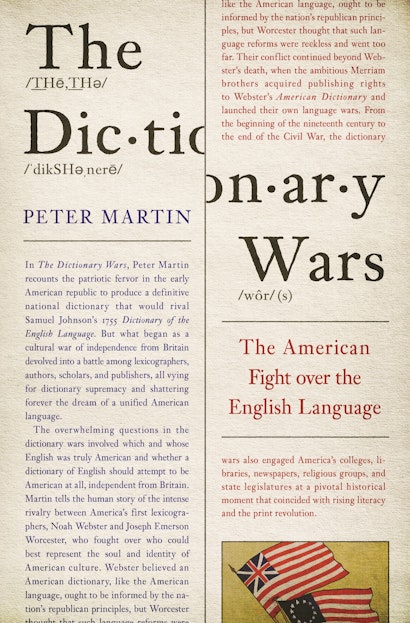
In The Dictionary Wars, Peter Martin recounts the patriotic fervor in the early American republic to produce a definitive national dictionary that would rival Samuel Johnson鈥檚 1755 Dictionary of the English Language. But what began as a cultural war of independence from Britain devolved into a battle among lexicographers, authors, scholars, and publishers, all vying for dictionary supremacy and shattering forever the dream of a unified American language.
Which dictionary author do you align yourself with ideologically: Webster, or Worcester?
PM: My account of the dictionary wars featuring the fight between Joseph Emerson Worcester and Noah Webster, the authors whose dictionaries dominated the dictionary market in mid-nineteenth-century America, and whose burning rivalry engaged much of the nation for over half a century, is not ideological so much as based on abundant documentary and literary evidence. The issues at the center of my book are agonizingly personal, moral, and lexicographical, as well as literary and national. Webster was remarkable for his resilience and energy, but I admire Worcester more than Webster because of his excellent scholarship, unrivalled command in America of the history of dictionaries of the English language, extensive knowledge of English language and literature, and measured and reasoned approach to the complex issues involved in writing dictionaries. On top of that, his dignity and respect for the efforts of others, including those whose views differed from his, made him an admirable presence in the intellectual life of early American nationhood, admired by leading literary figures, scholars, and critics on both sides of the Atlantic.
Webster thought of himself as the savior of the American language. His mission with his dictionary was to unify the country by establishing a commonness or standard of language that would prevent its fragmentation into a multitude of regional dialects 鈥� a lofty vision, to be sure, but one certain to fail from the very beginning of his career as a writer of dictionaries. To the end of his life he endured considerable frustration that he could not achieve much traction for his large designs on behalf of America鈥檚 linguistic future. His two-volume 1828 unabridged dictionary, which may be regarded as America鈥檚 first comprehensive dictionary of the language, earned him just praise, especially for his definitions. But it also came in for an avalanche of criticism for its extreme reforms and bizarre features, such as its orthography and etymology.
Webster鈥檚 battles with Worcester ended with his death in 1843, but the wars against Worcester continued when the Merriam brothers in 1844 bought the rights to publish his dictionary. Worcester bore these renewed animadversions on his scholarly integrity with equanimity, for the most part, except when his personal reputation was at stake, or when he spotted foul play on the part of publishers and critics. Through them all, he continued to produce dictionary editions.
I suppose it is reasonable to say there is in my book an element of rooting for Worcester the underdog. I have wished to bring back the public鈥檚 awareness of this important and unjustly forgotten figure who did so much to guide the progress and determine the future of the American language.
Why was there a strong sense in the 18th and 19th centuries that American English was improper or offensive?
PM: Dismay in Britain over what the Americans were doing with and to the English language began in earnest no later than the first half of the 18th century. The British resented the progress of American English partly because they read it as another major signal of America鈥檚 thirst and drive for independence from the mother country. Countless well-educated Americans, members of the literati, academia, and critical world especially, felt the same way. American English had its defenders, of course, notably Thomas Jefferson, John Adams, and Webster. Both Jefferson and Adams, in fact, wished for Americans to follow their own path in the development of the language, a type of linguistic independence from Britain; at the same time, however, both had a deep respect for the historical traditions of the language. And Adams (like Jonathan Swift earlier on) was in favor of the creation of an American academy, as had the Italians and French, for the protection of the language from the proliferation of vulgar and indiscriminate an undisciplined looseness of expression, replete with slang and violations of grammar. For his part, and here he differed dramatically from Worcester, Webster argued that if you wanted to locate the recent half century of abuses of the language you needed to look at Britain, not America. He was vicious in his attacks on what he called England鈥檚 鈥渃orruption鈥� of English, focusing especially on Samuel Johnson鈥檚 famous Dictionary of the English Language, published in 1755 and still popular in America well into the 19th century.
John Witherspoon, a Scot who emigrated to the United States and became a prominent politician and later president of the College of New Jersey (later named 快色直播 University), had difficulty adjusting to the 鈥渋mproprieties,鈥� 鈥渧ulgarities,鈥� and 鈥減ersonal blunders鈥� he heard all around him, such as the use of mad instead of angry, I thinks rather than I think, he has fell down instead of fallen down, I had wrote instead of had written, had spoke instead of had spoken, and drownded instead of drowned. He could have made a list without end, he thought.
A few of the language traits of Americans over which the British cringed were: contractions, 鈥渧ulgarities鈥� such as the words pants and thanks, racy language, volubility, shortcut pronunciation, a whining cadence of speech and twang, provincialisms, and colloquial barbarisms. People took sides and argued vehemently for or against 鈥淎mericanisms.鈥� Fanny Trollope, mother of the English novelist Anthony Trollope, wrote a scathing attack on American manners in her Domestic Manners of the Americans (1832), in which she classified American speech as ill-mannered 鈥� although she was delighted she could understand Americans wherever she traveled in the country because of the very few dialects she encountered 鈥� compared to England, that is. The corpus of attack and defense became part of the body of early American literature. The fight continued throughout the 19th century, and it continues today. One of the great defenders of the American language in the early 20th century was the poet E.H. Mencken in his book The American Language, who patriotically pulled no punches in his attracks on critics of American English. Another, more recent, defender was Daniel J. Boorstin in his book, The Americans: The National Experience, in which he admired the 鈥渂rash vitality鈥� and flamboyance of what he called 鈥渢all talk,鈥� especially in the West 鈥� words like down-town, flat-footed, scalawag, hunkydory, plumb crazy, slambang and true-blue. 鈥淲hile the greatness of British English could be viewed in a library,鈥� he wrote, in the pages of an American Shakespeare and John Milton, 鈥渢he greatness of American English had to be heard to be appreciated.鈥�
Who did the dictionary authors intend the primary readership to be?
PM: The dramatic rise of immigration to America, notably from countries other than Britain, beginning at the turn of the 19th century, and the rapid evolution of the American language with continuous coinages, new meanings for old words, and additions of new words reflecting life and culture there 鈥� as Webster put it, 鈥�different forms of government, different laws, institutions and customs鈥� — made it imperative that dictionaries of English should serve the needs of those unfamiliar with American life (including British immigrants and visitors, by the way) or needing guidance in the proper grammatcial use of the language. This is a point underlined by the numerous dictionaries published specifically for schools, to which there was a steady flow of immigrants and others with little or no ability with the language. More generally, an American dictionary could serve as a secular authority and guide to life, much as the Bible served as a spiritual authority 鈥� indeed, the dictionary became a kind of bible for Americans. Americans came to depend on their dictionaries for all manner of information, as a matter of fact, to a greater extent than the British did on Johnson鈥檚 and other dictionaries. By the middle of the century, and probably earlier, an American home without a dictionary was rare.
This subject touches on the lexicographical principle that the dictionary of a language should be descriptive and record the language as it is used, not prescriptive by telling readers how to use the language. Worcester鈥檚 focus was in explaining and recording the language, without letting himself personally into the picture. One of the prominent features of his steadfast adherence to the descriptive function, for example, was his major attention to pronunciation. Immigrants, especially, appreciated this. Nor should a dictionary teach moral or religious lessons or reveal the lexicographer鈥檚 personal biases. Much of the conflict in the 19th century dictionary wars centered on this very distinction, with Webster in his dictionary aiming to teach and guide to a far greater extent than did Worcester 鈥� and, as his definitions illustrated, not just linguistically. In the Preface to his famous 1828 edition, Webster was quite up-front and personal about this: his dictionary was 鈥�for the continued increase of the wealth, the learning, the moral and religious elevation of character, and the glory of my country.鈥� Webster included this statement and variations on it in all his prefaces. Worcester was never able to bring himself to write such a passage in any of the prefaces to his dictionary, never adumbrating social, political, philosophical, or schematized linguistic principles.
How did Webster and Worcester decide which words were appropriate to include in a dictionary? Was it worth including colloquialisms, loanwords, or obsolete words?
PM: The issue of which words to include in a dictionary was itself a major battlefield in the dictionary wars. Should an archaic or obsolete word be included? Although he somewhat mechanically imported nearly all of Johnson鈥檚 obsolete words into his 1828 edition, Webster nervously came to feel that including them was distracting for a reader. He accused Worcester of including too many of them in order to inflate his total count of entry-words. Both men played that game. (A higher number of entry-words was always a marketable feature.) Without confronting Webster directly on this point, Worcester simply explained that many words in Shakespeare and the works of other British authors are indeed archaic, and that without a dictionary that included them readers would not be able to understand much of English literature. Webster was also against including what he regarded as vulgar or offensive words. Shakespeare and other 鈥渙ld鈥� authors in the Elizabethan era and 17th century were best avoided: 鈥淚t was most injudicious in (Samuel) Johnson to select Shakespeare as one of his principal authorities. Play-writers in describing low scenes and vulgar scenes use low language, language unfit for decent company; and their ribaldry has corrupted our speech as well as the public morals. I have made it a main point to reject words belonging to writings of this character鈥︹��. He attacked Worcester for that sin. Webster took the same line in his revised version of the Bible in 1818, refusing to include words from the Bible that he thought were offensive to youth and 鈥渢o delicacy and even to decency鈥�: fornication becomes lewdness, stink becomes odious, sucked becomes nursed, whore becomes lewd woman, and took me out of the womb becomes brought me forth into life.
Webster enlarged the entry-word count in his dictionary by including words of common use (iceberg, parachute, fracas), historical names often used, legal terms, and terms drawn from the arts and sciences. With the inclusion of most of these, Worcester agreed. Worcester tended to make more of a point than Webster did of including words he found in 鈥渞espectable authors,鈥� irrespective of how 鈥渓ow or exceptional鈥� they were and how they may have sat with moral standards of his day. Most of those he took from English authors and dictionaries. He was also careful to include classical, scriptural, and geographical proper names; and for the inclusion of provincial, colloquial, recent, and local words, in his magnum opus (his 1860 unabridged quarto edition), he scrupulously provided respected authorities.
Was it even possible to standardize the American language with a 鈥渟tandard鈥� dictionary of the language?
PM: Webster thought so. This was crucial for his plan, his personal lexicographical elixir, of an unattainable unified language that would somehow unify America. And once the Merriams got into the Websterian act in 1844, they made much of their Webster editions as the incontestable 鈥渟tandard鈥� for the nation. The paradox and irony was that in their succession of revised editions they removed more and more of Webster鈥檚 lexicography, so that even if Merriam editions had achieved a 鈥渟tandard鈥� for the country, they would not have been Webster鈥檚 idea of a standard. Worcester would have none of this nonsense and never entertained the notion that it was the proper function of a dictionary to standardize any part of the language. Webster鈥檚 efforts to standardize the language were essentially prescriptive, more or less what a national academy to control the language would have attempted. Worcester knew that to try to control the language was futile, a waste of effort. Languages change constantly and the function of dictionaries was to record those changes. He subscribed entirely to Samuel Johnson鈥檚 conclusion in one of his Rambler essays: 鈥淲hen we see men grow old and die at a certain time one after another, from century to century, we laugh at the elixir that promises to prolong life to a thousand years; and with equal justice may the lexicographer be derided, who being able to produce no example of a nation that has preserved their words and phrases from mutability, shall imagine that his dictionary can embalm his language, and secure it from corruption and decay, that it is in his power to change sublunary nature, and clear the world at once from folly, vanity, and affectation.鈥� Neither may it be deemed possible, of course, for some of the same reasons, to standardize the English language across all Anglophone countries. Every individual country has its own culture which determines how its use of the English language evolves.
Who won the 19th century American dictionary wars?
PM: There were mostly losers for one reason or another. Webster achieved much and perhaps remains something of an icon in American history and culture. He died in 1843, however, a disappointed man: his dictionaries did not sell well and he thought it was very likely he and they would be forgotten in the dustbin of history. Moreover, after the Merriams and people like Chauncey Allen Goodrich, Webster鈥檚 brilliant son-in-law and Professor of Rhetoric at Yale College, got through revising Webster out of Webster, there was not much of his lexicography left. Worcester was certainly not a winner. Many agreed he wrote the finest dictionary of the English language since Johnson to be written by one man, before the age of teams of scholars compiled dictionaries, but he has been all but forgotten in American history. He lost the fight against the Merriams. The real winners were the Merriam brothers whose prescience and astonishing entrepreneurial skills ultimately carried them to victory over Worcester and his publishers, and made them a fortune on the way. The continuing success today of the G. and C. Merriam Company bears witness to the brothers鈥� triumph a century and a half ago.
Peter Martin is the author of numerous books, including the acclaimed biographies Samuel Johnson and A Life of James Boswell. He has taught English literature in the United States and England and divides his time between West Sussex, England, and Spain.