
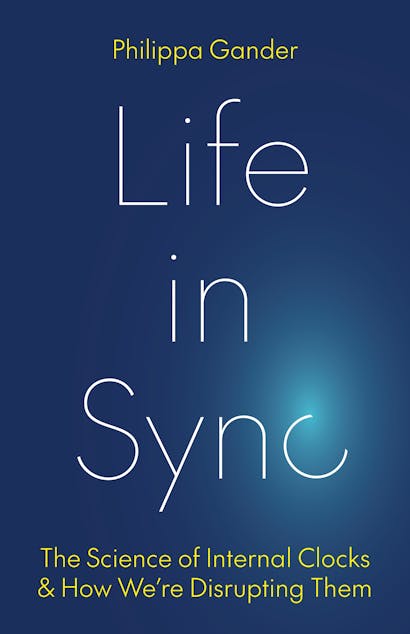
All of life is profoundly shaped by the daily, monthly, and yearly cycles of our planet, and all creatures have internal timekeeping systems that rely on cues from the surrounding environment. With modern technology, we are changing our environments鈥攁nd by proxy, the ecosystems around us鈥攖o override these innate rhythms of life. But at what cost? Life in Sync reveals how Earth鈥檚 rotations shape our biology, what human sleep cycles looked like before the advent of artificial light, and why technology can鈥檛 free us from the constraints of our circadian clocks.
Why did you write this book?
Philippa Gander: Like all living things on Earth, we have internal biological clocks that drive rhythms in the way we function and feel. They are adaptations to the environmental cycles 鈥� the day night cycle, the 28-day lunar cycle, and the seasons - and they rely on specific time cues from the environment to stay in step with the outside world. I have spent more than 40 years studying how our work patterns affect our sleep and internal daily (circadian) rhythms.
My family and friends have always been interested in my work, but most of them are not scientists. I have also had the privilege of sharing science with front-line workers, unions, company managers, executives, and government regulators in multiple countries. The aim was to pool our different expertise to come up with better ways of managing shift work and the health, safety, and well-being challenges it creates in different occupations.
These experiences have fueled my passion for making science accessible and useful. They motivated me to write this book because I believe that understanding internal rhythms is relevant to our health and wellbeing every day of our lives.
It is also critical for understanding the complex ecosystems that sustain us. Internal rhythms exist in all types of living organisms. Genes that generate internal daily rhythms (circadian clock genes) are found in everything from bacteria and single-celled algae to the trillions of cells in our bodies.
Why do we sleep at night?
SR: Sleeping at night is not a social convention. It is programed by a circadian master clock in your brain that has two key functions. It is designed to keep circadian rhythms in the different tissues and organs throughout your body in step with each other, and it monitors blue light as a time cue to stay in step with the day/night cycle. Blue light in the morning speeds up the circadian master clock cycle, while blue light in the evening slows it down. We are the first species that has tried to override our internal circadian time keeping system, with our rapidly expanding use of artificial light at night and accelerating rush to 24/7 work and entertainment.
Why does sleep matter?
SR: When you are awake, much of your brain鈥檚 activity is focused on monitoring and responding to the world around you. In sleep, it disengages from these activities to undertake essential recovery and maintenance. After a good night鈥檚 sleep, you wake up an updated version of yourself. All your experiences of the previous day have been integrated, and you are prepared physically and mentally for the demands of the next day. Both the length and quality of sleep are vital for your day-to-day functioning and wellbeing in the short term, and your physical and mental health in the long term.
Shift work and jet lag disrupt our environmental time cues and can disturb sleep patterns and the internal synchrony among circadian rhythms in different organs and tissues in the body, leading to greater risk of serious health problems and shortening life.
Why is artificial light a problem?
SR: Artificial light at night masks the daily, monthly and seasonal light cycles that are also vital time cues for the biological clocks of many other species. For example, street lighting can delay preparation for winter in some deciduous trees, seen as losing their leaves later, which increases their risk of frost damage. Some species of animals are also attracted to light at night, while others move away from it. For example, artificial light at night is sometimes used in commercial fishing operations to attract fish and squid. However, it can also attract and disorient some migrating seabirds, causing them to crash land or fly off course and eventually die of exhaustion. The impacts on different ecosystems are interactive and complex and we are just beginning to understand them. However, with different lighting technologies that are already available, we can begin to reduce these effects.
Can we live elsewhere in our solar system?
SR: Internal rhythms in life on Earth are synchronized by specific time cues from the environmental cycles of our planet. Astronauts in near-Earth orbit see multiple sunrises every 24 hours and often experience circadian desynchrony due to schedule constraints and mis-timed lighting, accompanied by restricted sleep and increased use of sleep medications.
The day on Mars is only slightly longer than on Earth (24.6 Earth hours). However, Earth-based life would have to be protected from the high energy solar particles and high levels of cosmic radiation that reach the surface of Mars. How would we generate safe daily light cues for ourselves and anything we might want to grow for food? Mars has an elliptical orbit around the sun that takes 687 Earth days, compared to Earth鈥檚 365.25 days. The seasons range from 142 days in autumn to 194 days in spring. What would these time cues do to the internal annual rhythms of Earth-based life?
We still have much to learn about the internal rhythms of life on Earth and the environmental cycles that govern them.
Philippa Gander is professor emeritus and founder of the Sleep/Wake Research Centre at Massey University in New Zealand. An internationally renowned expert on sleep and circadian rhythms, she is a fellow of the Royal Society of New Zealand and an officer of the New Zealand Order of Merit.