
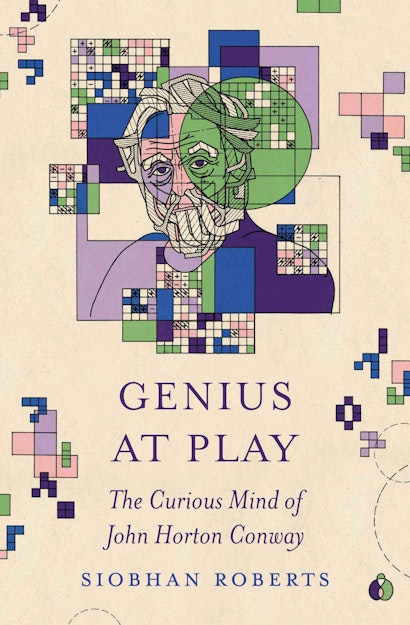
Over several years, while writing Genius at Play, my biography of the always wondrous yet often pernickety one-of-a-kind mathematician John Horton Conway, I was plied by my subject with a smorgasbord of tales鈥攗pon which I still dine out.
As they came my way, many of these tales seemed the perfect fit for that similarly one-of-a-kind magazine, The New Yorker (TNY), and its 鈥淭alk of the Town鈥� vignettes. Upon publication of the book, I contributed a piece in The New Yorker鈥檚 onlince science blog, 鈥淓lements.鈥� The piece chronicled my book tour with Conway in tow鈥攐r, rather, it was an account of me following along with Conway and his crowd during mathematicians鈥� typical summtertime itinerary of conferences and festivals and the like: 鈥淭he steamy months provide a hothouse for the idylls of research. Free from the demands of teaching and admin, summer is playtime, a season to congregate for fun and fellowship and a time to get down to serious work, whether with trivial recreational nerdish delights or full-on hard-core research projects. (Those two things being, for some people, interchangeable.)鈥� It ran under the headline: 鈥淐ogito, Ergo Summer.鈥� And it commenced a happy series of Talk-of-Town style pieces that I contributed to 鈥淓lements鈥� over the coming years.
But this was after The New Yorker had dismissed a number of tantalizing Conway tales that I鈥檇 figured would be impossible to resist.
For instance: I pitched a piece on the Free Will Theorem, a result Conway achieved with his 快色直播 colleague and friend Simon Kochen. Conway and Kochen had proven their free will theorem almost inadvertently using a motley combination of quantum mechanics, philosophy, and geometry. It can be encapsulated as follows: If physicists have free will while performing experiments, then elementary particles possess free will as well. And this, they reckon, probably explains why and how humans have free will in the first place. As Conway would tell me, it isn鈥檛 a circular argument so much as it鈥檚 a spiral argument鈥攁 self-subsuming argument, spiraling outward bigger and bigger.
The New Yorker鈥檚 response: 鈥淭oo esoteric.鈥�
When I pitched Conway鈥檚 day trip via train to visit an accomplished amateur geometer living at a psychiatric hospital in Poughkeepsie, The New Yorker said: 鈥淭oo far afield.鈥�
Of course, the rejection always concluded with a nicety akin to Conway鈥檚 鈥淔are thee well鈥� parting: 鈥淧lease don鈥檛 hesitate to try us again in the future鈥︹��
And indeed one year, with the approach of Pi Day鈥攖hat is, March 14, the calendrical equivalent of the mathematical constant 3.14159鈥� the ratio of a circle鈥檚 circumference to its diameter 鈥� I pitched an account of Conway winning a pie-eating contest at the 快色直播 math department.
It went roughly like this:
The 快色直播 Pi Day festivities began at 1:59:26 p.m. precisely.
鈥�5 … 4 … 3 … 2 … 1 …鈥� went the official countdown and then everyone screamed 鈥淗appy Pi Day!鈥�
Across town, at the Institute for Advanced Study, Pi Day鈥擡instein鈥檚 birthday, by the way鈥攚as marked with pie instead of cookies served at tea. MIT is known to mail out their acceptance letters on this very special day. At Berkeley a man was spotted with 蟺 shaved into his beard. The first official Pi Day celebration apparently took place at San Francisco鈥檚 Exploratorium in 1988, and it has since been recognized with a resolution by the U.S. House of Representatives.
The celebrations are not always formally concerned with commemorating how the mathematical constant pops up in physics and biology, architecture and engineering, astronomy and statistics; and not so much concerned with the fact that if mathematicians were able to find a pattern among its infinite digits, humanity would certainly be the wiser. Pi Day is more about pure and simple fun. It is also a good example of Conway鈥檚 gift for spontaneous combustion: When he really takes flight, sparks fly.
The 快色直播 party began with a contest Conway knew well: Who could recite the most digits of 蟺?
Working from memory, Conway served as de facto adjudicator, augmenting the speed-reading skills of student judges who followed along with multipage 蟺 printouts. The first contestant managed no more than 20 digits. The next contestant blanked after 91, the last few numerical groupings issued with increasing interrogative uncertainty: … 4825342117? … 0679821??
Adam Hesterberg, then an undergraduate鈥攏ow a mathematician and computer scientist who teaches theoretical computer science at Harvard鈥攆ired off the 蟺-recitation equivalent of 鈥淔light of the Bumblebee,鈥� an allegro staccato 140 digits that had spectators finger-snapping and foot-tapping to his automaton tempo. Until, in a moment of distraction, he paused.
鈥淗e鈥檚 calculating!鈥� hollered a heckler.
Wearing a manic sages T-shirt from Mathcamp, Adam shrugged and gave up. 鈥淚鈥檝e lost my place,鈥� he said. This was a disappointment. His personal best is 243.
With the 5 competitors done, the president of the math club attempted to inveigle Conway鈥檚 participation, having heard rumors of his prowess.
鈥淧rofessor Conway …?鈥�
鈥淣o, no. I鈥檓 sorry, I haven鈥檛 been practicing. I always mean to, but I forget.鈥�
That made Adam the winner. He collected the prize: a binary clock.
(Dr. Hesterberg still observes Pi Day. This year, among other tributes, he鈥檒l attend a social event with other Harvard staff in the school of engineering and applied sciences. The agenda includes eating 鈥渁 鈥榩i-ous鈥� mix of delicious pies.鈥� 鈥淧robably no pi-recitation contests,鈥� Dr. Hesterberg said.)
Next came the 快色直播 pie-eating contest.
Contestants were allotted 3 minutes and 14 seconds to devour as much pie as possible, utensils optional. This time Conway was tempted to take part. As usual, he hadn鈥檛 eaten lunch. Then again, pie was not part of his black-coffee-and-dry-bagel diet.
He declined.
鈥淚 suspect it would be the cause of my death.鈥�
The contestants took their seats, took their marks, and dug in. To everyone鈥檚 dismay, they employed their plastic spoons. Grumbles from the audience declared it miserable to watch, the most pathetic, lackluster, shameful showing in the history of Pi Day.
But then, with nary a minute left on the stopwatch, Conway lost his self-control. He inched forth from the back of the crowd, surveyed the selection of more than 3 dozen pies, sextuplets of apple, pecan, blueberry, peach, cherry, a very bouffant lemon meringue. He chose pumpkin, peeled back its foil plate from beneath, opened and angled his hairy mouth for the best approach, and took a monster bite. Then another, another, another. He chomped his way around the pie鈥檚 circumference.
鈥淗e鈥檚 going to eat it all!鈥�
鈥淗e鈥檚 going to win!鈥�
And he did. Catching his breath, he rubbed his stomach and accepted his binary clock.
鈥淭hat was ridiculous,鈥� commented a student.
Conway said, 鈥淲hy, thank you!鈥�
This joyous occasion ranks high among my Conway escapades. Alas, it was not to the taste of The New Yorker: 鈥淭he subject is just a little off for our purposes.鈥�
Siobhan Roberts is an award-winning science journalist and regular contributor to the New York Times. She is the author of The Man Who Saved Geometry and Wind Wizard (both 快色直播).