
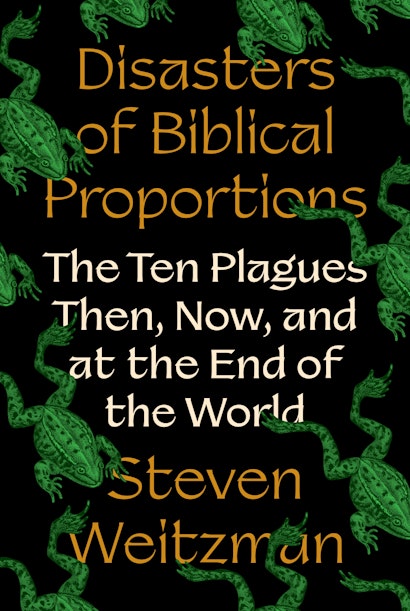
People have been telling and retelling stories about disasters for as long as they have been telling stories. One of the oldest of such stories is the ten plagues in the book of Exodus, the series of disasters that forced the Egyptians to liberate the Israelites. These plagues packed enough catastrophe to fill a series of summer blockbusters鈥攔ivers of blood, invasions of frogs and insects, mass disease, fiery hail, smothering darkness, and a midnight massacre of the firstborn. In Disasters of Biblical Proportions, Steven Weitzman explores how people of later ages鈥攁rtists, writers, activists, philosophers, believers and unbelievers alike鈥攈ave reshaped the story of the ten plagues to give expression to their own trauma, outrage, guilt, humor, and hope.
The focus of Disasters of Biblical Proportions is the famous biblical story of the ten plagues, the story of how God sent a series of catastrophes against the Egyptians in order to force Pharaoh to set the Israelite free, but it is not a study of the Bible itself. Can you explain what the book is about?
Steven Weitzman: Many biblical scholars are focused on questions like who wrote the Bible or did biblical events like the ten plagues really happen? Those questions are interesting to me too, but what fascinates me even more is what people do with biblical stories, how they reimagine them and draw on them to make sense of their own lives. This is what has kept the Bible alive as part of human culture for thousands of years, not just the transmission of the Bible from one generation to the next, but people reading and retelling its stories again and again. This is my focus鈥�how people use the act of retelling, visualizing or reenacting the Bible to create stories that appear biblical but are really stories about their own lives.
But people do something similar with many biblical stories鈥攖he stories of Adam, King David and Jesus. Why focus on the ten plagues in particular?
SW: The initial idea for the book came to me during Passover of 2020, which coincided with the beginning of the pandemic and the global shutdown. During the Passover meal calls, participants try to see themselves as if they had personally left Egypt, but that night what felt intensely present about the story was not the exodus from Egypt but the plagues: the convergence of the pandemic with the biblical story made it feel as if that part of the story was actually happening again in real life.
At the time, there was a lot of scholarly interest in plagues narratives, real-life or fictional accounts of earlier epidemics and pandemics鈥擳hucydides鈥� account of the plague of Athens, for example, or Albert Camus鈥� novel The Plague鈥攂ut I did not find much on how people had used the ten plagues story to make sense of disaster. My original ambition for this book was to fill that gap. There was so much source material to work with鈥擩ews have recounted the plagues as part of the Passover meal for more than a thousand years; Christians have been sermonizing about the story since the second century. The Qur鈥檃n has its own version of the story that has left a lasting imprint on the imagination of Muslims, and even post-religions philosophers like Albert Camus have felt moved to come up with their own versions of the plagues (one of the central characters in the Plague is a priest who delivers a sermon about the novel鈥檚 fictional epidemic as a ten-plagues-like divine punishment). I was looking for a way to connect my scholarship to what I myself was experiencing during the pandemic鈥攁 period of stress, uncertainty, grief and depression鈥攁nd that’s what led me to the idea of a book that explores the history of how people use the story of the ten plagues to help them cope with and overcome the experience of catastrophe, injustice, powerlessness and despair.
Can you tell is a little bit more about what the book covers?
SW: The book has an unusual structure. It is a kind of history, tracing the interpretation and retelling of the story from the earliest known examples of biblical interpretation, through the history of Judaism, Christianity and Islam all the way to contemporary retellings of the story, but it is not arranged chronologically. Instead, each chapter focuses on a single plague, using it as a way to reveal something distinctive about the interpretive history of the ten plagues. In Exodus鈥� account of the plague, there is something distinctive about each plague, a new plot twist or an interpretive puzzle that captured the attention of readers. I use those points of distinction to tell ten different historical stories about how people have reimagined the biblical story.
As I developed the book, I came to realize that an exclusive focus on disaster was too narrow鈥攁nd too depressing鈥攕o I began to think more expansively. Apart from its role in helping people make sense of catastrophe, the ten plagues story has also played other important roles in the history of religion and culture, intersecting with the history of justice, ritual, art, literature, philosophy, political activism, and even magic, and I wanted to convey those dimensions of the story鈥檚 history as well. As a result, some chapters retain my original focus on the story鈥檚 role in making sense of catastrophe, but others venture in other directions, such as the chapter on the second plague, the plague of frogs, which explores the role of humor in transforming that episode into something funny, playful and subversive. While each chapter charts its own pathway through the Bible鈥檚 interpretive history, however, there is a whole greater than the sum of the parts that comes into view if one reads all ten plagues in order, and so I hope readers will go on the whole journey with me.
The subtitle of the book is 鈥渢he Ten Plagues Then, Now, and at the End of the World鈥� Can you elaborate on that?
SW: The 鈥淭hen鈥� of the subtitle refers to the ten plagues as understood and retold in the past. The earliest known retellings of the story are to be found in ancient texts from before the rise of Christianity like the Dead Sea Scrolls and Philo of Alexandria, beginning a history of retelling and interpretation that extends over the next two thousand years and reaches into every part of the world inhabited by Christians, Muslims or Jews. The 鈥渢hen鈥� signals that the first goal of the book is historical鈥攏ot to uncover the real-world catastrophes behind the biblical story as other books attempt to do, but to shed light on the story itself as a part of history, how it has been invested with new meanings by people living in different times and places.
Skipping to the end of the subtitle, 鈥渢he End of the World鈥� refers to the role of the ten plagues story in shaping how people imagine the Apocalypse, the end of everything. The single most important text in this regard is the New Testament book of Revelation, which modeled its vision of a catastrophe-filled end of the world on the ten plagues. Its influence put the ten plagues at the heart of Christian apocalypticism, and Disasters of Biblical Proportions, especially the chapter on the seventh plague, traces that evolution of the tradition from antiquity into modern, secular science fiction. Our own culture struggles with the feeling that humanity鈥檚 end is drawing near, and this part of the book offers historical perspective on that feeling by exploring its connection to the apocalyptic reading of the ten plagues.
And what about the 鈥渘ow鈥� in the middle of the subtitle?
SW: Disasters of Biblical Proportions is about the history of a biblical story and about the role of that story in how people think about the future, but it is also about the present鈥� about how Jews, Christians, Muslims and the post-religious are retelling the story in our own day. It is impossible to keep up with the present, but I was able to get to 2024, including in the book examples of how the story has been retold in response to the Covid pandemic and other recent disasters of our era, racial injustice in America, and violence in the Middle East. Although biblical literacy has been declining in the United States in recent decades, it remains the single most important source of shared stories, and people still turn to it as a way to make sense of life鈥檚 slings and arrows even when they haven鈥檛 read the story or can鈥檛 recall all its details.
When I first conceived the book, the early months of the pandemic, I have to admit that I wasn鈥檛 only reading about the ten plagues in this period: I was also spending too much time doomscrolling, compulsively consuming one heartbreaking story of the pandemic鈥檚 impact after another in a quest to better understand what was happening, but that kind of reading never led to any deep insight, and I finally had to stop it because it only made me more depressed. In the same period, there were people using the ten plagues to assert a different response to the pandemic, drawing on it to frame the pandemic as 鈥渁 sign鈥�, not a random accident but a warning to repent of one鈥檚 sins or rectify injustice before it is too late. Even for those who don鈥檛 believe in miracles, this remains a powerful way of calling for change. Yet another goal of the book is to explain how this ancient story remains alive in our own era as a source of empowerment in the face of disaster and despair.
Steven Weitzman is the Abraham M. Ellis Professor of Hebrew and Semitic Languages and Literatures at the University of Pennsylvania, where he also serves as the Ella Darivoff Director of the Herbert D. Katz Center for Advanced Judaic Studies. He is the author of Solomon: The Lure of Wisdom and The Origin of the Jews: The Quest for Roots in a Rootless Age (快色直播), the winner of a National Jewish Book Award. He is also a coeditor of The 快色直播 Companion to Jewish Studies (快色直播).