
Forty years ago, I was deeply involved with a manuscript housed in the Bancroft Library at UC Berkeley. It was written in a language variously known as Aztec, Mexicano, and Nahuatl. Each of these names carries a bit of truth. It was spoken by people we call Aztecs (and also by some of their neighbors) in the heart of today’s nation of Mexico. Nahuatl basically means “intelligible speech, that which can be understood within earshot.â€� It is the opposite of Popoluca, meaning “unintelligible speech, gibberish,â€� a name the speakers of this clear speech bestowed on several unrelated neighboring languages. For some time now, we have continued to speak of Aztecs as a people while favoring Nahuatl as the name of their language.
In the 1970s and 1980s historian James Lockhart and I worked together intensively on documents written in Nahuatl in Mexico between the 1540s and the early 1800s. We were aware that the alphabetic writing system devised for Nahuatl by Spanish friars missed important features of the spoken language and this deficit was reflected in the existing dictionaries, muddying proposed etymologies and leading to serious mistranslations.
Jesuits in 17th-century Mexico shared this awareness and took to augmenting the earlier spelling with diacritics—marks written over vowels—in order to bring written Nahuatl into line with its pronunciation.
The manuscript that we called the Bancroft Dialogues is an example of this Jesuit project. It gives every evidence of having been composed in the mid-to-late 1500s and later carefully copied in the mid-1600s and supplied with diacritics and commentary by an Indigenous scholar trained by the Jesuits.
Lockhart and I painstakingly transcribed and checked the manuscript. We translated it twice, once literally and again in more colloquial English. We analyzed the content in depth, and wrote an introduction that perhaps only a fellow Nahuatl scholar could love. Our publication circulated to a small number of specialists and soon became inaccessible.
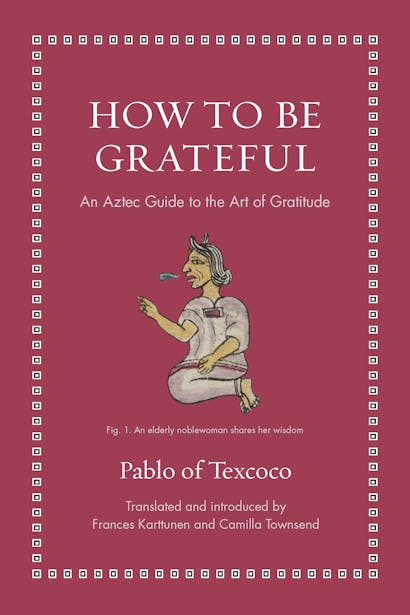
Now it has come back to life in a new format for a broader audience as an exemplar of ancient wisdom for modern readers. This time I have worked together with historian Camilla Townsend to produce How to Be Grateful. We two women of different generations have once again taken great pains with the transcription while importing to the colloquial English translation some of the features of the literal translation, the better to showcase the beauty and ingenuity of the original. Had they known the importance of this text so many centuries in the future, the Aztecs might have described it as a jewel, “a precious greenstone feather.�
Whereas Lockhart and I were engrossed in how the language of the manuscript works, Townsend has been drawn deeply into what wisdom is being conveyed in the language—Aztec concepts more easily shared with readers.
The text consists of speeches made by Aztecs of different generations, reminding each other of debts owed to one another, and what they should be grateful for. The young owed all that they had to the efforts of older people in years gone by, when they themselves were young. Those elders in turn expressed gratitude to the young for their implicit promise to “pay it forward� and to keep their communities going into the future.
Forty years ago, I might have identified with the young, attending to the exhortations of their elders. Today I am myself an elder, and in this book, I hand on our earlier efforts to younger readers as they seek to understand the people of precolonial Mexico.
We hope that this new edition of the Bancroft Dialogues underscores the point that the Nahuatl language literally embodies a sense of gratitude to others. The ubiquitous benefactive construction intersects with reverential speech, so that it is said of honored personages (teachers, elders, political leaders) that they do things for the benefit of others. That idea need not be put into words; it is built into Nahuatl.
One might imagine that all languages are organized from the same grammatical building blocks, and at a very abstract level, this may be true. But the languages of the world are startling in the variety of what must be expressed overtly (with obligatory prefixes and suffixes, for example) and what ignored. Specificity may be more important than number, animacy more important than gender. Possession in one language may distinguish between what cannot be taken away without grave harm to one’s personhood (one’s genealogy, for instance, or one’s body parts) and all those things of which one can be deprived. In another language possession may distinguish between what one has by birthright and what one acquires during one’s lifetime. Prior to contact with Spanish, it appears the Nahuatl verb that later took on the sense of “to ownâ€� instead meant “to be responsible for, to have stewardship of.â€�
In Nahuatl respect is hardwired in the grammar where verbs and nouns have obligatory forms in address directed to one’s superiors, one’s elders, and—counterintuitively—one’s subordinates, since those who serve are accorded respect just as those who govern. The Jesuit grammarian Horacio Carochi warned of the pitfalls awaiting anyone inattentive to Nahuatl’s grammatical distinctions. In the Bancroft Dialogues, it is meant to be funny when a Spanish friar responds to a respectful and gratitude-infused greeting from a young Indigenous boy with the bald equivalent of, “I’m fine.�
Readers who seek Nahuatl words exactly equivalent to “gratitude� or “to thank� will be disappointed. The Aztecs expressed the concept of gratitude in their own way, not ours, but the concept is implicit everywhere. Speakers refer to the act of receiving something as enjoying it, deserving it, being so lucky to receive it, and so on. The notion also appears in specific phrases that are different than ours. The most common of these translates literally as “You have befriended me.� It is used where a speaker of English would say, “I thank you for what you have done.� Another common formulation is “for someone’s heart to deliver things.� In the text, one boy says, “The heart of our Lord has granted things,� by which he means, “I give thanks to our Lord for his generosity.� A third way in which the Aztecs expressed gratitude was to use the phrase “to acknowledge as dear, as valuable.� This has survived the centuries: today a person in a Nahuatl-speaking village will say “Tlazocamati�, a shortened version of saying that an action is “acknowledged as valuable�.
In that spirit, we wish to thank you, the reader, very much for caring to find out how people of long ago once expressed things. We ask you to carry it forward with you in thinking about Mexico and the indigenous ancestors of modern Mexicans.
Tlazocamati huel miac.
Frances Karttunen retired as Senior University Research Scientist at the Linguistics Research Center at the University of Texas at Austin, where she established the Early Mesoamerican Languages Project. Her books include The Art of Nahuatl Speech: The Bancroft Dialogues.