
Women are everywhere in economic life, and nowhere very much in economic history. In Joseph Vernet鈥檚 great series of paintings of the 1750s and 1760s, the waterfronts of the ports of France are crowded with women pulling carts and selling fish, talking and bargaining. But until the nineteenth century, there were very few registers of women鈥檚 employment. Women were less literate than men, and left fewer signs in official archives. They had less access to credit, and fewer legal rights. They have been the subject, in their economic lives, of history from below, or of the uneventful, un-individual history of social existence.
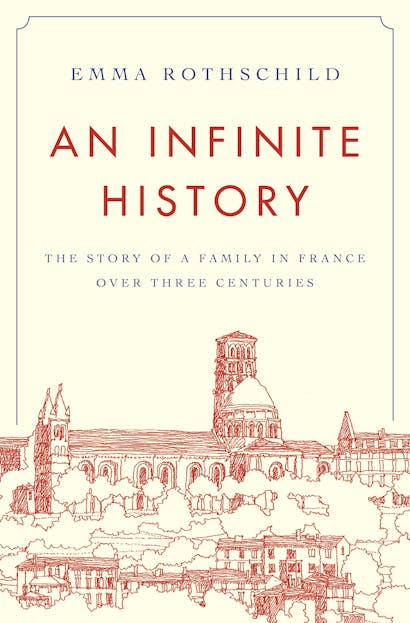
My book An Infinite History starts in the world depicted by Vernet, and ends in a village in the foothills of the Pyrenees, in 1906. It became, somewhere along the way, a story about women in the history of economic life. I say 鈥渋t became,鈥� because I had no idea, when I started to write the book, where it was going to end. It begins with a party, in 1764鈥攖he festivities for the signature of a pre-nuptial contract, between the daughter of a carpenter and the son of tailor, in the small interior town of Angoule虃me鈥攁nd with Marie Aymard, the mother of the bride-to-be. The book is the story of what happened next.
There were eighty-three signatories of the contract, and the initial inquiry was into who they all were. It became a story in time, about Marie Aymard鈥檚 social network, and about her children and grandchildren. It followed them in their own lives, and into the political time of the French revolution.
My expectation, in following the family into the great transformations of political and economic life, was that the inquiry would become a history, eventually, of Marie Aymard鈥檚 sons and grandsons; of the individuals I could find in the archives, or in the public record.
Everything turned out very differently. The lives of Marie Aymard鈥檚 grand-daughters were filled with events, and so were the lives of the women amidst whom she lived. Of the eighty-three signatories in 1764, forty-three were women or girls. One sold cooking oil, and another, her sister, was a shopkeeper; there was a fripie虁re, or seller of old clothes, and a trinket seller; two sisters, cousins of the bridegroom, were seamstresses. There was a close neighbour, the daughter of the director of the post, who became director of the post herself, after her husband鈥檚 death.
One of the things I wanted to explore in the history of this small, inland town was the extent to which individuals were aware of the distant world of the French colonies, or of early 鈥済lobalization.鈥� Marie Aymard鈥檚 late husband had gone as an indentured servant to the Caribbean island of Grenada, and died on the way home. She was herself illiterate, but she had heard a report, from someone in the town, that her husband had been able to save money, and buy several slaves, and a goat. She even knew how much the slaves brought him, when he rented them out to work for other people.
One of the signatories of the pre-nuptial contract, the daughter of a shoemaker, was a signatory, some years later, of the baptism record of a fifteen-year old boy, who had been bought as a slave in Benin, and transported, via Saint-Domingue, the modern Haiti, to La Rochelle and Angoule虃me. Another signatory had a brother who was an unsuccessful merchant in Saint-Domingue, and advertised, in 1769, for the capture of his slave; a dressmaker called Nannette, who spoke 鈥渧ery good Spanish and French,鈥� was 鈥渂randed on her two breasts鈥� with his name, and was 鈥渁bout to give birth if she has not already done so.鈥�
Even in the political time of the French revolution, the lives of the women in the story were full of events. The youngest of the signatories of the pre-nuptial contract鈥擱osemarin, who signed at the age of ten鈥攚as the only one of the eighty-three whose political opinions were recorded in an official document. She had the misfortune to be inscribed on the list of individuals who had emigrated, even though she had gone no further than the nearby town of Tours; denounced, or so it seemed, by 鈥減eople who owed her money.鈥� The dossier of her efforts to be removed from the list is a chronicle of five years of petitions, including a testimonial from the fiercest of the local revolutionaries; the conclusion was that 鈥渢his citizen is of a known patriotism.鈥�
Women were at the center, eventually, of the economic life of Marie Aymard鈥檚 own family. When her grandson was married, in 1790, to the daughter of a local apothecary, his parents could provide no capital at all. His prospects were saved, in the end, by the two seamstresses who had signed the original pre-nuptial contract so many years before; his first cousins once removed, and the source of his future wealth.
The richest person in the family, by 1799, was Jeanne aine虂e, the oldest of the Marie Aymard鈥檚 grand-daughters. She was the only one in the family to sign a register of the individuals in the town liable to taxes on luxuries; she was described as a marchande, or shopkeeper, and she declared, 鈥渢he rental value of my personal accommodation is 250, from which 50 should be deducted for the rent of my shop.鈥�
In 1811, Jeanne aine虂e and her four unmarried sisters entered into by far the largest capital transaction in the family鈥檚 history. They were by now identified as schoolteachers, and they acquired half of the family home from their father, brothers and sisters (or their brothers-in-law, since married women were considered incompetent in French law.) Ten days later, they bought a large house on the ramparts of Angoule虃me, with a mortgage on the security of the family home. They started a business鈥攁 boarding school for girls鈥攖hat became the center of the life of the extended family, over more than half a century.
The sisters鈥� own inheritance was severely, and even startlingly, restricted to their female relations. The first of the sisters to die left her estate to her three nieces, and the house on the ramparts was at one point owned in fifteen shares, all held by Marie Aymard鈥檚 granddaughters and great-granddaughters. Jeanne aine虂e herself died in 1860, at the age of ninety-two; she left, as her universal heiress, her niece, the daughter of her sister, with reversion to her great-niece, the eventual heiress of the entire family fortune.
Louise Lavigerie, with whom the book ends, was also a great-niece of the five sisters, and she was for a time a teacher in the school on the ramparts. She is the only member of the entire extended family, over five generations, of whom there are any private letters that survive (or that I have been able to find.) This was only by chance, as so often in women鈥檚 history. For Louise鈥檚 beloved brother was the only member of this large, obscure family who became famous, and indeed world famous; he was Charles Martial Allemand Lavigerie, Cardinal of Algiers, and opponent of the trans-Saharan slave trade.
A few of Louise鈥檚 letters are there, in the Cardinal鈥檚 archives in Rome, and they are charming, discursive exchanges. She lived for a time in a paper mill near Angoule虃me; she writes about a 鈥渓ocal financial catastrophe,鈥� the price of paper, 鈥渇oreign competition,鈥� and their first cousin; 鈥渉is character is such that it is impossible to have a rational explanation with him.鈥� She retired to a village in the Pyrenees, and in the winter before her death, in 1906, she spent the long evenings burning the family papers.
These are only a few of the stories of which An Infinite History is made up. They show, at least, how much is there to be found, in a history that starts with people鈥檚 lives, which are so rich, and not with the official registers of economic life, which are so impoverished. They point to aspects of the economic revolution of the long nineteenth century that are too easily forgotten in large-scale economic history, including the intensely 鈥渆conomical鈥� activities of women who were employed in the most unindustrial of occupations. They point, certainly, to the inequality of economic destinies: one of Louise鈥檚 third cousins was a street seller in Paris, a marchande ambulante, and another was a seamstress, who had ten children, of whom nine died in infancy or childhood.
The stories of Marie Aymard鈥檚 family point, too, to the importance of the relationships that are left out, often, in genealogical or ancestral history. It was the two first cousins once removed, the seamstresses, who saved the family鈥檚 economic future in 1790; it was the five unmarried sisters on the ramparts who were at the center of the nineteenth-century story. Cousins and great-aunts, too, are part of women鈥檚 history, and of the history of modern times.
Emma Rothschild is the Jeremy and Jane Knowles Professor of History at Harvard University, where she directs the Center for History and Economics. Her books include The Inner Life of Empires (快色直播) and Economic Sentiments.