
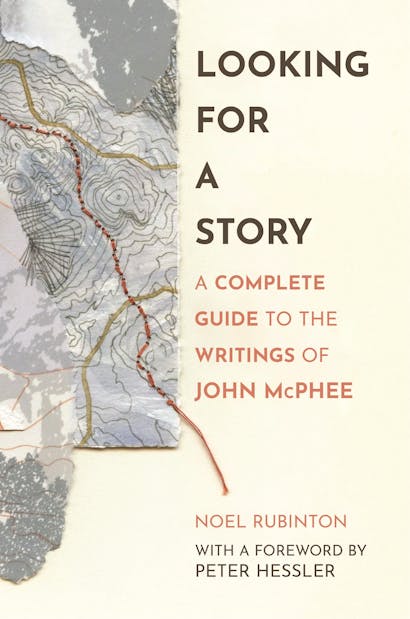
When I set out to find the whole world of John McPhee, to document and explore his extraordinary career as a writer, I had no sense of the fascinating marathon of research ahead.
I knew my chief goal: to give readers more knowledge and access to McPhee鈥檚 over 70 years of writing. After reading and admiring him for decades, I thought I had a good sense of how to construct what I would think of as the Library of McPhee. Not so fast.
I started with what seemed to be easy and obvious鈥攈is books and New Yorker articles. The 30+ books so elegantly published by Farrar, Straus, and Giroux were straightforward. But before long I was also finding his writing in many other books.
Exhaustive web searches and visits to the Library of Congress unearthed all sorts of McPhee contributions to other people鈥檚 books in the forms of prefaces, forewords, introductions, an afterword, and what he called a benelogue. There was a largely unknown body of work that McPhee had written over the decades for books in support of people and subjects he cared deeply about, such as a beloved high school teacher or a summer camp or Thoreau. I could tell my work was getting more interesting and complicated.
Seemingly straightforward research to compile all McPhee鈥檚 New Yorker articles showed itself to be more complex because of McPhee鈥檚 productivity and versatility. The base was dozens of long articles for which he was celebrated, later published as books, on subjects from Bill Bradley to Alaska to fishing and much more. Yet McPhee was also busy doing shorter pieces for the magazine, particularly in the 1960s and 70s. Most of these contributions were for the Talk of the Town section, and some were 鈥渘ewsbreaks,鈥� short humorous items wedged between stories. Many were unsigned, though the New Yorker archives mercifully included attribution to McPhee.
Tracking McPhee鈥檚 contributions to another magazine, Time, became an extended hunt. I knew that he spent eight formative years (1957-65) at the nation鈥檚 best-selling news magazine, mostly in the show business department. I also knew that for years, including while McPhee was there, Time operated under the group journalism rubric of founder Henry Luce and there were no bylines on stories. So how to document McPhee鈥檚 stories? Even his prodigious memory could not be counted on to go back more than a half century.
I traveled to the Time archives, now in the Manhattan library of The New York Historical (formerly the New-York Historical Society). First efforts were fruitless. Then came a lightning-bolt from a librarian and Bill Hooper, the archivist for Time Inc. for more than 40 years.
I learned from them about rarely examined Time bound volumes that had been carefully marked through the years by members of the magazine鈥檚 copy desk. Each story was identified in red grease pencil or pen with the initials of the writer. For several weeks, I went through the annotated volumes, turning every page, thousands of them, during the time McPhee was at Time. When I finished, I had compiled a list of more than 500 stories definitively attributed to McPhee for the first time.
Nine of McPhee鈥檚 articles were masterful cover stories, profiling stars such as Richard Burton, Barbra Streisand, and Jackie Gleason, using the bright, creative prose and innovative story structures that would become a hallmark of his work. He could also write with equal authority and flair about a new TV show, 鈥淭he Flintstones,鈥� Sidney Poitier becoming the first Black actor to win the Best Actor Oscar, and President Eisenhower returning to Normandy for D-Day鈥檚 20th anniversary.
My longest search involved McPhee鈥檚 stint as a television screenwriter. After graduating from 快色直播 and a year of study at Cambridge in England, McPhee was determined to be a screenwriter for television. Always smart about connections, McPhee found his older brother, a lawyer in President Eisenhower鈥檚 White House, knew Robert Montgomery, a noted Hollywood actor-and-director-turned- television-producer, who was advising Eisenhower on his television appearances. McPhee attached himself to Robert Montgomery Presents, a weekly show of television dramas whose guest stars were among the most famous in Hollywood, such as Lillian Gish and James Cagney. It was filmed in Manhattan and McPhee watched the creative process for months, learning the craft.
McPhee eventually wrote two episodes of the show that were produced, adaptations of short stories by Robert M. Coates in The New Yorker, the magazine where McPhee already wanted to work.
I was confident those screenplays, which most McPhee readers knew nothing about, would provide an important early window into his development as a writer. Finding the screenplays in print and video forms proved difficult. I was able to find scripts for 鈥淚n a Foreign City鈥� and 鈥淭he Man Who Vanished鈥� in a private collection and later in the collection of Yale University鈥檚 Beinecke Rare Book and Manuscript Library. Yet reading hundreds of pages of dialogue and stage directions did not fully bring them to life.
My search intensified for video versions. Dozens of hours of web searches produced copies of numerous episodes from the eight-year run of Robert Montgomery Presents, but not McPhee鈥檚. Inquiries at television archives around the country came up empty.
Finally, a breakthrough came. The UCLA Film & Television Archive, one of the largest in the world, had a video copy of 鈥淭he Man Who Vanished鈥� episode. How could I see it from my East Coast location? The archive would only make a duplicate if copyright of the program could be proven and necessary releases obtained. After weeks delving into the world of copyright for a show that stopped more than 60 years earlier, it became clear that a path to figure out that access did not exist.
I found it irresistible to go to Los Angeles to see what was apparently the only video in the world of a television show created by McPhee. In a small computer viewing room in a UCLA library, McPhee鈥檚 1956 drama came to life.
McPhee鈥檚 鈥渢eleplay鈥� credit was followed by Montgomery praising McPhee and saying, 鈥淭onight鈥檚 play is an imaginative comedy, which I think television sees far too little.鈥� McPhee, at 25, showed sophisticated skills. The McPhee episode is a dramatic reimagining of Coates鈥� story about a seemingly normal businessman who finds himself vanishing from sight. McPhee changed the sequence of the story significantly and built new characters and scenes, giving the story new comedic touches and making it more of a psychological drama.
Even with my productive visits to more than ten libraries and archives, my research was probably aided most by McPhee himself. With an incredible memory, he was the source of crucial information and wonderful surprises. He recalled many articles he wrote outside of the New Yorker, oftentimes providing the breadcrumbs key to finding the articles in archives. One day a former classmate of his from elementary school presented him with a cache of one-paragraph articles that he wrote for a school 鈥渕agazine鈥� when he was eight years old.
Perhaps McPhee鈥檚 most unexpected revelation was about his relationship with the New Yorker. Several times he and I talked about the origins of his interest in the magazine, and each time he recalled that an elementary school friend shared with him a copy from his parents. It seemed a bit flat, but he had nothing more to say. Then, out of the blue two years later, McPhee wrote me with a memory that had come back to him, more precisely explaining his New Yorker passion.
McPhee recalled being mentioned in a New Yorker article. At the age of 10, he had made his first appearance as writer Rogers E. M. Whitaker, who covered college football for the magazine for 31 years, referred to him. I traced McPhee鈥檚 memory back to a November 22, 1941 story about 快色直播鈥檚 team and its efforts to run faster. Whitaker described how McPhee, the son of the team鈥檚 doctor, ran with the players during practice, wearing a 快色直播 jersey and carrying a miniature football.
Noel Rubinton is a journalist and strategic communications consultant whose writing has appeared in leading publications such as the New York Times and the Washington Post. He was a reporter and editor for Newsday for many years.