
How do we see the world whole? We can start by looking at it through the lenses that southern writers and storytellers offer us, and coming to understand it better both 鈥榝rom below鈥� and in the round.
Most of the time when we imagine our planet, we do so with the North Pole uppermost, the aspect shown in most world maps. In the northern hemisphere, there are the great world capitals like Beijing, Paris, London, Delhi, New York. Here, the news media informs us, is where the really important events happen. Decisions made in these cities and others like them impact the world as a whole.
Such north-centered views are not confined to global cartography. They also impact how we view geopolitics, history and even climate. We all subscribe to the general idea that people from the great landmasses of North America and Eurasia drive world history and have done so for millennia. By and large, we ignore social and cultural frameworks centered in the south. In many cases, even where we look for influential southern ideas, we do not find them. Many were simply not recorded, or the traditions from which they emerged have been lost. When European colonialism extended outwards to the very edges of South America, southern Africa, and Australasia鈥攖hose far distant southern landmasses鈥攖he languages and belief-systems of many southern peoples (the M膩ori, the Noongar, the Khoi, the Selk鈥檔an, the Yaghan, and multiple others), were partially undermined and even destroyed.
Views from the dominant north all tend to overlook or obscure the watery southern hemisphere, with its vast oceans and huge south polar icecap (containing 95% of the earth鈥檚 ice). And this means that we never really see the world in its entirety. We never properly take into account the impacts of southern climates, cultures, geographies and knowledge on human and non-human lives across the world. For example, we accept without question that all of the major world languages have northern roots.
Such overlooking is limiting and destructive; it holds serious environmental consequences for us all. The southern oceans are warming, and the southern ice melting, at a far greater rate proportionately than anywhere else on the planet. Yet until very recently, we simply chose not to notice these developments. From where we stood, the things happening at the 鈥榣imits鈥� of the world seemed less important than what happened at the center.
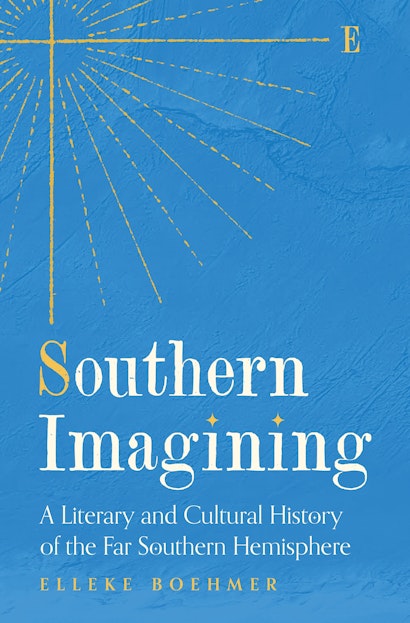
Southern Imagining invites us to look at the world afresh by seeing it from the far south, from the legendary edges of the planet鈥攖hose angles that are mostly absent from western or northern histories and philosophies. How do we go about achieving this southern gaze? My book looks to southern indigenous myth, song, and epic鈥攑eople鈥檚 stories about the movement of the stars and the behavior of the ocean. It considers perspectives from ethnoastronomy and oceanography on how the peoples of the south have read their skies, lands and waters, and by drawing correspondences through these stories, builds relativizing links and balances between austral points of view that speak back to the rest of the world.
Most of all, Southern Imagining finds in literary writing from the south ways of thinking about the world against the grain of dominant northern perspectives. The book notices how southern poetry and fiction stimulate our curiosity about the vast scale and reach of southern lands, suggesting that the local languages and symbol systems that encode southern geographies supply us with powerful tools for questioning and disrupting hemispheric biases. Southern writings provide us with mechanisms for thinking outside the terms and structures of conventional northern knowledge, tracing lateral pathways for thinking around and across the hemisphere.
There are numerous examples of the counterclockwise thinking that southern stories and poems can stimulate. Contemporary Indigenous Australian novelists like Alexis Wright and Kim Scott show how sky and seascapes are interwoven, with the environments of the air impacting those of the ocean, and vice versa. (The one-time mariner Herman Melville curiously does the same in Moby-Dick with his descriptions of Polynesian funerals in which the dead drift away to meet the starry horizon.) Meanwhile, New Zealand-born writer Katherine Mansfield, her fellow countrywoman Janet Frame, and the South African Zoe Wicomb allusively draw us into the feeling of living on the farthest edges of the world. The Cape Town poets Gabeba Baderoon, Diana Ferrus, and Ronelda Kamfer, among others, register the pain both physical and psychological that the southern body feels from being historically disdained and marginalized. And the South African writer and artist Zakes Mda and the M膩ori novelist Witi Ihimaera outline how it is to interact with watery southern environments鈥攚aves, shores, current and rocks. They show how these worlds push back against northern narrative patterns and so disrupt conventional ways of thinking.
The south-centered world map, refracted through the work of southern authors, encourages us to think at scale, and at multiple different scales. The epic poems and environmental stories of writers like Jazz Money, Bessie Head, Samanta Schweblin, and others shuttle restlessly between the miniscule, and the very large. It is these perspectives that help to destabilize the models of planetary development in which the northern human has always been placed at the forefront of history.
Elleke Boehmer is Professor of World Literature in English at the University of Oxford. Since 2023, she has been an Extraordinary Professor in English at the University of Pretoria and in 2024 she was Visiting International Fellow at the University of Adelaide. She is the author of, among other books, Postcolonial Poetics; Indian Arrivals 1870鈥�1915, winner of the ESSE Book Award; and the field-defining Colonial and Postcolonial Literature: Migrant Metaphors; as well as the collection of short stories To the Volcano and the novel The Shouting in the Dark, winner of the Olive Schreiner Prize. She is a Fellow of the Royal Society of Literature and a Fellow of the Royal Historical Society.