
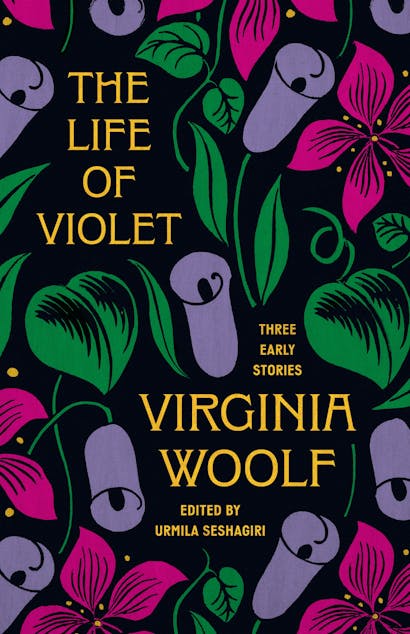
In 1907, eight years before she published her first novel, a twenty-five-year-old Virginia Woolf drafted three interconnected comic stories chronicling the adventures of a giantess named Violet鈥攁 teasing tribute to Woolf鈥檚 friend Mary Violet Dickinson. But it was only in 2022 that Woolf scholar Urmila Seshagiri discovered a final, revised typescript of the stories. The typescript revealed that Woolf had finished this mock-biography, making it her first fully realized literary experiment and a work that anticipates her later masterpieces. Edited by Urmila Seshagiri and published here for the first time in its final form, The Life of Violet blends fantasy, fairy tale, and satire as it transports readers into a magical world where the heroine triumphs over sea-monsters as well as stifling social traditions.
An unknown typescript by Virginia Woolf! How did you find this work?
Urmila Seshagiri: It was pure serendipity. I was researching Woolf鈥檚 magnificent autobiography A Sketch of the Past at the University of Sussex, and I came across a letter she wrote to her friend Violet Dickinson asking for Violet鈥檚 鈥淢emoir of the Stephen Family.鈥� The Sussex archivists suggested that I contact Longleat House in Wiltshire, where Violet鈥檚 papers are held. Longleat replied to my inquiry saying that Yes, they had Violet鈥檚 鈥淢emoir,鈥� and they also had 鈥淔riendships Gallery鈥� by Virginia Woolf: would I be interested in seeing it?
I was confused. 鈥淔riendships Gallery鈥� is a 1907 work by Woolf archived in the New York Public Library: Was the Longleat item a copy?
To my astonishment, it turned out that Woolf had reworked the stories held in the NYPL and had them professionally typed in 1908. That鈥檚 the typescript that Longleat House owns, and no one was aware of it because it鈥檚 part of Violet Dickinson鈥檚 papers.
Visiting Longleat House in 2022 and reading the typescript was like watching Woolf鈥檚 writing come to life. In some ways, it鈥檚 even more exciting than discovering an entirely new work by Woolf: seeing her revise the first draft into a polished, refined version is a treasured glimpse into her writing process, a key step on her path to becoming one of the most influential of the modern novelists. And I felt joy at reading stories that are as absurd as they are poetic.
This new book is called The Life of Violet but the stories seem to have been known as 鈥淔riendships Gallery.鈥� Why the new title?
US: Woolf never called it 鈥淔riendships Gallery.鈥� That was Violet鈥檚 title. Woolf referred to it as 鈥淭he Life鈥� or 鈥淭he Myth,鈥� and Vanessa Bell, Woolf鈥檚 sister, called it the 鈥淟ife of Violet.鈥� I felt that was a more accurate title than 鈥淔riendships Gallery,鈥� which is the name of the first of the three stories.
Who was Violet Dickinson?
US: I would love to have known Violet Dickinson, who inspired these three stories and was a very close friend and mentor for Woolf. Dickinson was born into an aristocratic Somerset family in 1865 and she grew to be 6鈥�2鈥� tall. Can you imagine how extraordinarily complicated, how difficult, it would have been for a wealthy woman to be that height? (Woolf even teased her, 鈥淎m I right in saying that to be 6 ft tall in the age of Q Victoria was equivalent to having an illegitimate child?鈥�)
Being so tall made Violet unmarriageable. But she did not inhabit her life as a single woman with abjection or a desire for invisibility. Instead, she made friends from all walks of life and expanded her social world beyond the wealthy titled members of her immediate circle to include writers, artists, women who had been institutionalized for alcoholism or crime, a family of dwarfs in London, a man who pioneered a new technology for crematoriums, art collectors鈥he list goes on. She was Mayoress of Bath (you can see the custom jeweled brooch she wore on formal occasions in the Bath City Hall, where it features in daily tours.) She traveled the world. She built a cottage of her own.
Most importantly, Violet was a writer, an editor, and a family archivist. She wrote a 鈥済et-well鈥� pamphlet for Woolf in the voice of a 17th-century philosopher; she edited and published a volume of letters by her aunt, the author and artist Emily Eden; she kept exhaustive records of her maternal and paternal ancestors in beautiful bound books that are scattered across different archives.
Violet Dickinson is largely remembered as a minor character in Virginia Woolf鈥檚 life. It was wonderful to research her own life and see what an unusual, fulfilling place she created for herself during a historical moment that didn鈥檛 offer her many possibilities. She opens up the question that Woolf asked in every one of her novels: what is a woman鈥檚 life?
We know more about Woolf鈥檚 life than perhaps any other 20th-century writer. What does The Life of Violet add to this vast trove of knowledge?
US: Virginia Stephen (not yet Woolf) wrote this mock-biography in the period between leaving 22 Hyde Park Gate, her storied South Kensington childhood home, and leading the equally storied life we associate with the Bloomsbury Group. The discovery of her revised version reveals that she was already writing sophisticated fiction and was imagining vastly different possibilities for literature than she had herself encountered in her reading. Above all, it reminds us that Virginia Woolf had a brilliant comic streak and that she could be hilarious.
Do you read Woolf differently because of this discovery?
US: At this moment in my scholarly life, I have had the extraordinary fortune of studying Woolf鈥檚 earliest and latest works of life-writing; I prepared her 1908 revision of Violet for publication while also editing her 1939-41 memoir A Sketch of the Past. This sustained work has deepened my understanding of Woolf as a biographer and autobiographer, of a writing career that pushed in multiple ways against received conventions. Woolf simply refused the idea that human existence was determined by linear chronology, or by 鈥榝act,鈥� or, in the case of The Life of Violet, by the laws of gravity. And although she is best known as a novelist, she was a novelist whose abiding passion was biography.
How should readers approach the stories in The Life of Violet?
US: With great enjoyment! I hope that readers of all ages from all over the world will laugh when they read these stories. Whether you鈥檝e read Mrs. Dalloway or A Room of One鈥檚 Own, or whether you鈥檝e never opened a page of anything written by Woolf, I hope you鈥檒l pick up this book and lose yourself in the magic and comedy of Woolf鈥檚 early stories.
Virginia Woolf (1882鈥�1941) was one of the twentieth century鈥檚 most important writers. In addition to writing ten novels, including Mrs. Dalloway and To the Lighthouse, Woolf was the cofounder of the Hogarth Press and a prolific essayist and critic. Her manifesto A Room of One鈥檚 Own is a cornerstone of modern feminist thought. Urmila Seshagiri is Distinguished Professor of Humanities and Professor of English at the University of Tennessee, Knoxville. She is the author of Race and the Modernist Imagination, the editor of the Oxford World鈥檚 Classics edition of Virginia Woolf鈥檚 Jacob鈥檚 Room, and a contributor to the Los Angeles Review of 快色直播.