
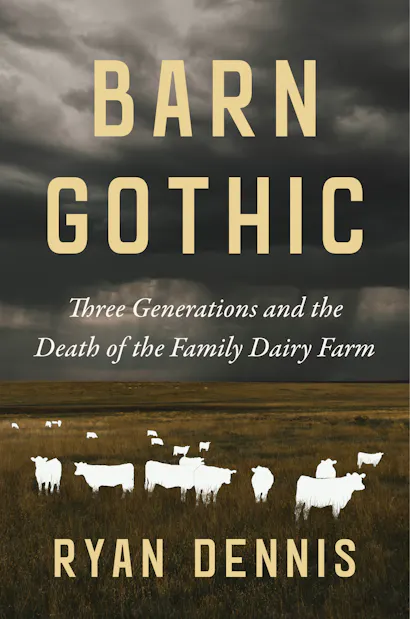
There are only three times when a farm receives a lot of visitors: during an open house after expanding, after the farmer gets seriously injured, and when the farm sells out and auctions its machinery. My father, like many dairy farmers in the twenty-first century, experienced all three.
Typically, other than the milk man, the only people who came to the farm were bill collectors. When I was a child, my father would meet them in the driveway and make small talk as they avoided mentioning the money he owed. Eventually, my father would promise to put 鈥渟omething in the mail鈥� after the next milk check. By the time I was in my late teens, however, he seldom talked to bill collectors. Instead, if I told him a truck pulled up to the barn he would ask me what type of vehicle it was and then tell me to say that he was doing fieldwork somewhere else.
The farm crises of the eighties received national attention but had little impact on the dairy industry. In fact, low grain prices were mostly beneficial to dairy farmers, since they had cows to feed. However, dairy farming became more turbulent a decade later. In 1994, our family expanded from one hundred to two hundred cows in order to try to survive lower profit margins. Many families did something similar, creating a surplus of milk and driving prices down further.
Unfortunately, a difficult industry was only part of what my family faced. My grandfather鈥檚 farm shared the same mortgage as ours. My grandfather鈥檚 personality changed after he injured his head in the milking pit and he found it difficult to keep up with the demands of farming. As his farm struggled, it also pulled ours into financial trouble. When my grandfather quit farming without consulting the bank, the bank took one of our two monthly milk checks as 鈥渃ollateral鈥� while his farm sale was processing. The sale took nine months, leaving us with half of our income during that period.
Then my father was crushed by the arms of a skidsteer. Three surgeons refused to operate because they were sure he would die. The fourth agreed to the procedure, but told him that if he did survive, he would live in a wheelchair. Days after my father awoke from the surgery, he had to fight banks and lawyers from his hospital bed to keep his farm. After he taught himself to walk again, he went back to farming, now with a rod in his back and a wire mesh over the organs on the right side of his body. By then, our farm was in irreparable debt.
The decline of our family farm was not an isolated incident. Instead of trying to manage overproduction in the dairy industry, US agriculture policy has encouraged it. The 1996 Farm Bill ended support programs that removed excess milk from the market or set aside land to remain idle. Instead, the industry relied on international markets to soak up excess production, which proved to be unreliable in supporting farm income. Between 2000 and 2020, the number of US dairy exports increased by a factor of eight. However, according to Food and Water Watch, the average dairy farm only made a profit twice in those years.
In January 2015 I received a message to call home. I was in Iceland, getting a second master鈥檚 degree, which was less about the education than having a place to be. I needed the distance to process the fact that I probably wasn鈥檛 going to be a farmer, partly because it was difficult to imagine a future for the farm. There was a four-hour difference between Reykjav铆k and the farm in New York State, but being the winter, the sun was just coming up in both places.
鈥淲e wanted to tell you before you heard it from someone else,鈥� my mother said.
Saying that you鈥檝e quit farming sounds similar to a death announcement, but when someone dies on a farm, the farm keeps going, at least at first. While neighbors and hired hands can fill in gaps during the initial hours, any grief is eventually positioned alongside the necessity of cows having to be milked and the livestock fed. There鈥檚 the feeling that the farm is a family鈥檚 place on earth and bigger than any one person. When a farm ends, however, it leaves behind people with a lot to figure out.
I wasn鈥檛 there when the last of the cows left on an aluminum trailer or when the machinery was auctioned off. I was glad for that. I didn鈥檛 want to see strangers put a price tag on the old equipment that shaped my childhood. With that plow, disk and mower I traced the contours of the fields that defined our family鈥檚 geography. It would be tough to see them driven towards neighboring counties. More importantly, I didn鈥檛 want to have to watch my father going through that.
There are stories of farmers not going to their own auctions or staying in the house until everyone leaves. I knew my father would be standing in the crowd as his equipment was bid on. Years later, I asked him about that day, and he said the auctioneer knew enough to keep him busy, starting the machinery or answering questions. Most farmers in the area went to our auction, even if most didn鈥檛 have intentions to buy anything. There wasn鈥檛 much they could say to my father, so they mostly nodded when he passed. It was their way to show respect to our family, and to prepare themselves for what they would likely face themselves.
Our dairy farm was one of 40,000 that went out of business between 2003 and 2019. Manufacturers and retailers of dairy products flourished, largely because the price paid to farmers was kept low. Within a generation, the United States lost over half of its dairy herds. Adding insult to injury, it was a crisis that went largely unregistered in media coverage. Not only weren鈥檛 there novels or movies showing what people like our family were going through, but farming journals鈥攍argely funded by agribusiness鈥攖ended to portray a reality different than what farmers were experiencing. They all pushed the same message: get big to make money. In the end, however, only large corporations profited from an expanding dairy industry.
When we talked about that day, I asked my father what he felt afterwards.
鈥淟ike a failure,鈥� he said.
For people who鈥檝e raised cattle, the farm is their center of gravity, and it determines how they live and die. The rhythms stay with a person long after the last cow is milked. That鈥檚 probably why the suicide rate among farmers is 3.5 times higher than the national average.
A nation that privileged cheap food is now reckoning with those decisions. When my father was young there were twelve farms in our small township. Now there are two. There are half as many students in the local school than there were a generation ago, and it will have to shut its doors soon. Towns like ours have declined in step with the disappearance of the family farm. Without agriculture鈥攑articularly smaller farms, which spend locally鈥攅conomic opportunities dry up and people leave. Those who鈥檝e stayed have become increasingly disillusioned, which, ultimately, had consequences for national politics. In the end, Trump carried the vote of people he had nothing in common with because, in part, they hoped he would break a system that had already left them behind.
In 2015, when he sold the machinery, my father had only ever been a farmer. Despite everything my father went through, perhaps the most courageous thing he did was to reinvent himself at the age of fifty-three. After failing the test twice, he became a school bus driver. For the first time in his life, he worked in public, which suited his quick wit and affable personality. He had time off and, while bus driving is not a lucrative occupation, disposable income for the first time in many years.
鈥淚 don鈥檛 miss milking cows,鈥� he said. 鈥淚 don鈥檛 miss it.鈥�
Maybe someone who didn鈥檛 know my father would have believed him. However, my father wasn鈥檛 the type of person to make such declarations, which was the first sign that he didn鈥檛 completely move on. He still kept a small herd of Angus, not because he was a beef farmer at heart, but because it allowed him to do acts of farming that were similar to what he knew. It gave him chores, which allowed for a certain structure to his days and a connection to animals. Still, he had to pass by the crumbling milking parlor every day, and whether he opened the door or not, he knew it was there. Weeds grew up in the barn鈥檚 driveway where the milk truck used to park, and he watched someone else work the fields he rented out. Once, he admitted to me that he still had nightmares. One recurring dream was that he had somehow forgotten to milk his cows, leaving them waiting.
In the end, this may be the most tragic aspect of losing a farm. Guilt that should be borne collectively because of policy that let farmers down is instead shouldered by the farmers themselves. They consider themselves failures in a game they could never have won.
Ryan Dennis of Canaseraga, New York is the author of .