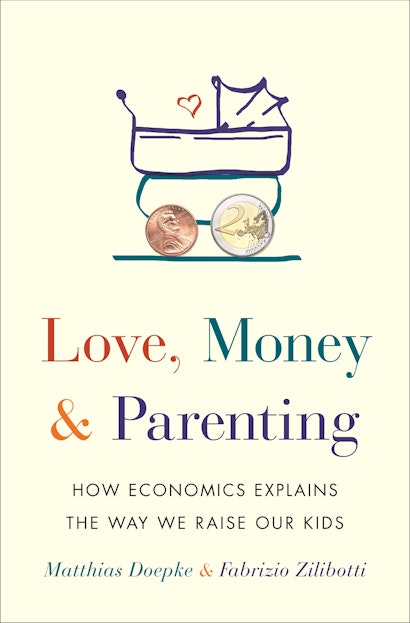
Parents everywhere want their children to be happy and do well. Yet how parents seek to achieve this ambition varies enormously. For instance, American and Chinese parents are increasingly authoritative and authoritarian, whereas Scandinavian parents tend to be more permissive. Why? Love, Money, and Parenting investigates how economic forces and growing inequality shape how parents raise their children. From medieval times to the present, and from the United States, the United Kingdom, Germany, Italy, Spain, and Sweden to China and Japan, Matthias Doepke and Fabrizio Zilibotti look at how economic incentives and constraints鈥攕uch as money, knowledge, and time鈥攊nfluence parenting practices and what is considered good parenting in different countries.
Through personal anecdotes and original research, Doepke and Zilibotti show that in countries with increasing economic inequality, such as the United States, parents push harder to ensure their children have a path to security and success. Economics has transformed the hands-off parenting of the 1960s and 鈥�70s into a frantic, overscheduled activity. Growing inequality has also resulted in an increasing 鈥減arenting gap鈥� between richer and poorer families, raising the disturbing prospect of diminished social mobility and fewer opportunities for children from disadvantaged backgrounds. In nations with less economic inequality, such as Sweden, the stakes are less high, and social mobility is not under threat. Doepke and Zilibotti discuss how investments in early childhood development and the design of education systems factor into the parenting equation, and how economics can help shape policies that will contribute to the ideal of equal opportunity for all.
Love, Money, and Parenting presents an engrossing look at the economics of the family in the modern world.
Awards and Recognition
- A Fatherly Top Ten Best Parenting Book of the Decade
- A Choice Outstanding Academic Title of the Year
"Psychologists, sociologists and journalists have spent more than a decade diagnosing and critiquing the habits of 鈥榟elicopter parents鈥� and their school obsessions. . . . But new research shows that in our unequal era, this kind of parenting is essential. That鈥檚 the message of the book Love, Money and Parenting: How Economics Explains the Way We Raise Our Kids, by the economists Matthias Doepke of Northwestern University and Fabrizio Zilibotti of Yale. It鈥檚 true that high-octane, hardworking child-rearing has some pointless excesses, and it doesn鈥檛 spark joy for parents. But done right, it works for kids, not just in the United States but in rich countries around the world."鈥擯amela Druckerman, New York Times
"An incisive look at parenting and economic inequality."鈥擟arolyn Dever, Public 快色直播
"Why do so many seemingly sane people get over-involved with their kids? The answer is not that parents have collectively come unhinged, according to the new book Love, Money and Parenting: How Economics Explains the Way We Raise Our Kids. Rather, parents today are rational economic actors responding to an increasingly unhinged environment."鈥擩enny Anderson, Quartz
"An earnest tilt at a genuinely hard question: To what degree are parental choices informed by economic realities? Reducing his answer to a single line is reductive, but let鈥檚 do it anyway. When it comes to raising Americans kids, it鈥檚 the economy, stupid."鈥擯atrick A. Coleman, Fatherly.com
"As economists Matthias Doepke and Fabrizio Zilibotti reveal in their recent book Love, Money, and Parenting: How Economics Explains the Way We Raise Our Kids, today鈥檚 American parents are not so crazy after all. For better and worse, their parenting style is perfectly rational."鈥擪ay Hymowitz, Institute for Family Studies
"All in all, a highly informative read."鈥擠avid Lorimer, Paradigm Explorer
"The book introduces stimulating ideas in an accessible manner."鈥擩ohn Ermisch, Journal of Economic Inequality
"N/A"鈥擜lexandra Martynenko, Antropologicheskij Forum
鈥�Love, Money, and Parenting presents a fascinating, insightful analysis of the origins and consequences of different parenting styles over time and place. Doepke and Zilibotti explain how and why parents shape child preferences and skills to adapt their offspring to the anticipated social and economic realities facing them as adults. The authors creatively use basic economic theory to integrate and interpret a vast body of evidence from multiple disciplines. This ambitious, well-argued book carefully examines how families influence the social and economic fortunes of their children.鈥濃�擩ames J. Heckman, Nobel Laureate in Economics
鈥淓conomics is usually the last thing on people's minds when they think about parenting. This wonderfully readable and original book aims to change that. It shows how different parenting styles are all about trade-offs, how they shape the way children explore and experiment with the world and take risks, and how economic factors have played an important role in the striking changes we have experienced in the way parents think about their children and parent them. A must-read.鈥濃�擠aron Acemoglu, coauthor of Why Nations Fail
鈥淚n their stimulating account of the reasons behind different parenting practices, Doepke and Zilibotti unashamedly argue for an economic interpretation, while also including social and cultural factors. Worryingly, the authors show how emerging societal divisions could enable some parents to promote their children even as they disable the efforts of parents in more difficult economic circumstances. Parenting regimes by class threaten equal opportunities, social mobility, and political participation. The authors鈥� hope is that thoughtful policy interventions can head off such threats.鈥� 鈥擩ane Humphries, author of Childhood and Child Labour in the British Industrial Revolution
鈥淧resenting many key findings and novel explanations, Love, Money, and Parenting argues that we can use economic principles to explain why different parenting styles exist across different countries and within countries at any given point in time. At once intelligent, sophisticated, and accessible, there is no other book that tackles the same themes as this one. I really enjoyed reading it.鈥濃�擭attavudh Powdthavee, author of The Happiness Equation
鈥淏ringing together personal experiences, reasoning, and evidence, this fascinating and persuasive book shows that parenting decisions are governed by incentives and an economic approach can help us to understand why parents鈥� choices might vary across countries and over time. The wealth of information, detail, and strength of economic argument is impressive.鈥濃�擩o Blanden, coauthor of The Persistence of Poverty across Generations
No known hazards or warnings
Accessibility Features
-
Inaccessible, or known limited accessibility
-
No known hazards or warnings