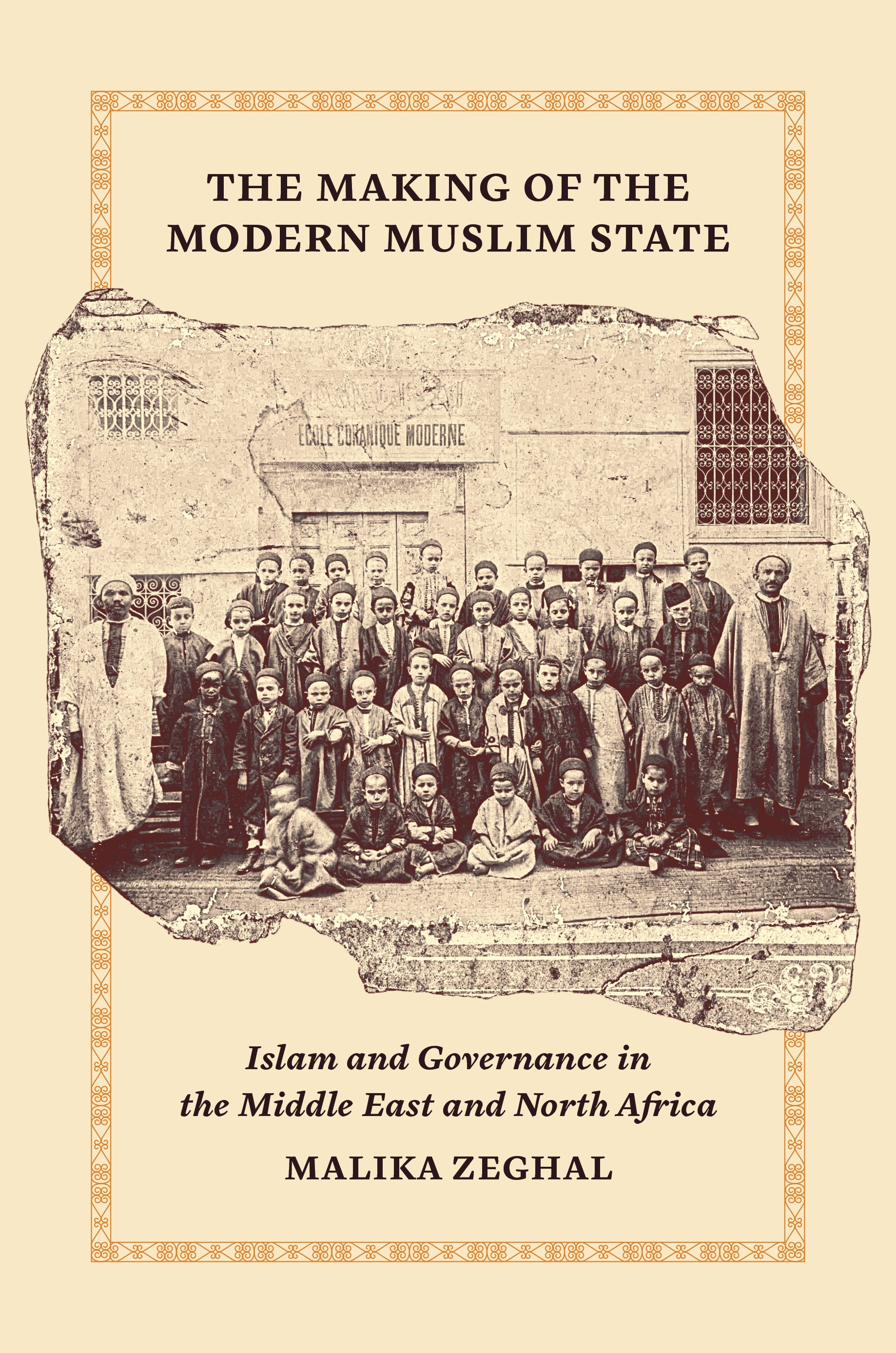
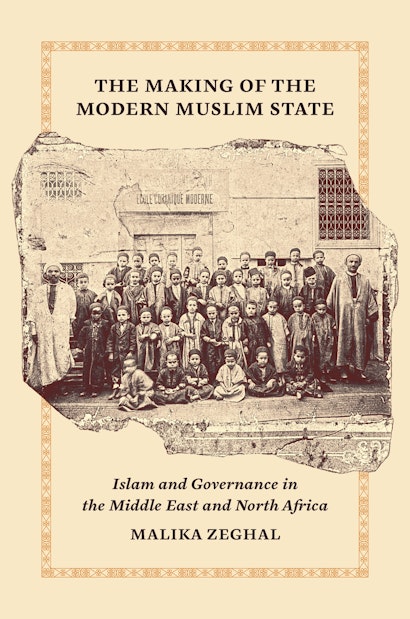
In The Making of the Modern Muslim State, Malika Zeghal reframes the role of Islam in modern Middle East governance. Challenging other accounts that claim that Middle Eastern states turned secular in modern times, Zeghal shows instead the continuity of the state鈥檚 custodianship of Islam as the preferred religion. Drawing on intellectual, political, and economic history, she traces this custodianship from early forms of constitutional governance in the nineteenth century through post鈥揂rab Spring experiments in democracy. Zeghal argues that the intense debates around the implementation and meaning of state support for Islam led to a political cleavage between conservatives and their opponents that long predated the polarization of the twentieth century that accompanied the emergence of mass politics and Islamist movements.
Examining constitutional projects, public spending, school enrollments, and curricula, Zeghal shows that although modern Muslim-majority polities have imported Western techniques of governance, the state has continued to protect and support the religion, community, and institutions of Islam. She finds that even as Middle Eastern states have expanded their nonreligious undertakings, they have dramatically increased their per capita supply of public religious provisions, especially Islamic education鈥攆urther feeding the political schism between Islamists and their adversaries. Zeghal illuminates the tensions inherent in the partnerships between states and the body of Muslim scholars known as the ulama, whose normative power has endured through a variety of political regimes. Her detailed and groundbreaking analysis, which spans Tunisia, Morocco, Egypt, Turkey, Syria, and Lebanon, makes clear the deep historical roots of current political divisions over Islam in governance.
Awards and Recognition
- Finalist for the American Academy of Religion Book Award, Historical Studies
Malika Zeghal is the Prince Alwaleed Bin Talal Professor in Contemporary Islamic Thought and Life in the Department of Near Eastern Languages and Civilizations and the Committee on the Study of Religion at Harvard University. She is the author of Gardiens de l’Islam, Les Oul茅mas d’al-Azhar dans l’Egypte Contemporaine and Islamism in Morocco: Religion, Authoritarianism, and Electoral Politics.
"Fantastic."鈥擜lice Evans, Rocking Our Priors
"In this erudite and intelligent book, Zeghal . . . aims to reframe debates about the relationship between religion and the state in the Muslim world. . . . A novel and important argument about the often ignored role of religion in the foundation of modern states."鈥擫isa Anderson, Foreign Affairs
"Malika Zeghal offers a provocative intervention . . . [and] novel data that should inspire further comparative historical research."鈥擡d Webb, Religion, State & Society聽
"No serious scholarly treatment of the history, substance or function of the modern Muslim state, and ultimately of Muslim politics, will be able to dispense with a serious engagement with this groundbreaking book."鈥擲herman A. Jackson, Islamic Law and Society
"Malika Zeghal has offered a terrific historical analysis of how the expectation of the custodianship of Islam in Muslim majority states has been discussed and practiced, as well as the consequences of this. It is an empirically strong book, supported by qualitative and quantitative data, and a welcome contribution to the rich and often unknown variety and complexity of Muslim political thought."鈥擣rancesco Cavatorta, The Journal of Church and State
"The Making of the Modern Muslim State is an ambitious, foundational text. . . . Zeghal’s work is essential reading for scholars, policymakers, and anyone interested in the evolving nexus of religion, law, and politics in the Muslim world. It is a book that demands serious engagement—and generously rewards it."鈥擨saac Kfir, Journal of Islamic Studies
“An original and outstanding contribution to our understanding of the connection between religion and the state in the Middle East and North Africa. While the subject of her research has been treated by a number of other scholars and is an almost classical issue in political history and political science, Zeghal’s method is entirely new. The volume of empirical material she gathered and analyzed is truly amazing.”—Lucette Valensi, E虂cole des Hautes E虂tudes en Sciences Sociales
This publication has been produced to meet accepted Accessibility standards and contains various accessibility features including a table of contents, a page list to navigate to pages corresponding to the print source version, and elements such as headings for structured navigation. Appearance of the text and page layout can be modified according to the capabilities of the reading system.
Accessibility Features
-
WCAG v2.2
-
WCAG level AA
-
Table of contents navigation
-
Print-equivalent page numbering
-
Next / Previous structural navigation
-
Landmark navigation
-
Index navigation
-
Epub Accessibility Specification 1.1
-
ARIA roles provided
-
All non-decorative content supports reading without sight
-
No known hazards or warnings