Defining Russia Musically: Historical and Hermeneutical Essays
Paperback
ebook (EPUB via app)
- Sale Price:
- $50.40/拢42.00
- Price:
-
$72.00/拢60.00 - ISBN:
- Published:
- Oct 6, 2020
- Copyright:
- 1997
- 127 music exs., 11 figures, 3 diagrams
30% off with code PUP30
ebook (PDF via app)
- Sale Price:
- $50.40/拢42.00
- Price:
-
$72.00/拢60.00 - ISBN:
- Published:
- Oct 6, 2020
- Copyright:
- 1997
- 127 music exs., 11 figures, 3 diagrams
30% off with code PUP30
-
Audio and ebooks (EPUB and PDF) purchased from this site must be accessed on the
快色直播 app. After purchasing, you will receive an email with
instructions to access your purchase.
About audio and ebooks - Request Exam Copy
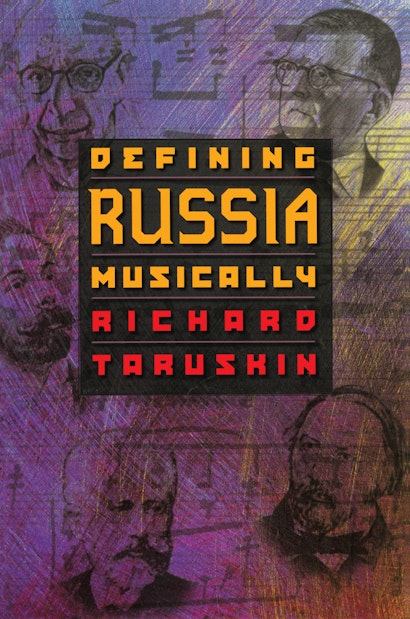
The world-renowned musicologist Richard Taruskin devoted much of his career to helping listeners appreciate Russian and Soviet music in new and sometimes controversial ways. Defining Russia Musically represents one of his landmark achievements: here Taruskin uses music, together with history and politics, to illustrate the many ways in which Russian national identity has been constructed, both from within Russia and from the Western perspective. He contends that it is through music that the powerful myth of Russia’s 鈥渘ational character鈥� can best be understood. Russian art music, like Russia itself, Taruskin writes, has 鈥渁lways [been] tinged or tainted … with an air of alterity鈥攕ensed, exploited, bemoaned, reveled in, traded on, and defended against both from within and from without.鈥� The author’s goal is to explore this assumption of otherness in an all-encompassing work that re-creates the cultural contexts of the folksong anthologies of the 1700s, the operas, symphonies, and ballets of the 1800s, the modernist masterpieces of the 1900s, and the hugely fraught but ambiguous products of the Soviet period.
Taruskin begins by showing how enlightened aristocrats, reactionary romantics, and the theorists and victims of totalitarianism have variously fashioned their vision of Russian society in musical terms. He then examines how Russia as a whole shaped its identity in contrast to an 鈥淓ast鈥� during the age of its imperialist expansion, and in contrast to two different musical 鈥淲ests,鈥� Germany and Italy, during the formative years of its national consciousness. The final section focuses on four individual composers, each characterized both as a self-consciously Russian creator and as a European, and each placed in perspective within a revealing hermeneutic scheme. In the culminating chapters鈥擟haikovsky and the Human, Scriabin and the Superhuman, Stravinsky and the Subhuman, and Shostakovich and the Inhuman鈥擳aruskin offers especially thought-provoking insights, for example, on Chaikovsky’s status as the 鈥渓ast great eighteenth-century composer鈥� and on Stravinsky’s espousal of formalism as a reactionary, literally counterrevolutionary move.
Awards and Recognition
- Richard Taruskin 鈥� 2017 Kyoto Prize Laureate in Arts and Philosophy, Prize Field: Music, Inamori Foundation
- One of Choice's Outstanding Academic Titles for 1997