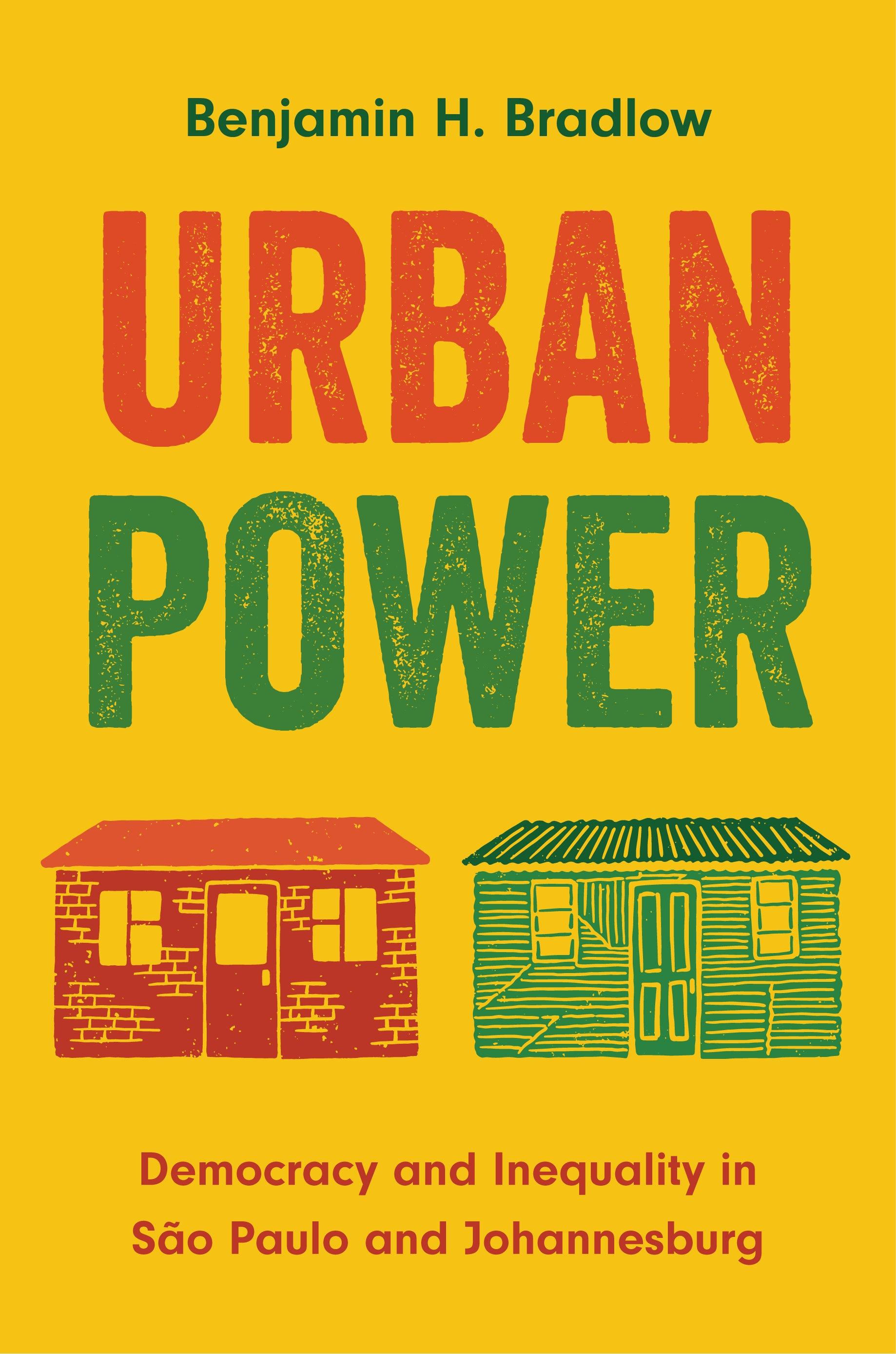
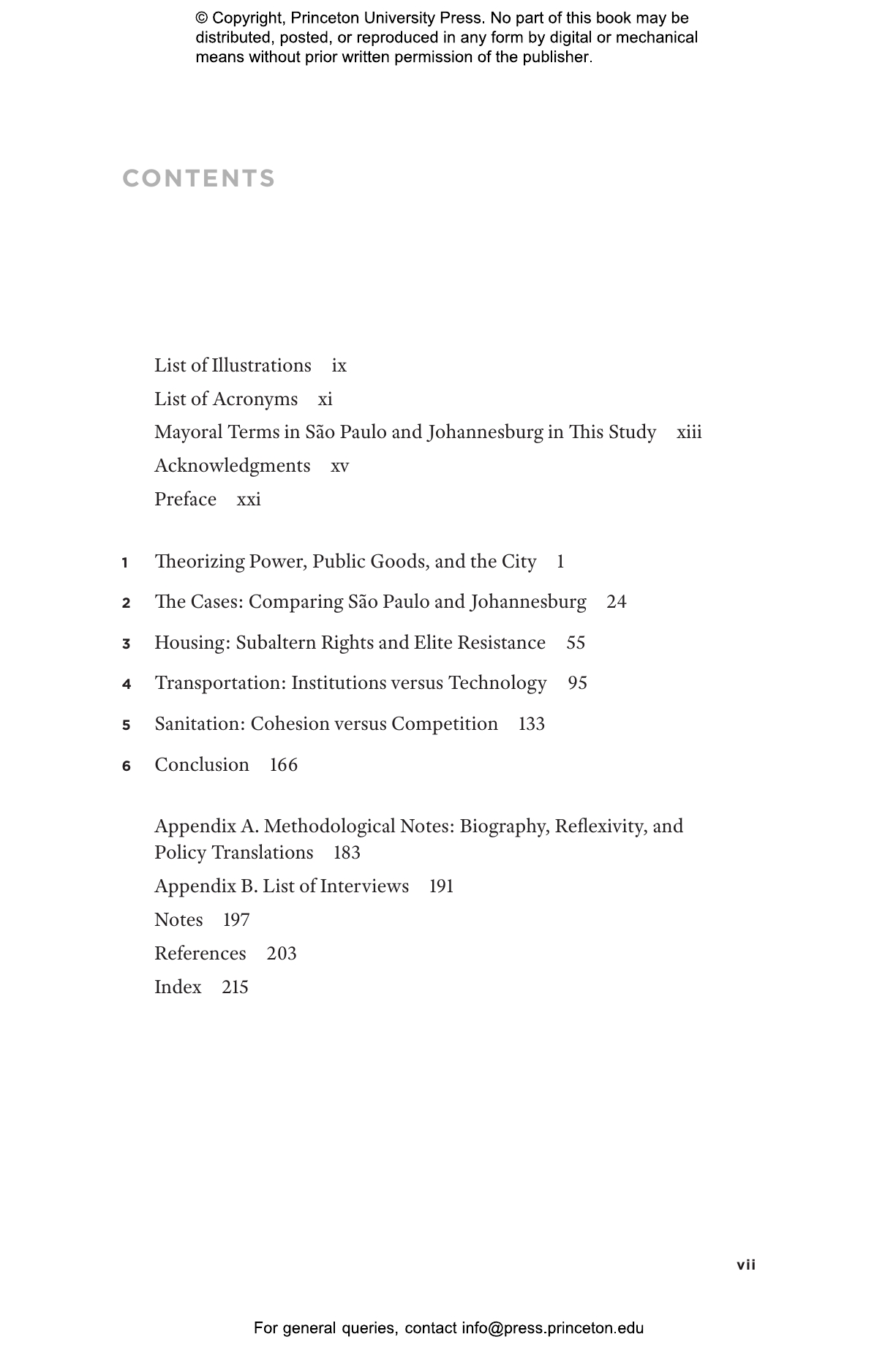
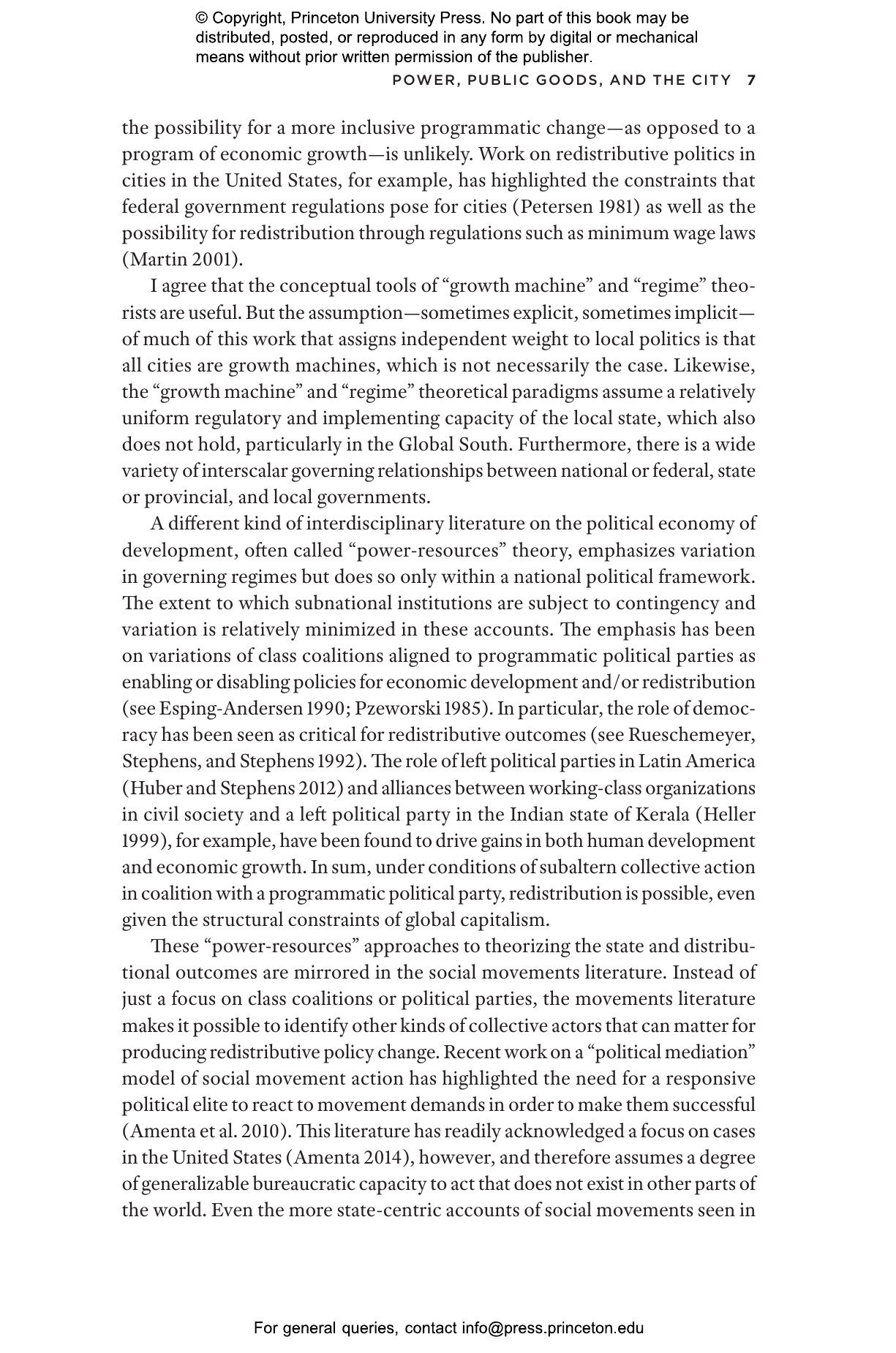
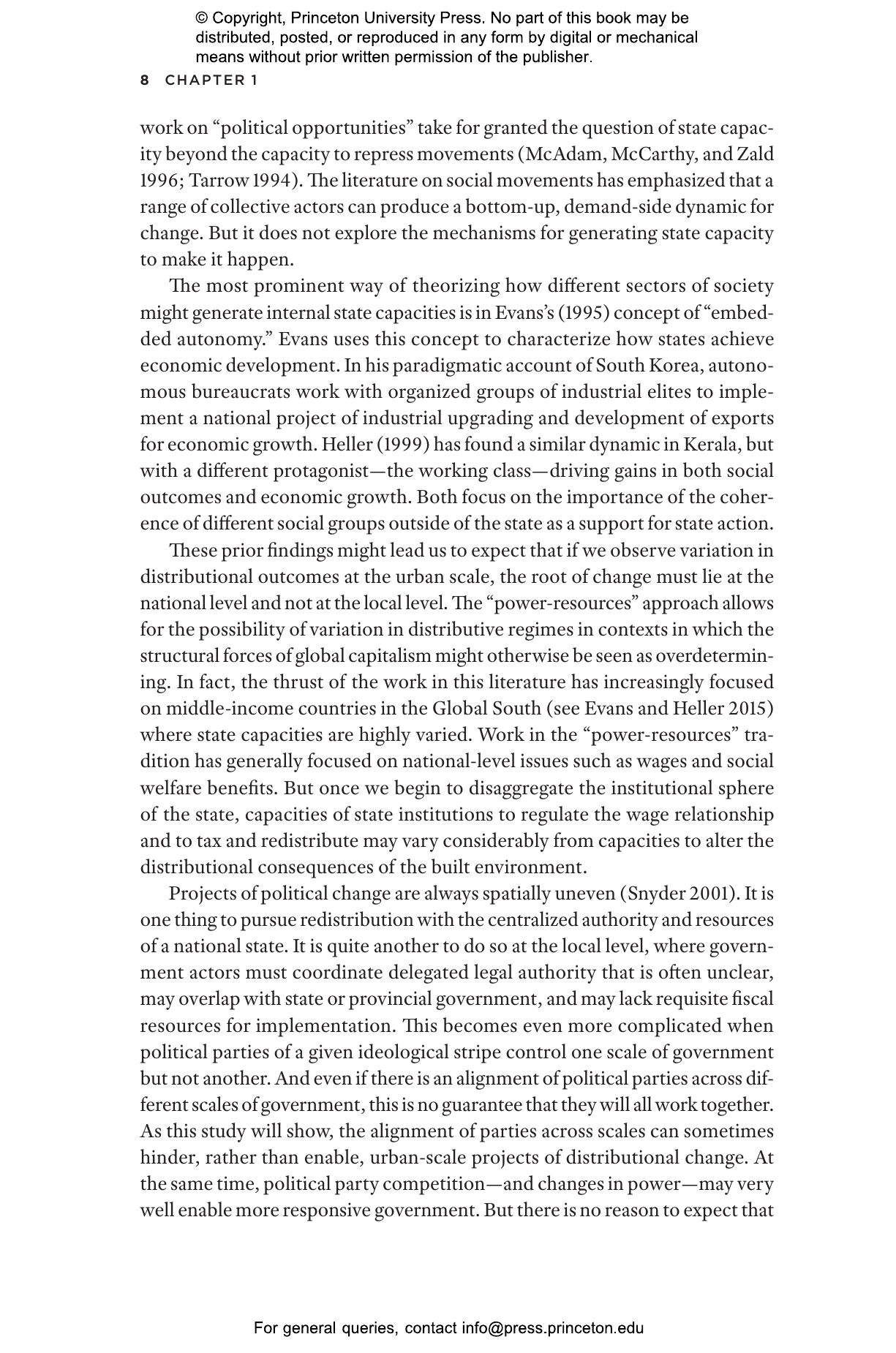
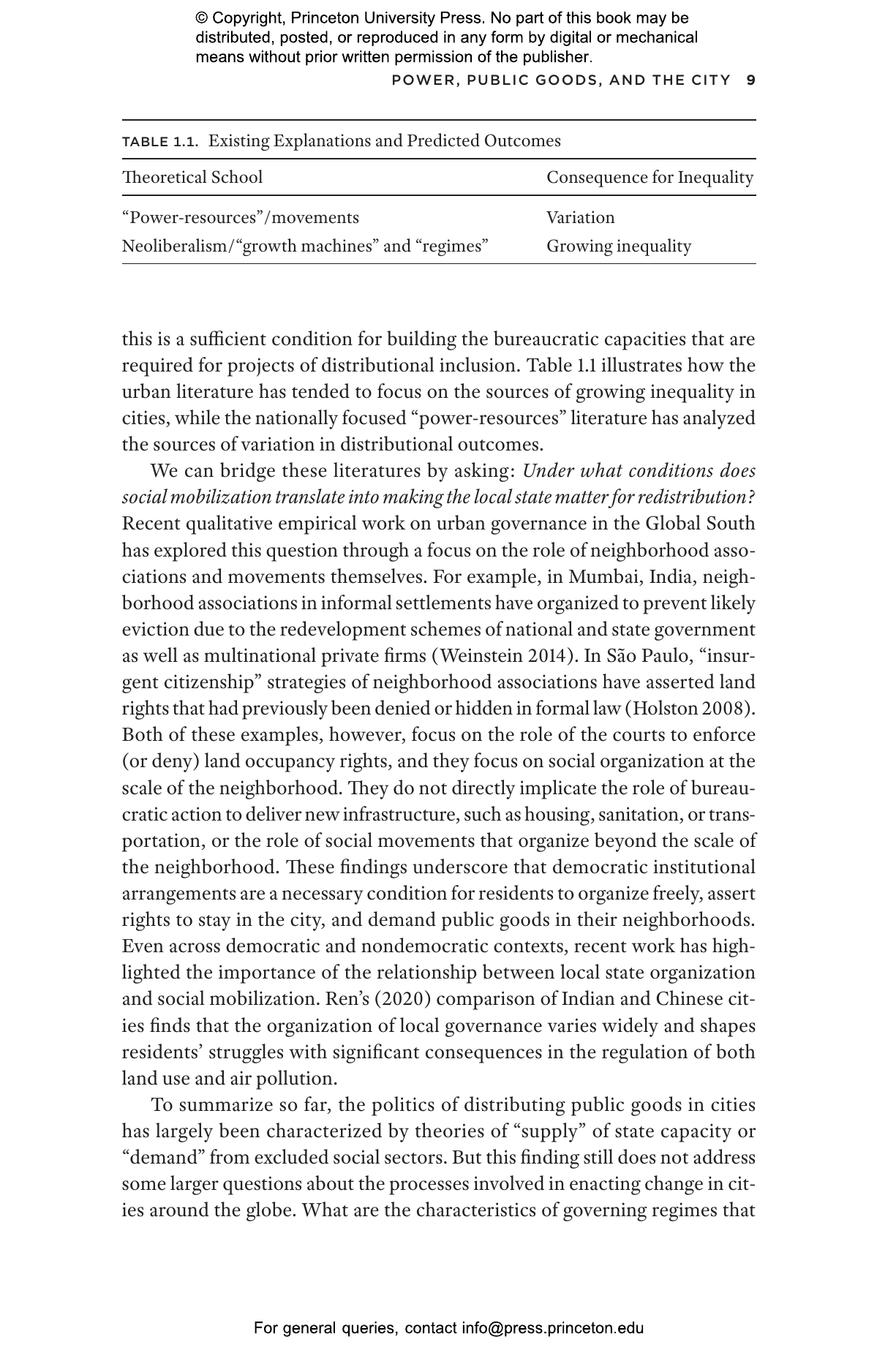
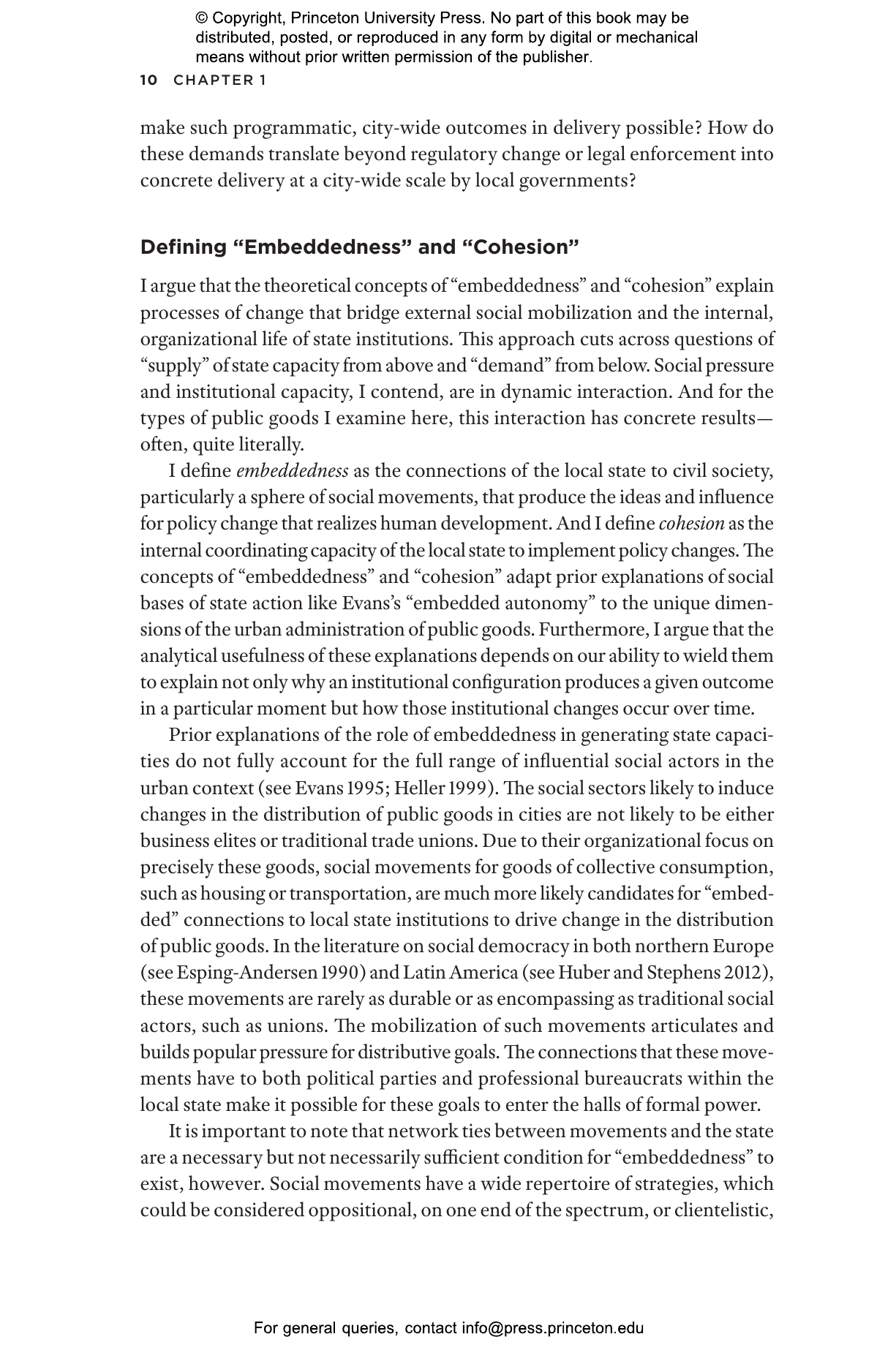
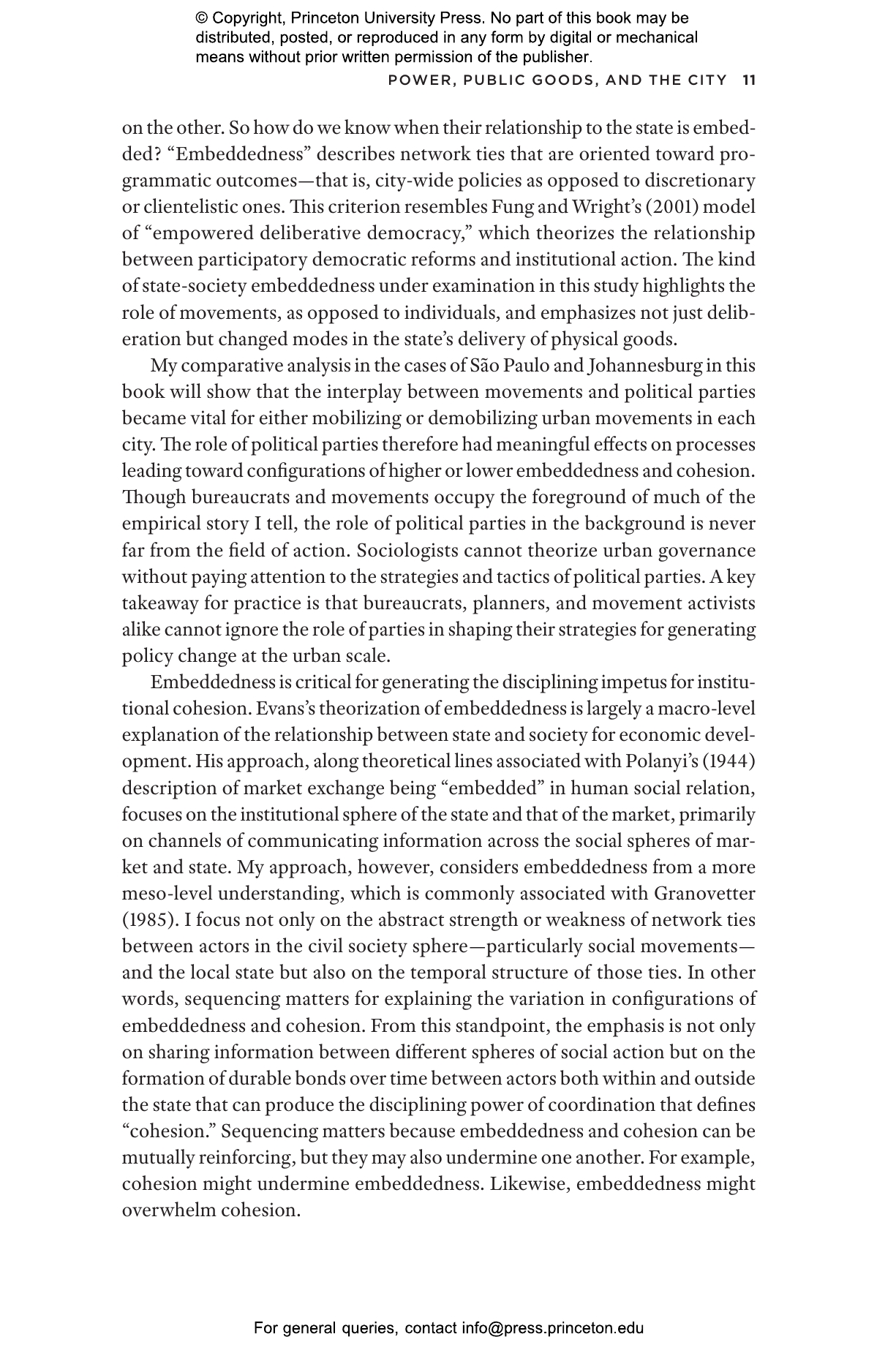
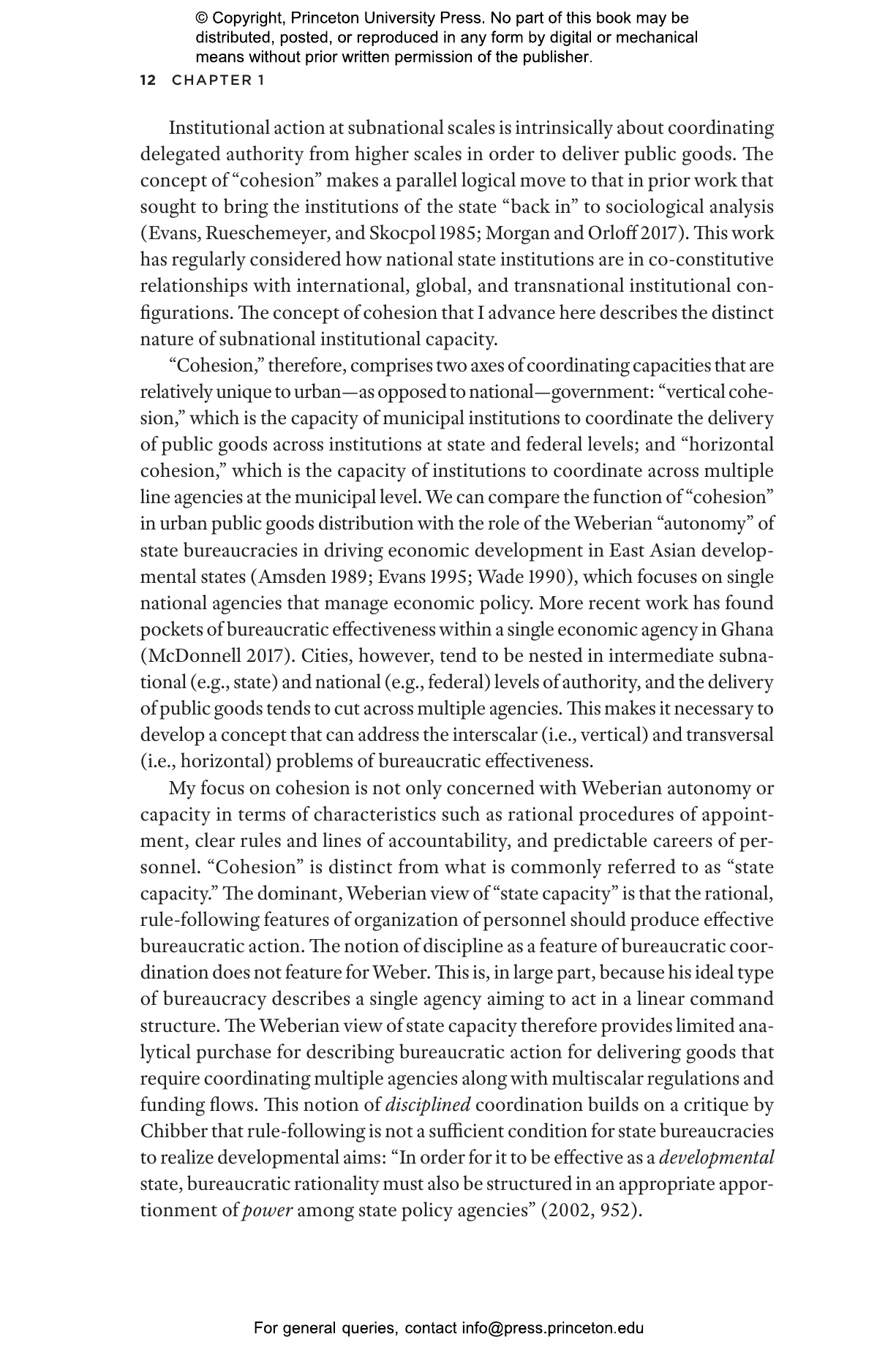
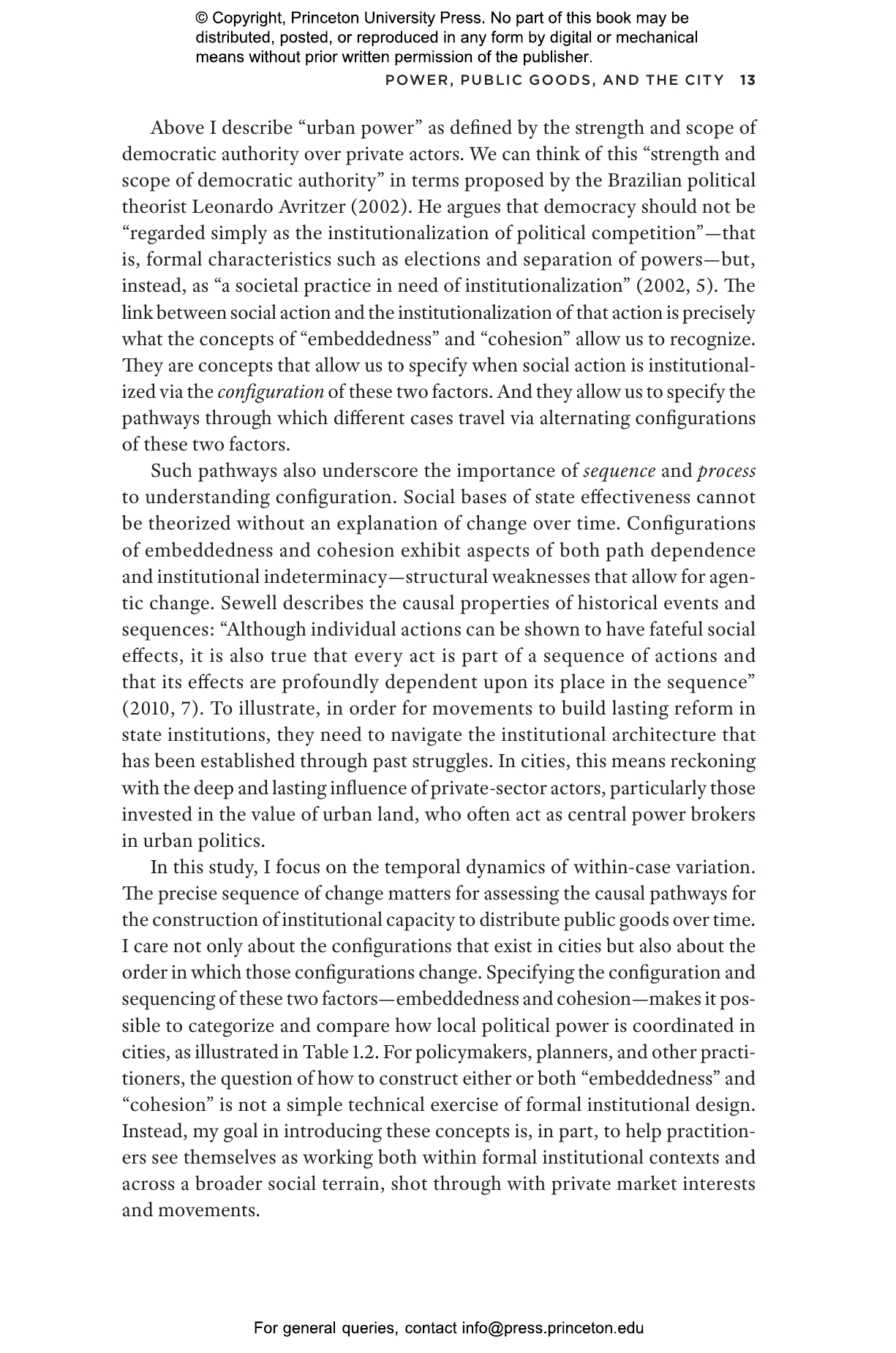
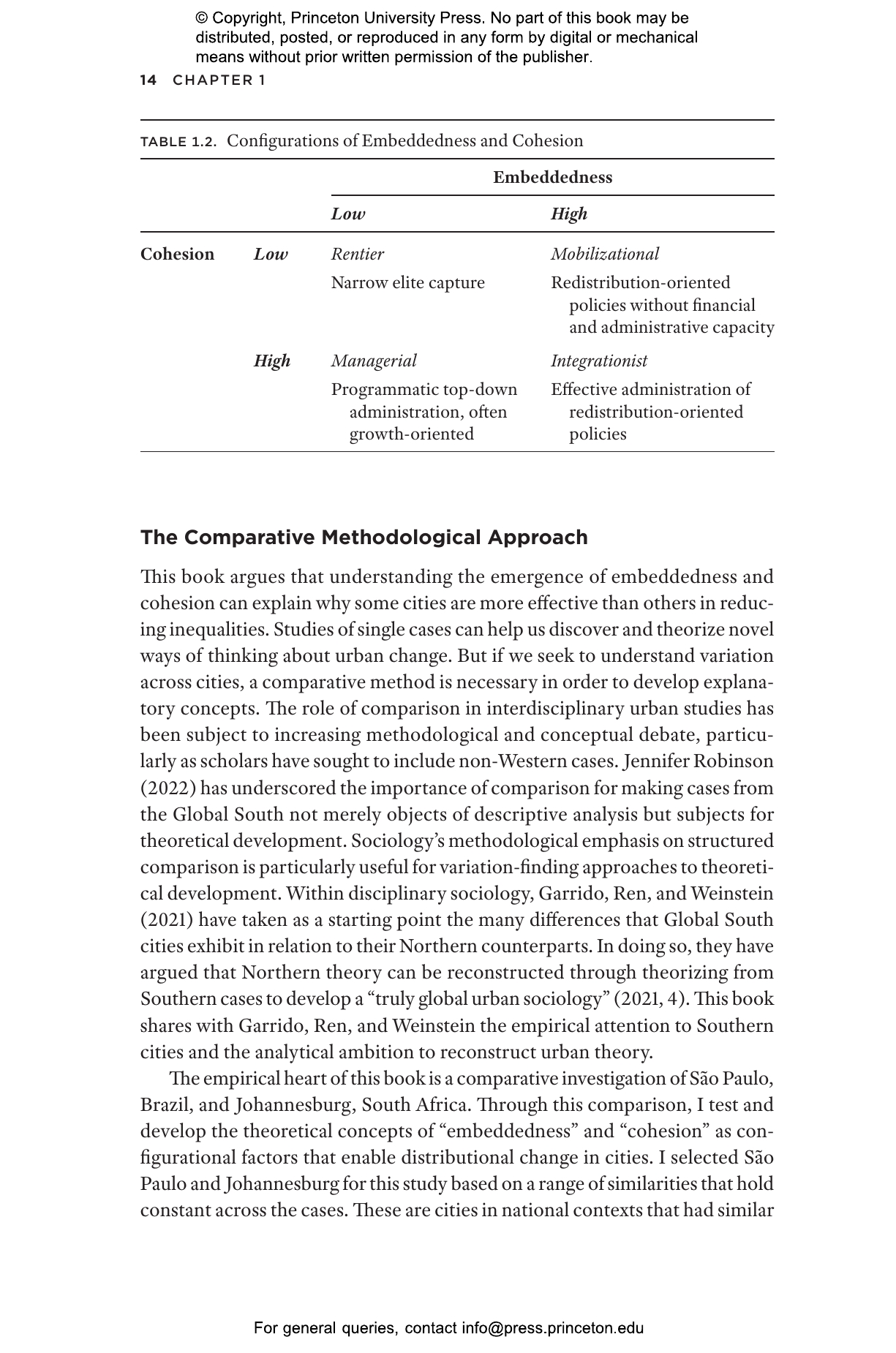
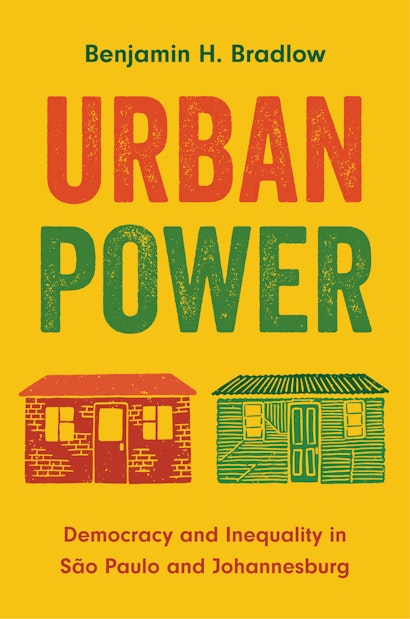
For the first time in history, most people live in cities. One in seven are living in slums, the most excluded parts of cities, in which the basics of urban life鈥攊ncluding adequate housing, accessible sanitation, and reliable transportation鈥攁re largely unavailable. Why are some cities more successful than others in reducing inequalities in the built environment? In Urban Power, Benjamin Bradlow explores this question, examining the effectiveness of urban governance in two 鈥渕egacities鈥� in young democracies: S茫o Paulo, Brazil, and Johannesburg, South Africa. Both cities came out of periods of authoritarian rule with similarly high inequalities and similar policy priorities to lower them. And yet S茫o Paulo has been far more successful than Johannesburg in improving access to basic urban goods.
Bradlow examines the relationships between local government bureaucracies and urban social movements that have shaped these outcomes. Drawing on sixteen months of fieldwork in both cities, including interviews with informants from government agencies, political leadership, social movements, private developers, bus companies, and water and sanitation companies, Bradlow details the political and professional conflicts between and within movements, governments, private corporations, and political parties. He proposes a bold theoretical approach for a new global urban sociology that focuses on variations in the coordination of local governing power, arguing that the concepts of 鈥渆mbeddedness鈥� and 鈥渃ohesion鈥� explain processes of change that bridge external social mobilization and the internal coordinating capacity of local government to implement policy changes.
Awards and Recognition
- A New Urban Order Must-Read Book About Cities
- Winner of the Best Book Award, Subnational Politics and Society Section of the Latin American Studies Association
- Honorable Mention for the Best Book Award, Sociology of Development Section of the American Sociological Association
- Winner of the Charles Tilly Best Book Award, Collective Behavior and Social Movements section of the American Sociological Association
- Shortlisted for the Alice Amsden Best Book Award, Society for the Advancement of Socioeconomics
- Finalist for the Political and Social Sciences Book Award, Foreword INDIES
- Shortlisted for the Distinguished Contribution to Scholarship Book Award, Political Sociology Section of the American Sociological Association
"Urban Power is a landmark contribution to the study of urban governance and inequality, particularly in new democracies where addressing persistent patterns of social and spatial exclusion and improving the quality of life for slum residents are urgent priorities."鈥擨van Souza Vieira, International Journal of Urban and Regional Research
"Urban Power offers an important and intriguing comparison of two cities, and a theoretical framework that should propel research on development and the local state for years to come"鈥擬arcel Paret, The Journal of Development Studies
"Bradlow’s book illuminates how rapid urbanisation, entrenched inequality and fiscal constraints intersect. . . . For anyone interested in the politics of making cities fairer, it is essential reading."鈥擜strid R.N. Haas, The Conversation
"Benjamin Bradlow delivers an illuminating account of urban governance processes and their potential to reduce inequality. . . . Urban Power is a must-read to understand the factors underlying urban inequality and the pivotal role of civil society in urban development."鈥擲im贸n Escoffier, Perspectives on Politics
"Bradlow confronts one of the most urgent and elusive challenges of our urban age: how can democratic governance reduce inequality in cities that were built to entrench it? The book’s answer is at once intuitive and analytically original. . . . [An] important contribution."鈥擬anuel Schechtl, Social Forces
"Urban Power performs an essential service by bringing the city and its political institutions back into the study of democracy and development. . . . Bradlow's book offers valuable lessons for activists seeking to influence state power and achieve meaningful reform. His insights point toward a vision of citizen-centered city-making, one in which all residents are able to derive social and economic value from the urban spaces they inhabit. Yet as the case of Johannesburg makes clear, such transformations depend on more than grassroots mobilization, political turnover, or legal reform. They require urban power."鈥擩effrey W. Paller, European Journal of Sociology
"[Urban Power] displays the power of effective South–South comparison, through his analysis of Johannesburg and S茫o Paulo. . . . The book is beautifully crafted with careful attention paid to the reporting of the empirical work. The granular accounts of respondents’ experiences provide a rich tapestry for the theorizing it enables."鈥擭ancy Odendaal, Journal of the American Planning Association
"Urban Power is a praiseworthy entry in the growing ranks of serious comparative urban analyses; it’s a wonderful, illuminating book that deserves the attention of every urbanist."鈥擩erome Hodos, Contemporary Sociology
"Urban Power is an exemplary work of comparative urban scholarship. It advances theory, delivers original empirical insights, and speaks directly to pressing normative and policy debates about inequality, democracy, and governance in the Global South and beyond."鈥擫uciana de Souza Le茫o, The British Journal of Sociology
"A masterclass. . . . With Urban Power, Bradlow not only establishes himself as one of the foremost scholars of cities in the Global South but also advances an urgent research agenda on urban governance and inequality. This is an ambitious book with wide-ranging applications. It will no doubt prove influential."鈥擩eremy R. Levine, American Journal of Sociology
"This excellent work. . . . argues for a ground-level fieldwork approach to understanding why some cities are better than others at lessening inequality as experienced by their least powerful citizens."鈥�Choice
"The proposed conceptual matrix allows the theoretical findings of the research to travel to and be tested in other cities in the Global South and beyond."鈥擬ariana Pinheiro de Carvalho, Brazilian Political Science Review
“Urban Power sheds light on the complexities of urban governance in two distinct cities known for their social movement activism. Bradlow shows that the way in which authorities engage with each other and with residents has great consequences for the advancement of democratic ideals. His argument is presented with care, insight, detailed documentation, and a commitment to critical inquiry.”—Diane E. Davis, Harvard University
“Benjamin Bradlow offers a bold recipe for solving global poverty: strong states with ties to strong social movements can deliver public goods to the poorest of the world's poor. Through impressive fieldwork and clear conceptualizations, Bradlow gives us an answer to the most important question of our day. This book will launch an entirely new conversation in sociology.”—Monica Prasad, author of The Land of Too Much
“Large cities in the Global South present us with tremendous contrasts: informal settlements next to luxury gated neighborhoods, heart-wrenching exclusion alongside innovative redistributive policies, and governing institutions that can seem simultaneously responsive and indifferent to popular demands. Benjamin Bradlow's landmark book compares attempts to reduce inequality in S茫o Paulo and Johannesburg in recent decades, while developing a framework of urban power that is sure to inspire further research and debate in many other contexts. Carefully researched and sharply argued, this book is a wonderful exemplar of what a truly global urban sociology can be.”—Gianpaolo Baiocchi, author of We, the Sovereign
This publication has been produced to meet accepted Accessibility standards and contains various accessibility features including concise image descriptions, a table of contents, a page list to navigate to pages corresponding to the print source version, and elements such as headings for structured navigation. Appearance of the text and page layout can be modified according to the capabilities of the reading system.
Accessibility Features
-
WCAG v2.2
-
WCAG level AA
-
Table of contents navigation
-
Single logical reading order
-
Short alternative textual descriptions
-
Print-equivalent page numbering
-
Landmark navigation
-
Index navigation
-
Epub Accessibility Specification 1.1
-
ARIA roles provided
-
All non-decorative content supports reading without sight
-
No known hazards or warnings