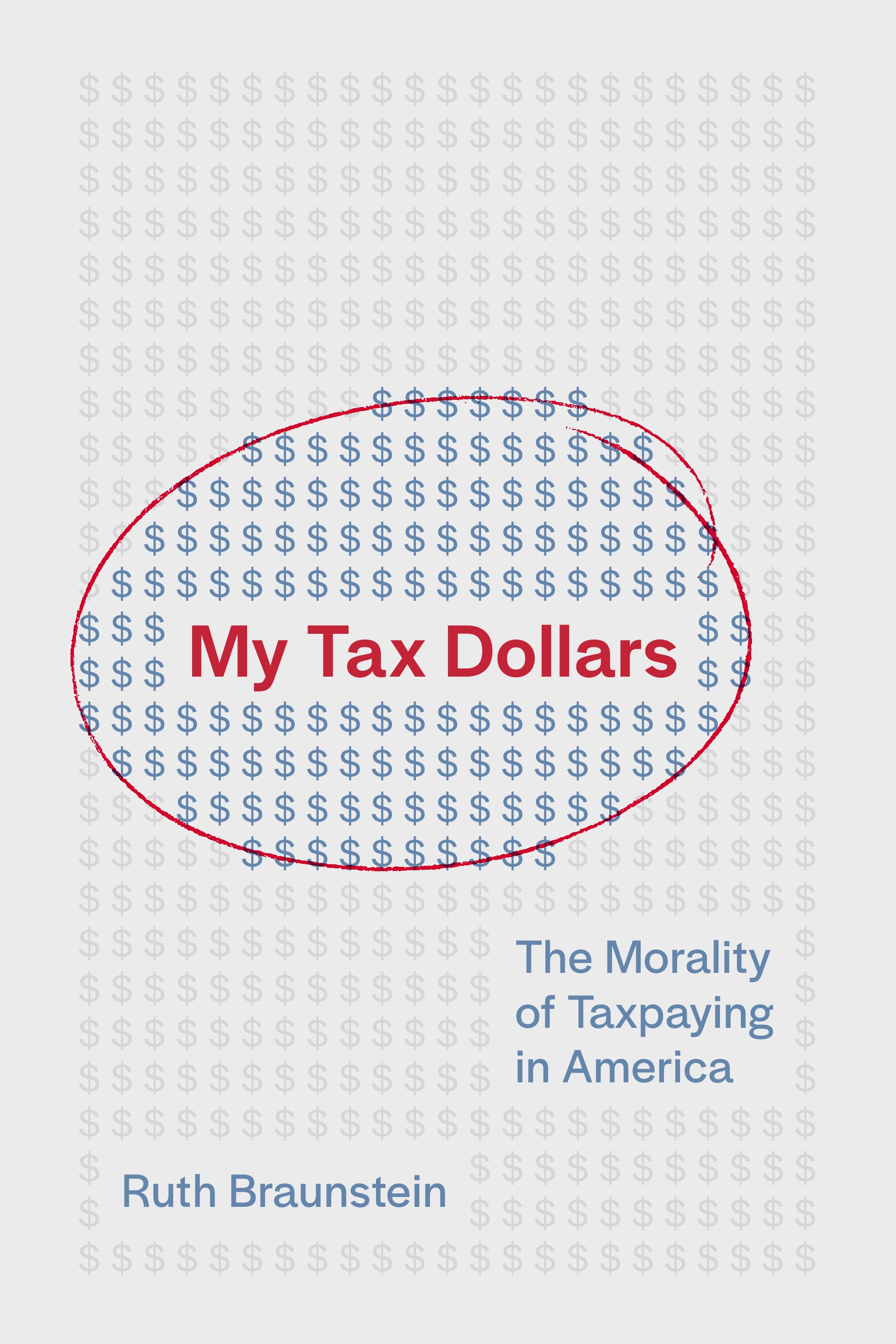
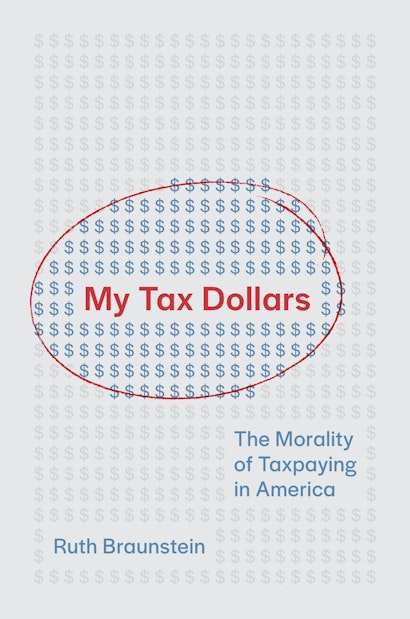
In My Tax Dollars, Ruth Braunstein maps the contested moral landscape in which Americans experience and make sense of the tax system. Braunstein tells the stories of Americans who view taxpaying as more than a mundane chore: antigovernment tax defiers who challenge the legitimacy of the tax system, antiwar activists who resist the use of their taxes to fund war, antiabortion activists against 鈥渢axpayer funded abortions,鈥� and a diverse group of people who promote taxpaying as a moral good.
Though taxpaying is often portrayed as dull and technical, exposure to collective rituals, civic education, propaganda, and protest transforms the practice for many Americans into either a sacred rite of citizenship or a profane threat to what they hold dear. These sacred and profane meanings can apply to the act of taxpaying itself or to the specific uses of tax dollars. Despite intense disagreement about these meanings, politically diverse Americans engaged in both taxpaying and tax resistance valorize the individual taxpayer and 鈥渕y tax dollars.鈥�
Braunstein explores the profound implications of this meaning making for tax consent, the legitimacy of the tax system, and citizens鈥� broader understandings of their political relationships. Going beyond the usual focus on tax policy, Braunstein鈥檚 innovative view of taxation through the lens of cultural sociology shows how citizens in value-diverse societies coalesce around shared visions of the sacred and fears of the profane.
Awards and Recognition
- A Behavioral Scientist Notable Book of the Year
- Winner of the Mary Douglas Prize for Best Book, Culture Section of the American Sociological Association
"[My Tax Dollars] serves as a reminder that political tax debate is rarely about the details of tax policy. . . . [A] valuable work, shedding much needed light on America’s fiscal institutions as seen from the eyes of actual American taxpayers."鈥擩oseph Thorndike, Forbes
"In her new book My Tax Dollars: The Morality of Taxpaying in America, Ruth Braunstein describes how the US government’s primary objective when introducing the nation’s first income tax was to frame taxpaying as something utterly mundane. . . . [She] reveals how, under certain conditions, the simple ritual of taxpaying can become something sacred. It is, after all, one of the very few rituals all Americans still share."鈥擟arey Mott, Los Angeles Review of 快色直播
"Ambitious. . . . My Tax Dollars establishes an important phenomenon and opens newlines of inquiry. I expect that it will be an important book for scholars of political and economic sociology."鈥擨saac William Martin, Social Forces
"Insightful. . . . My Tax Dollars is highly readable and engaging. Braunstein has uncovered many colorful characters and movements. . . . Her account helps us understand Americans’ many contradictory feelings about taxes and the implications of the sacred and profane, of individualism and pluralism, for democratic governance."鈥擜ndrea Louise Campbell, Perspectives on Politics
“In this wonderful new book, Ruth Braunstein reminds us that budgets are, inherently, moral documents. This book shows how the seemingly banal issue of taxes is actually vital to the articulation of the priorities and values of our society. At a time when many are seeking to cut taxes, regulations, and societal investments, Braunstein shows us why we must reconsider this from a moral and ethical perspective.”—Rev. Jim Wallis, Georgetown University
“With stunning analytic insight and gripping evidence, Ruth Braunstein transforms our understandings of the US tax system. My Tax Dollars turns seemingly dull financial ledgers into compelling cultural and social documents. A major contribution to economic and cultural sociology, the book will fascinate readers beyond the academy.”—Viviana A. Zelizer, author of Economic Lives: How Culture Shapes the Economy
“My Tax Dollars hits the intellectual jackpot. Alongside colorful portraits of tax propagandists, enthusiasts, resisters, and the ordinary Americans who dutifully, if grudgingly, file returns every April, Ruth Braunstein shows that our views of taxes are really about what we believe we owe each other as citizens. The surprise is not that in a fractured political landscape, those beliefs conflict. The surprise is that all parties to the debate, progressives as much as conservatives, venerate the individual ‘taxpayer,’ who contributes only to get something back—a decidedly contractual idiom that forecloses a more solidary understanding of citizenship. A stunningly original book.”—Francesca Polletta, author of Inventing the Ties that Bind: Imagined Relationships in Moral and Political Life
“The book is a masterclass on weaving together different kinds of sources, from Supreme Court decisions to ethnography to fiction books. Bringing together an extraordinary range of evidence, Braunstein examines how and why taxation is viewed as sacred, profane, or mundane.”—Vanessa Williamson, Brookings Institution
“This book is at once a sophisticated theoretical work, a really novel empirical treatment about a very controversial social fact, and remarkably well written. I am confident it will become a standard text in economic and cultural sociology.”—Jeffrey Alexander, Yale University
This publication has been produced to meet accepted Accessibility standards and contains various accessibility features including a table of contents, a page list to navigate to pages corresponding to the print source version, and elements such as headings for structured navigation. Appearance of the text and page layout can be modified according to the capabilities of the reading system.
Accessibility Features
-
Inaccessible, or known limited accessibility
-
No known hazards or warnings