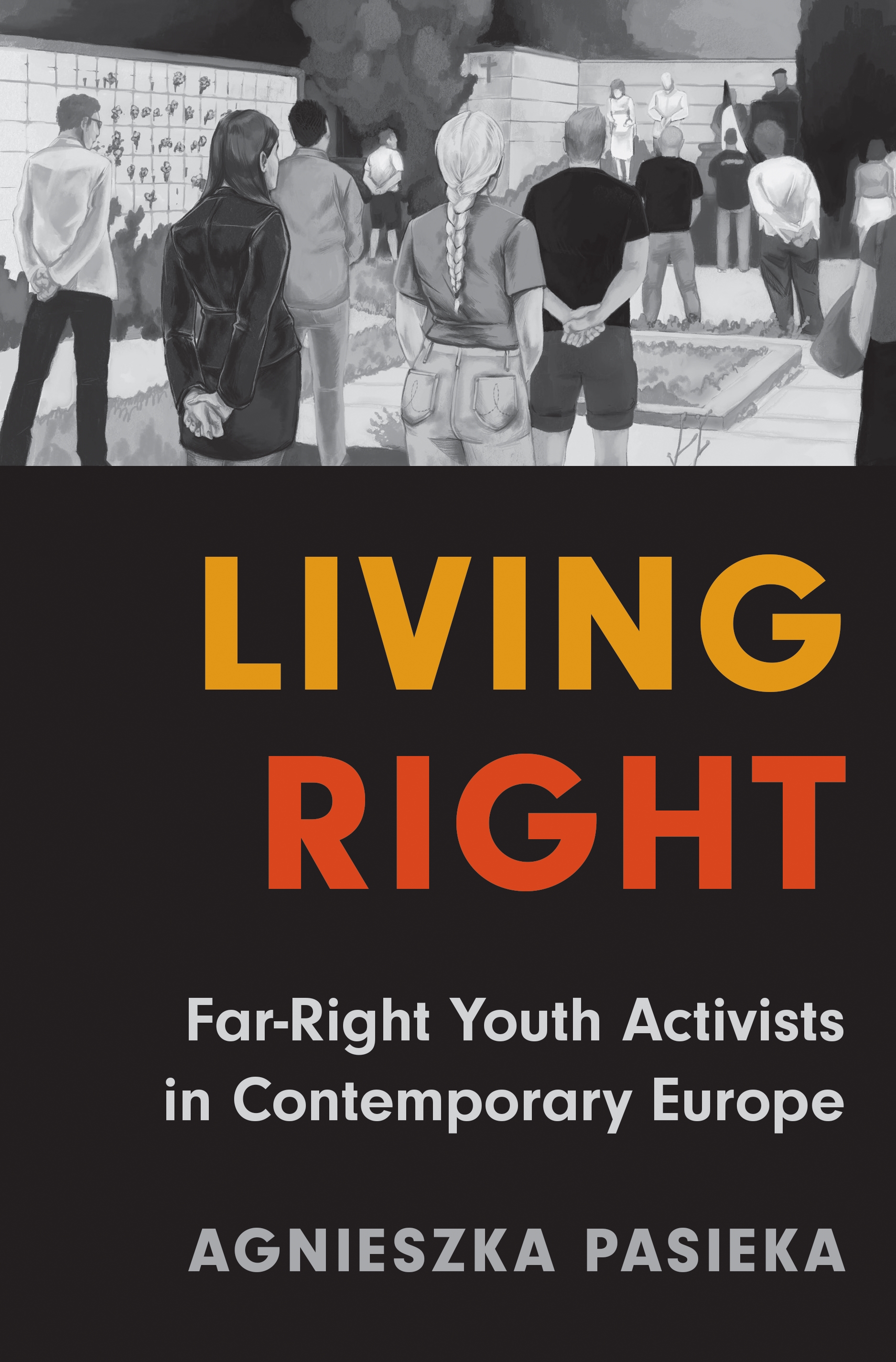
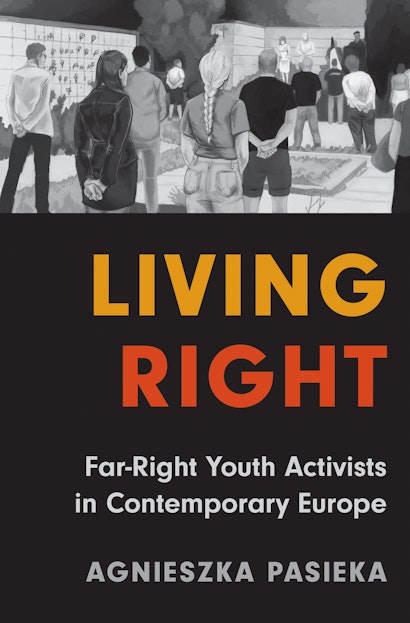
Radical nationalism is on the rise in Europe and throughout the world. Living Right provides an in-depth account of the ideas and practices that are driving the varied forms of far-right activism by young people from all walks of life, revealing how these social movements offer the promise of comradery, purpose, and a moral calling to self-sacrifice, and demonstrating how far-right ideas are understood and lived in ways that speak to a variety of experiences.
In this eye-opening book, Agnieszka Pasieka draws on her own sometimes harrowing fieldwork among Italian, Polish, and Hungarian militant youths, painting unforgettable portraits of students, laborers, entrepreneurs, musicians, and activists from well-off middle class backgrounds who have all found a nurturing home in the far right. Providing an in-depth account of radical nationalist communities and networks that are taking root across Europe, she shows how the simultaneous orientation of these groups toward the local and the transnational is a key to their success. With a focus on far-right morality that challenges commonly held ideas about the right, Pasieka describes how far-right movements afford opportunities to the young to be active members of tightly bonded comradeships while sharing in a broader project with global ramifications.
Required reading for anthropologists and anyone concerned about the resurgence of far-right militancy today, Living Right sheds necessary light on the forces that have made the growing appeal of fascist idealism for young people one of the most alarming trends of our time.
Awards and Recognition
- Honorable Mention for the Kulczycki Book Prize in Polish Studies, Association for Slavic, East European, and Eurasian Studies
- Honorable Mention for the Wayne S. Vucinich Book Prize, Association for Slavic, East European, and Eurasian Studies
- Honorable Mention for the William A. Douglass Prize, American Anthropological Association
Agnieszka Pasieka is assistant professor of anthropology at the University of Montreal. She is the author of Hierarchy and Pluralism: Living Religious Difference in Catholic Poland.
"Pasieka’s fieldwork shows how these individuals from diverse backgrounds, including students, laborers, entrepreneurs, and musicians, are drawn to fascist movements because of the community, purpose, and answers to personal and social anxieties they offer. Her analysis reveals that far-right activism is less about violence and more about ordinary practices—e.g., soup kitchens, sporting events, communal readings—that foster belonging and ideological commitment. . . . [A]n important contribution."鈥�Choice
"Living Right is a beautifully written manuscript that offers rare combination of rich ethnography and theoretical insights. It has wonderful empirical case evidence that is constantly intertwined and infused with deep theoretical premises and implications. And it is a breath of fresh air methodologically, particularly in the ways the author reflects on the challenges of undertaking ethnographic fieldwork during a postdissertation fieldwork phase of life, especially for women who might want to have children during those years. . . . This is a book that should be read not only by scholars of the far right but also by social scientists who study Europe, social movements, and activism, by ethnographic researchers, and by anyone interested in the intersections of politics, morality, emotions, and radicalization and mobilization to extremism."鈥擟ynthia Miller-Idriss, Perspective on Politics
“An ethnographic tour de force. Theoretically sophisticated and empirically rich, the book abounds with deep insights on the nature of political ideology, the importance of community, and contemporary challenges to social solidarity. Living Right is indispensable reading for anyone seeking to understand far-right movements.”—Genevi猫ve Zubrzycki, author of Resurrecting the Jew: Nationalism, Philosemitism, and Poland’s Jewish Revival
“This beguiling book resolves questions that have paralyzed anthropological inquiry into contemporary fascism. Pasieka navigates the complex transnational field of fascist activism across diverse settings and locales with acute insight and arresting candor, revealing how fascism seeks to colonize every expression of intimacy, personhood, and belonging.”—Douglas R. Holmes, author of Integral Europe: Fast-Capitalism, Multiculturalism, Neofascism
This publication has been produced to meet accepted Accessibility standards and contains various accessibility features including concise image descriptions, a table of contents, a page list to navigate to pages corresponding to the print source version, and elements such as headings for structured navigation. Appearance of the text and page layout can be modified according to the capabilities of the reading system.
Accessibility Features
-
WCAG v2.2
-
WCAG level AA
-
Table of contents navigation
-
Single logical reading order
-
Short alternative textual descriptions
-
Print-equivalent page numbering
-
Landmark navigation
-
Index navigation
-
Epub Accessibility Specification 1.1
-
ARIA roles provided
-
All non-decorative content supports reading without sight
-
No known hazards or warnings