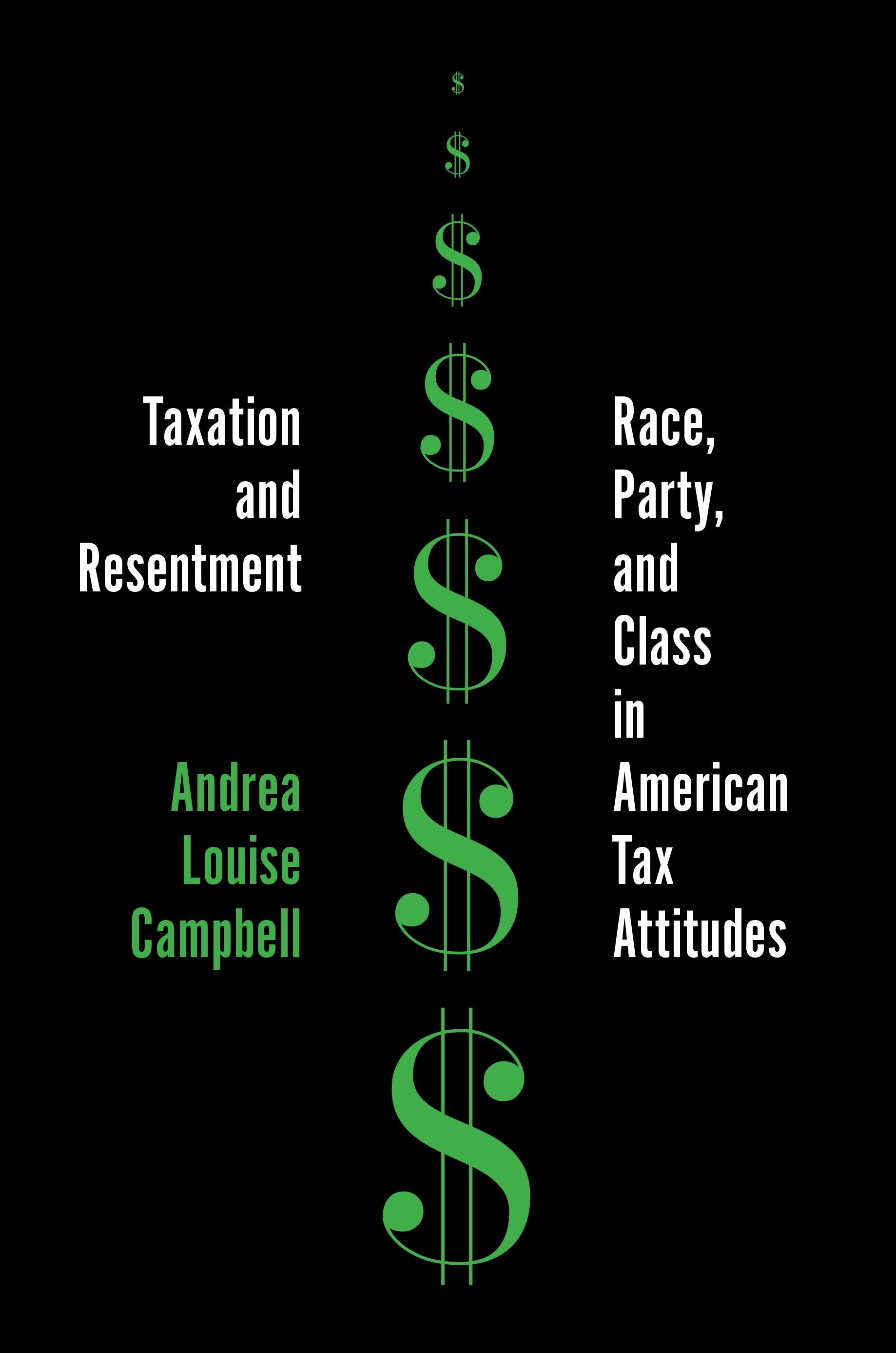
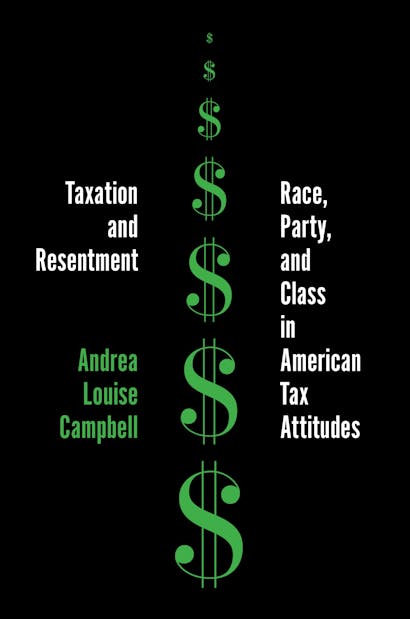
Most Americans support progressive taxation in principle, and want the rich to pay more. But the specific tax policies that most favor are more regressive than progressive. What is behind such a disconnect? In this book, Andrea Louise Campbell examines public opinion on taxation, exploring why what Americans favor in principle differs from what they accept in practice. Campbell shows that since the federal income tax began a century ago, the rich have fought for lower taxes through reduced rates and a complicated system of tax breaks. The resulting complexity leaves the public confused about who benefits from the convoluted tax code, and leads to tax preferences that are driven by factors other than principles or interests.
Campbell argues that tax attitudes vary little by income, or by party, as some Democrats, more Republicans, and even more independents want most taxes decreased. Instead, white opinion on nearly every tax is racialized. Many do not realize the rich benefit the most from tax breaks, attitudes toward which are racialized, too. And among Black and Hispanic Americans, long subject to government coercion, greater support for government spending is not matched by greater support for taxation. Everyone has a reason to dislike taxes, which helps antitax Republicans win votes鈥攁nd helps the rich in their long campaign to get their own taxes reduced and undermine progressivity.
Awards and Recognition
- Winner of the Best Book Award, Class and Inequality Section of the American Political Science Association
Andrea Louise Campbell is the Arthur and Ruth Sloan Professor of Political Science at the Massachusetts Institute of Technology. She is the author of How Policies Make Citizens: Senior Activism and the American Welfare State and Trapped in America’s Safety Net: One Family’s Struggle (快色直播).
"Andrea Louise Campbell’s new book Taxation and Resentment: Race, Party, and Class in American Tax Attitudes argues that many Americans fundamentally misunderstand taxpaying, and so actively vote against their own interests. . . . Campbell finds that racial sentiment has the single largest influence on white Americans’ tax attitudes, with white taxpayers perceiving their tax dollars as aiding nonwhites—a resentful relationship dating to the post–Civil War era. Black and Brown communities, meanwhile, are generally wary of a coercive state, and often believe they are taxed unfairly."鈥擟arey Mott, Los Angeles Review of 快色直播
"Fascinating. . . . [and] provocative."鈥擜jay K. Mehrotra, Lawfare
"A richly detailed quantitative portrait of a reality that defies easy generalizations: Americans’ tax attitudes are many things, but one thing that they are not [as] coherent. Taxation and Resentment is likely to remain the authoritative description of American tax attitudes."鈥擨saac William Martin, Amerikastudien
“An important and very welcome addition to the literature on public attitudes about public policies, which has not received as much attention as it deserves, with rich and often unexpected findings.”—Martin Gilens, University of California, Los Angeles
“In Taxation and Resentment, Andrea Campbell demonstrates that the wealthy have capitalized on white voters’ racial resentment in undermining support for progressive taxation and in shaping a revenue system that disproportionately burdens Black and Latino Americans. This persuasive and original account makes an essential contribution to our understanding of the impact of public opinion on the development of a fundamental feature of the American state.”—Eric Schickler, University of California, Berkeley
“Taxation and Resentment is essential reading for anyone who wants to understand what Americans actually think about taxes. The scope of the data Campbell brings to bear on this question is unparalleled, and the depth of her analysis of public opinion across time and demography is a monumental achievement.”—Vanessa Williamson, Brookings Institution
This publication has been produced to meet accepted Accessibility standards and contains various accessibility features including concise image descriptions, a table of contents, a page list to navigate to pages corresponding to the print source version, and elements such as headings for structured navigation. Appearance of the text and page layout can be modified according to the capabilities of the reading system.
Accessibility Features
-
WCAG v2.2
-
WCAG level AA
-
Table of contents navigation
-
Single logical reading order
-
Short alternative textual descriptions
-
Print-equivalent page numbering
-
Landmark navigation
-
Index navigation
-
Epub Accessibility Specification 1.1
-
ARIA roles provided
-
All non-decorative content supports reading without sight
-
No known hazards or warnings