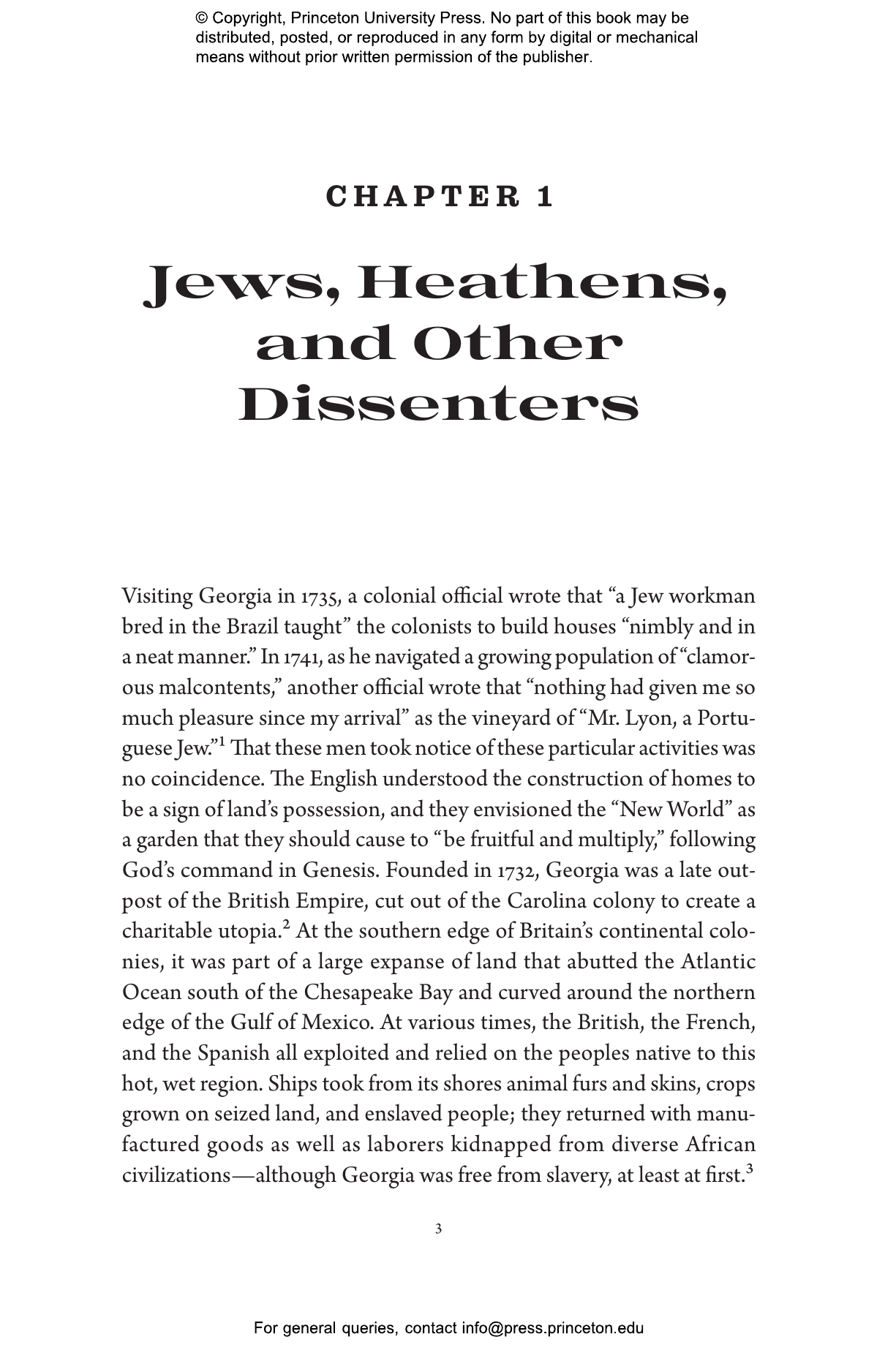
In 1669, the Carolina colony issued the Fundamental Constitutions of Carolina, which offered freedom of worship to 鈥淛ews, heathens, and other dissenters,鈥� ushering in an era that would see Jews settle in cities and towns throughout what would become the Confederate States. The Jewish South tells their stories, and those of their descendants and coreligionists who followed, providing the first narrative history of southern Jews.
Drawing on a wealth of original archival findings spanning three centuries, Shari Rabin sheds new light on the complicated decisions that southern Jews made鈥攁s individuals, families, and communities鈥攖o fit into a society built on Native land and enslaved labor and to maintain forms of Jewish difference, often through religious innovation and adaptation. She paints a richly textured and sometimes troubling portrait of the period, exploring how southern Jews have been targets of antisemitism and violence but also complicit in racial injustice. Rabin considers Jewish immigration and institution building, participation in the Civil War, the 1915 lynching of Leo Frank, and Jewish support for and resistance to the modern fight for Black civil rights. She examines shifting understandings of Jewishness, highlighting both the reality of religious diversity and the ongoing role of Christianity in defining the region.
Recovering a neglected facet of the American experience, The Jewish South enables readers to see the South through the eyes of people with a distinctive religious heritage and a southern history older than the United States itself.
Awards and Recognition
- Shortlisted for the National Jewish Book Award in Nonfiction, Jewish Book Council
"[An] engaging study. . . . [Rabin’s] deep archival research reveals how Jews participated in and were shaped by a dominant culture in which their status could be uncertain. . . . A rich account of how the Jewish minority claimed its place in Southern culture even as it retained its identity."鈥�Kirkus Reviews
"Crucial."鈥擱ien Fertel, New Orleans Advocate
"Comprehensive. . . . The Jewish South is a compelling narrative of the complex relationship between Southern Jews and the region they called home."鈥擬artin Green, Jewish Book Council
"The book is a triumph in both breadth and depth. It will anchor the field of Southern Jewish history while also making these fascinating stories and insights accessible to a broad readership."鈥擠avid Weinfeld, Jewish History
"Incisively researched and filled with surprising connections, the book offers a reimagined map of American Jewish history. . . . The Jewish South is a compelling decentralization of the American Jewish story, revealing that the South, too, has always been a Jewish place."鈥擡tan Nechin, Haaretz
"The Jewish South is based on an impressive mastery of secondary sources and lesser-known materials from the archives. The work is significant as a new reprise of the theory that US Jewish history develops along two fundamental subjective axes of the persecuted and the privileged. . . . This longstanding dialectic and paradox—Jewish freedom and African subjugation—infused with irony and ambivalence by generations of writing about ‘race’ in the US, continues to frame histories of Jewish life across the Americas and makes this narrative history a capacious and teachable book."鈥擡li Rosenblatt, American Religion
"To the growing literature on southern Jews, add Shari Rabin’s exceptional new book on the subject. In it, she has mined an extraordinary array of primary sources from across the region as well as a rapidly growing histography to tell a story that, while familiar to some readers, is executed with an intellectual framework and coherence that is fresh and compelling."鈥擬ark I. Greenberg, Journal of Southern History
"An exemplary work of scholarship. . . . Highly recommended."鈥�Choice
"Chapter brevity, combined with Rabin’s accessible, jargon-light prose make this book a tremendous resource for undergraduate instruction in Jewish studies, religious studies, and, indeed, American history."鈥擫aura Yares, American Historical Review
“The study of the Jewish South has come of age with the landmark publication of Shari Rabin’s transformational book. Telling this important story through the intersectional lens of race, religion, gender, and geography, Rabin skillfully leads readers into the complex ecologies of privilege and vulnerability southern Jews have navigated, from their settler colonial beginnings in the Caribbean and coastal South to the long civil rights movement.”—Marcie Cohen Ferris at University of North Carolina at Chapel Hill
“The Jewish South cuts through the romance and rhetoric that has swirled around Jews and the American South. Rabin provides instead a clear-eyed history of American Jews in this very particular region. She makes a brilliant case that southern Jewish history, while not separate from the history of Jews in other regions of the United States, stands in a class by itself. Unflinching in its analysis and clear in its writing, this book will be the standard against which all subsequent studies will have to be measured.”—Hasia R. Diner, author of Opening Doors: The Unlikely Alliance between the Irish and the Jews in America
“This magnificent synthesis of more than 350 years of Jewish life in the American South displays mastery of a large literature, graceful prose, and sensitivity to issues of religion and race. From now on, anyone who seeks to ‘turn to the South’ should turn first to this book.”—Jonathan D. Sarna, author of American Judaism: A History
“This panoramic history offers a compelling and colorful portrait of the Jewish experience in the South in all its complexity. Paying particular attention to race and religion—two defining features of the South—Rabin artfully explains how the region shaped Jewish life across more than three centuries. She does so by skillfully and sensitively recovering the voices of southern Jews. This will long be a landmark in the field.”—Adam D. Mendelsohn, author of Jewish Soldiers in the Civil War: The Union Army
This publication has been produced to meet accepted Accessibility standards and contains various accessibility features including concise image descriptions, a table of contents, a page list to navigate to pages corresponding to the print source version, and elements such as headings for structured navigation. Appearance of the text and page layout can be modified according to the capabilities of the reading system.
Accessibility Features
-
WCAG v2.2
-
WCAG level AA
-
Table of contents navigation
-
Single logical reading order
-
Short alternative textual descriptions
-
Print-equivalent page numbering
-
Landmark navigation
-
Index navigation
-
Epub Accessibility Specification 1.1
-
ARIA roles provided
-
All non-decorative content supports reading without sight
-
No known hazards or warnings