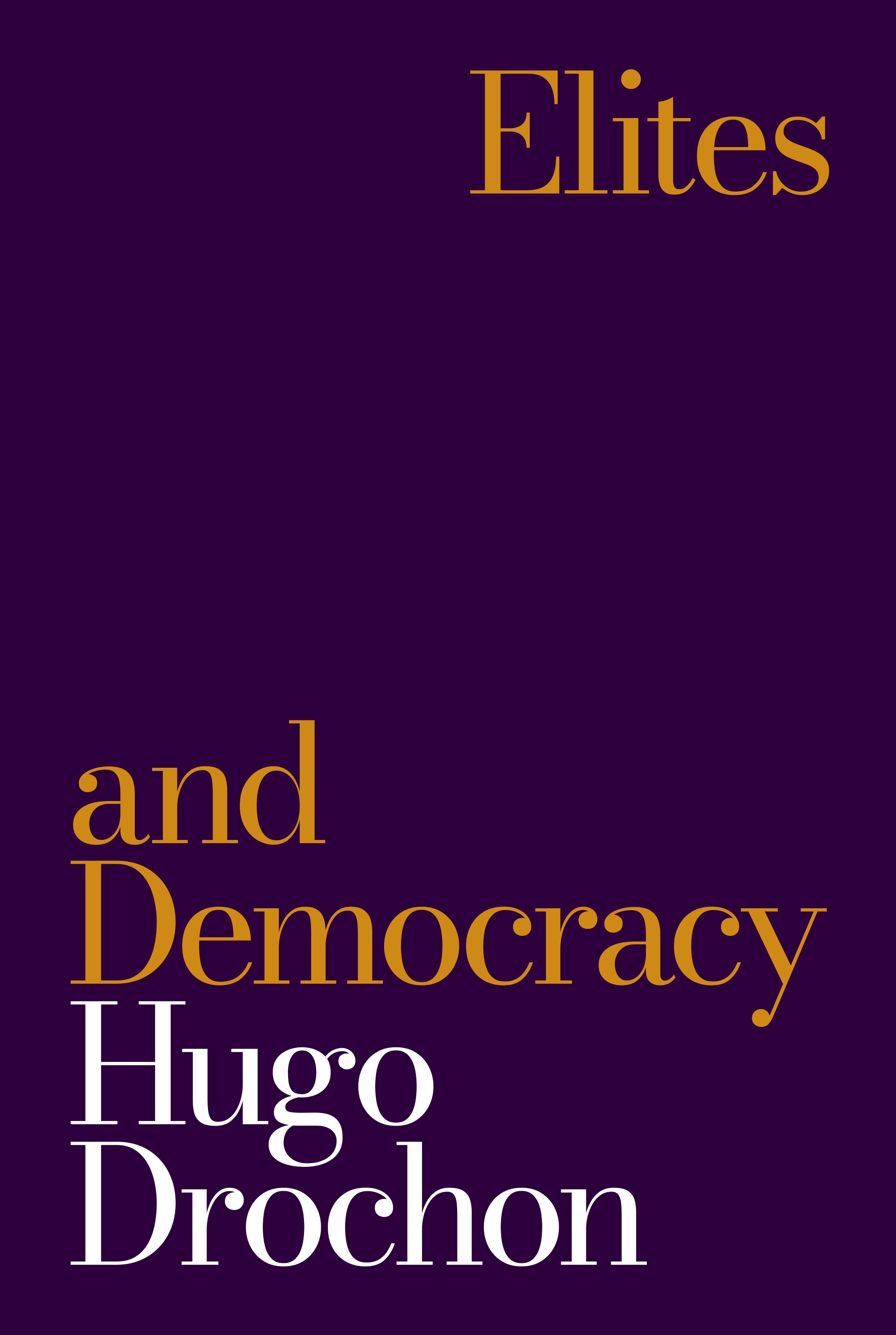
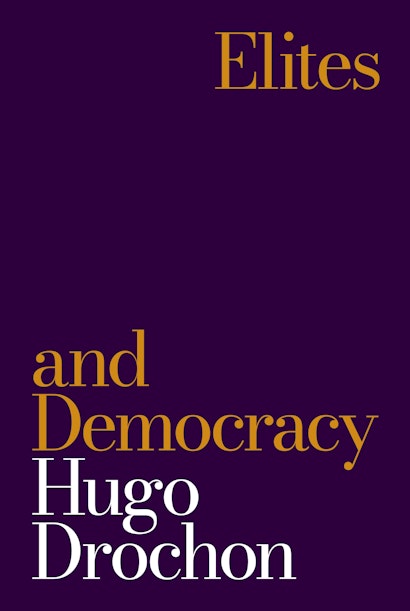
A central paradox of democracies is that they are always ruled by elites. What can democracy mean in this context? Today, it is often said that a populist revolt against elites is driving democratic politics throughout the West. But in Elites and Democracy, Hugo Drochon argues that democracy is more accurately and usefully understood as a perpetual struggle among competing elites鈥攂etween rising elites and ruling elites. Real political change comes from the interaction between social movements and elite political institutions such as parties. But, although true democracy鈥攖he rule of the people鈥攎ay never be achieved, striving towards it can bring about worthwhile democratic results.
At the turn of the twentieth century, Gaetano Mosca, Vilfredo Pareto, and Robert Michels put forward 鈥渆lite鈥� theories of democracy and gave us terms such as the 鈥渞uling class鈥� and 鈥渆lites鈥� itself. Drawing on their work and tracing the history of democratic thought through figures such as Joseph Schumpeter, Robert Dahl, C. Wright Mills, and Raymond Aron, Elites and Democracy reveals that this fundamentally elitist basis of democracy鈥攄emocracy understood as competition between elites鈥攚as there all along. The challenge is to think it anew.
Moving away from procedural or principled conceptions of democracy, Elites and Democracy develops a dynamic theory of democracy, one grounded in movement. With current politics defined by a populist backlash against elites, dynamic democracy offers the tools we urgently need to understand our contemporary predicament and to act upon it.
"Another way of explaining populism, suggested by Hugo Drochon in his new book, Elites and Democracy, is to see populist politics as 'the process of replacing one elite with another'. Trump and Farage may claim to be outsiders to the political mainstream but they are part of the elite — they just do not accept the established rules of the political game."鈥擩ason Cowley, The Times
"In his compelling book, Hugo Drochon argues that democracy contains the seeds of its own demise because it inevitably nurtures elites. Today, the word 'elite' has become a rhetorical Molotov cocktail the right and left toss into any debate. But it is crucial to understand the subtle ways in which elites operate and how they can turn democracy against itself. Drochon poses an ancient question: who really rules? He answers it with a clarity that feels, just now, like a form of intellectual resistance."鈥擳om Connolly,, The Arts Fuse
"As Hugo Drochon shows in his essential new book, Elites and Democracy, such harangues [against elites] gained momentum at the turn of the 20th century when European thinkers examined the composition of society and its representation by elected elites."鈥擱ichard Bourke, UnHerd
"In his new insightful book Elites and Democracy, Hugo Drochon tells the story of how the 'ruling class' and the 'iron law of oligarchy' came to dominate modern political life and theory."鈥擬ax Skj枚nsberg, Law & Liberty
"A cogent argument that democracies are always ruled by a minority. . . . A timely, provocative analysis of the nature of power in supposedly democratic polities."鈥�Kirkus Reviews
"Anyone who wants to grapple with the challenges of establishing participatory democracy in the modern world needs to read these theorists [Mosca, Pareto and Michels]—ideally, with Drochon’s clear and insightful book as a guide."鈥擭icholas Tampio, Contemporary Political Theory
"The book’s most significant theoretical contribution is the concept of dynamic democracy. Drochon accepts that elites will always rule but stresses that democratic health depends on their perpetual circulation. . . . This is an admirable and intellectually inspiring thesis. Drochon bridges radical democracy’s emphasis on movement and conflict with conservative realism about elite inevitability: if we want the dynamism of the former, we must accept the hard truths of the latter."鈥擜ris Trantidis, Democratization
"Clear and insightful."鈥擭icholas Tampio, Contemporary Political Theory聽
"Drochon does not offer hope in the conventional sense. What he offers instead is clarity. Democracy, he contends, is not the rule of the people, but the refusal to let power rule unchallenged. That struggle has no endpoint. But in continuing this Sisyphean task, we perform the only work democracy has ever truly required."鈥擲amuel Ross, Cascadian Advocate
"Intensively researched and soberly written….a nuanced, heavyweight contribution."鈥擜ndrew Lynch, The Irish Times
“Elites and Democracy offers a fresh and insightful examination of elite theory, showing its continued relevance to contemporary democratic systems. Revisiting the foundational thinkers—Mosca, Pareto, and Michels—Hugo Drochon brings historical depth and interpretive nuance to their work, treating their ideas not as historical artifacts but as powerful tools for analyzing the dynamics of modern power. By revitalizing elite theory for the twenty-first century, Drochon presents democracy not as a fixed structure, but as an ongoing struggle—marked by contestation, transformation, and resistance. This book is essential reading for those trying to understand today’s shifting political landscape and the enduring role of elites within it.”—Fernanda Gallo, Homerton College, University of Cambridge
“Elites and Democracy is lucid and engagingly written, taking on questions of unquestionable contemporary and theoretical importance. Drochon has produced a rich account of the history of elite theory and a provocative outline of an elite-focused, dynamic theory of democracy. Even for those who are not convinced, Drochon’s argument must be recognized and answered.”—John Medearis, author of Why Democracy Is Oppositional
“Drawing on the elitist tradition of democratic theory, Drochon confronts the paradox whereby democracy gives rise to oligarchy. In the spirit of Mosca, Pareto, and Michels, he develops a theory of ‘dynamic democracy’ as the continual challenge to elite rule. An important contribution to both the intellectual history and political theory of modern democracy.”—Richard Bellamy, University College London
“A fascinating and paradoxical study of democratic societies and the contest between elites that drives them...Tremendous.”—Matthew d’Ancona, The New World
This publication has been produced to meet accepted Accessibility standards and contains various accessibility features including a table of contents, a page list to navigate to pages corresponding to the print source version, and elements such as headings for structured navigation. Appearance of the text and page layout can be modified according to the capabilities of the reading system.
Accessibility Features
-
WCAG v2.2
-
WCAG level AA
-
Table of contents navigation
-
Print-equivalent page numbering
-
Next / Previous structural navigation
-
Landmark navigation
-
Index navigation
-
Epub Accessibility Specification 1.1
-
ARIA roles provided
-
All non-decorative content supports reading without sight
-
No known hazards or warnings