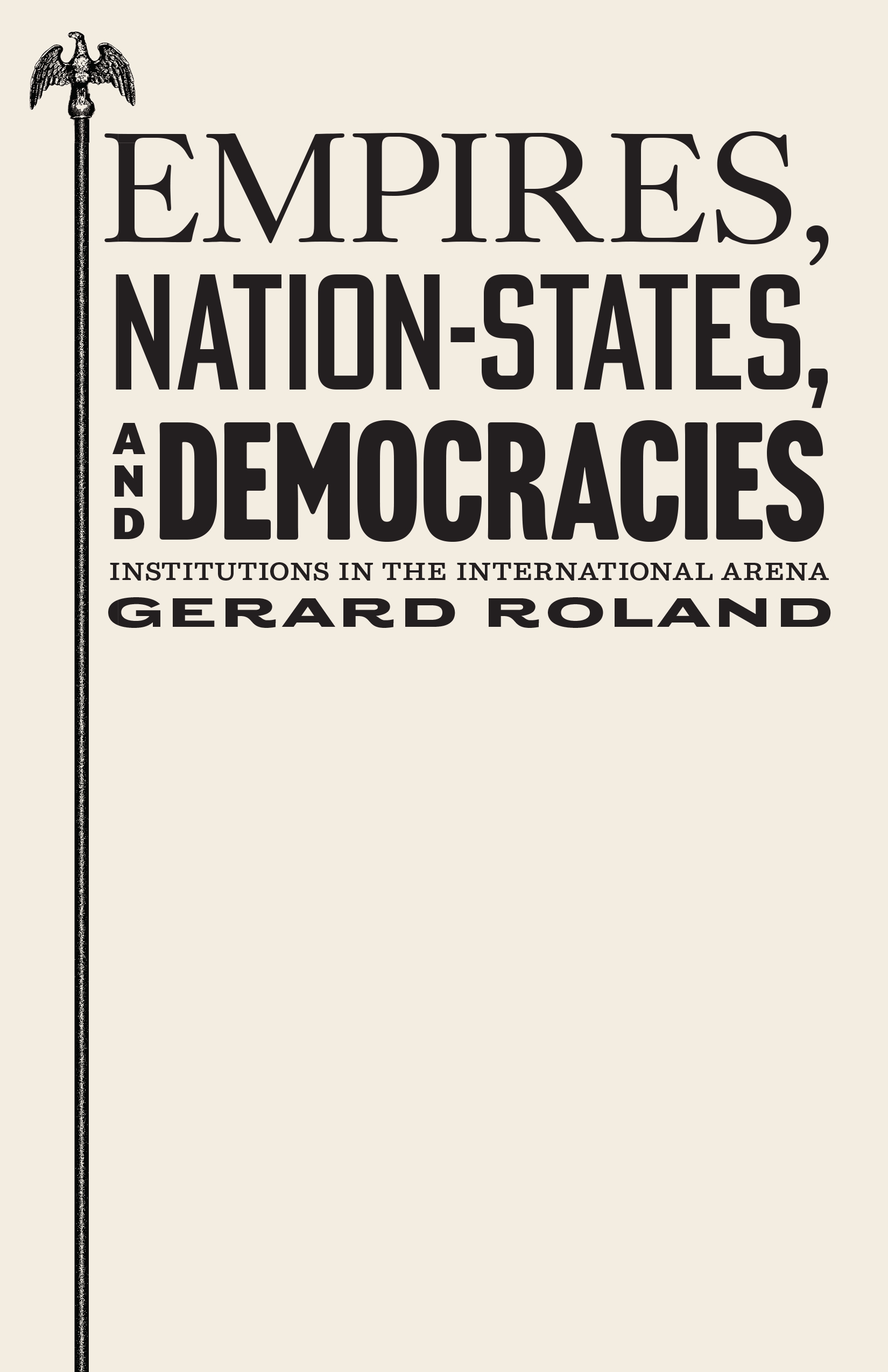
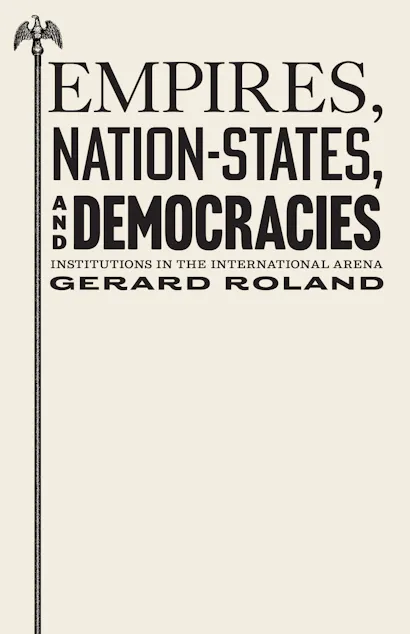
Today鈥檚 world is characterized by an unstable coexistence of empires, nation-states, and democracies. In this book, Gerard Roland examines these three fundamentally different institutional systems and considers whether the international behavior of nations is influenced by the nature of their political regimes. He explains that until the nineteenth century, international relations were driven by rivalries among competing empires; as empires started to disintegrate, they were replaced by nation-states, some of which became democracies. The nation-state project supported by today鈥檚 extreme right promotes ethnic homogeneity within a country鈥檚 borders, while democracies are based on universal values of citizenship. Interactions between countries with such essentially different political systems, Roland shows, are seldom harmonious and likely to evolve into cultural clashes and military conflict.
Drawing on his expertise in political and comparative economics, Roland analyzes why and how countries鈥� geopolitical behavior鈥攖heir actions and attitudes regarding war, peace, expansionism, and trade鈥攊s closely linked to their political systems. In the long run, he argues, the ethnically homogenous nation-state is doomed because of the strong economic inefficiencies entailed by economic nationalism and the lack of openness to immigration, trade, and foreign direct investment. A better path for the future of the international order, Roland suggests, would be a world of small democracies building supranational institutions on the basis of commonly accepted rules.
Gerard Roland is the E. Morris Cox distinguished emeritus professor of economics and professor of political science at the University of California, Berkeley. He is the author of Development Economics and Transition and Economics and the coauthor of Democratic Politics in the European Parliament.
"Gerard Roland has written one of the most creative books on international relations that I have read in decades. His novel typology of empires, nation-states, and democracies offers a fresh way to understand world politics, liberated from the straitjacket of traditional theories. And cutting against the grain of conventional wisdom, his analytical insights offer hope about why empires and nation-states are in decline and why democracies are more likely to endure. A must-read for policymakers and a valuable text for professors and teachers."—Michael McFaul, author of Autocrats vs. Democrats: China, Russia, America, and the New Global Disorder
"This book is remarkable in its scope and ambition. Only an author of Gerard Roland’s range and experience could pull off a project like this and deliver so many important insights into complex issues."—Tim Besley, London School of Economics and Political Science
"In the time of global turmoil and uncertainty, this book offers much-needed analysis of what lies ahead for international relations, long-term development, and the outlook for democracy. Gerard Roland, a preeminent economist, eloquently draws historical parallels, gives informative case studies, and distills core messages from previous research. His accessible account of trade-offs, past trajectories, and fundamental economic and political forces is both cautionary and hopeful. A must-read book!"—Yuriy Gorodnichenko, coauthor of Expectations Matter: The New Causal Macroeconomics of Surveys and Experiments
"Gerard Roland’s Empires, Nation-States, and Democracies is a tour de force—one of the most illuminating books on political order. Building on his landmark scholarship on political integration and in “The Breakup of Nations,” Roland brings bracing clarity to the institutional logics that separate empires, nation-states, and democracies."—Chenggang Xu, author of Institutional Genes: Origins of China’s Institutions and Totalitarianism
"In recent years, scholars of foreign affairs have been struggling to explain the rise of interstate tensions. Gerard Roland, a leading scholar of the role of economic and political institutions in development, offers an economics perspective on why neoimperialism is on the rise, why democracies have to defend themselves on the battlefield, and why focusing on building a nation-state might not be a great idea for a developing nation."—Konstantin Sonin, University of Chicago
Accessibility Features
-
Inaccessible, or known limited accessibility
-
No known hazards or warnings