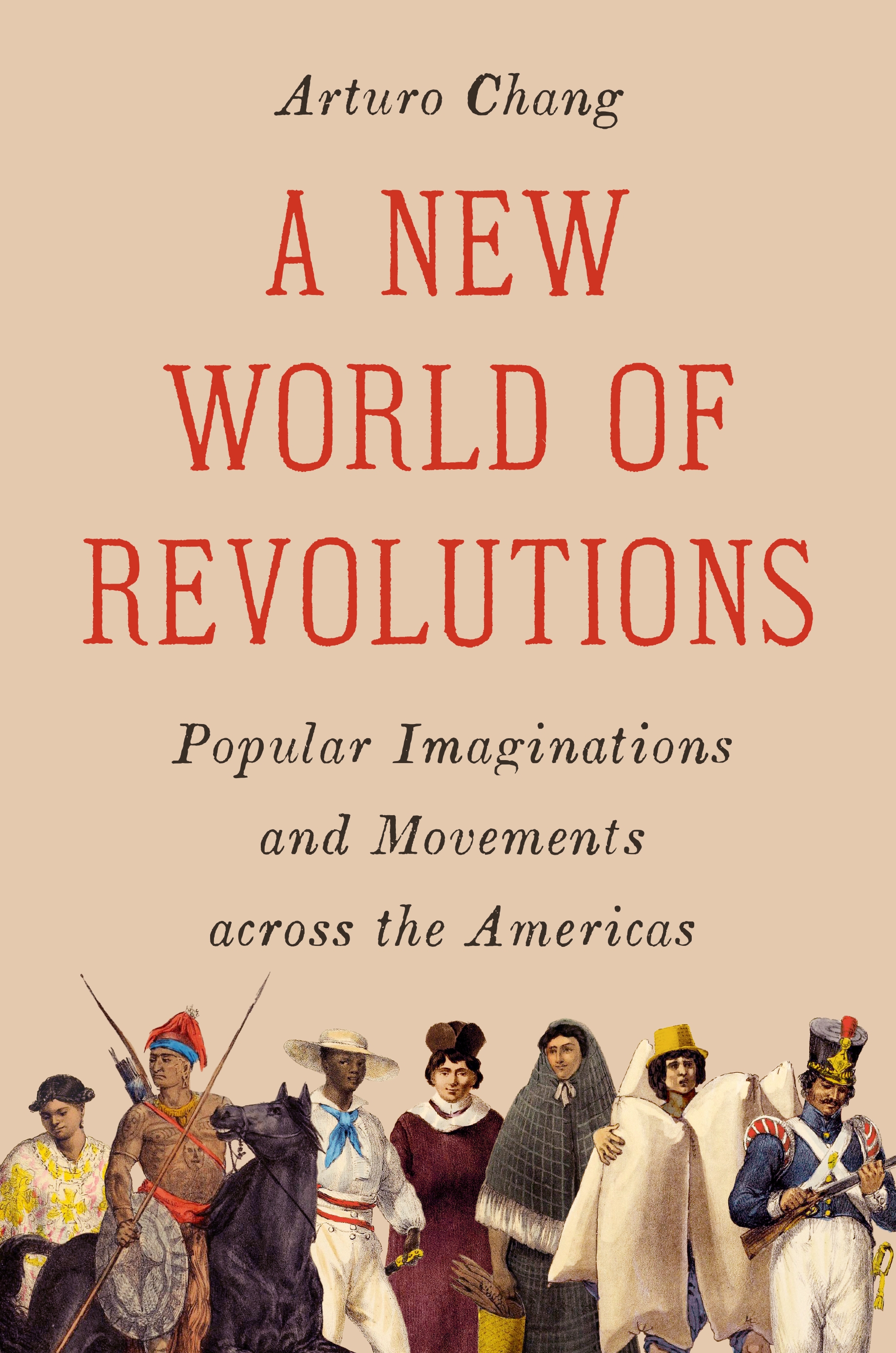
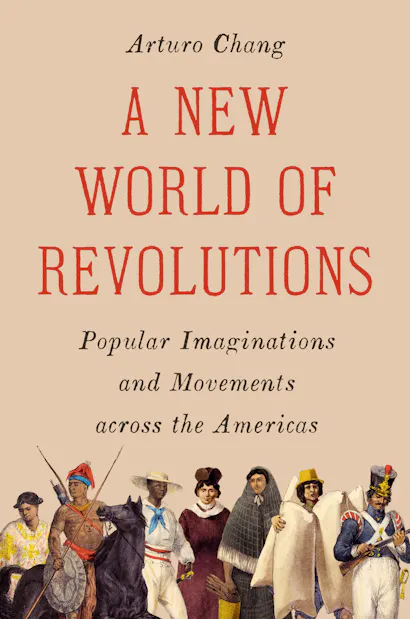
In A New World of Revolutions, Arturo Chang reconstructs the histories, politics, and legacies of the Age of Revolutions (c. 1770鈥�1850) from the vantage point of popular movements in the Americas. Challenging narratives that center the nation-state, Chang emphasizes the hemispheric politics, practices, and cultural production that connected revolutionary movements from the United States to Argentina. He draws on marching songs, poems, pamphlets, manifestos, plays, proclamations, constitutions, and other archival objects to show that hemispheric imaginaries were critical to the development of postcolonial republicanism in the Americas.
Chang shows that marginalized groups, especially Indigenous, Mestizo, and Pardo communities, contributed to and benefitted from narratives of American emancipation. Armed with hemispheric discourses, they were able to argue for such egalitarian reforms as the abolition of slavery, the elimination of colonial tribute, the protection of Indigenous lands, the end of the Spanish caste system, and the establishment of civic equality. Countering assumptions that actors in popular movements followed elite leaders or had little to say during moments of revolutionary change, Chang shows how each of these campaigns influenced republican principles in ways that reflected their own cultures and histories鈥攁nd how each produced concrete interventions in the legal, social, and material realities of their communities. Chang links popular movements in New Spain (Mexico), the United States, New Granada (Colombia, Venezuela, Panama, and Ecuador), and the postcolonial Andes (Peru, Bolivia, and Argentina), arguing that, together, they constituted an American tradition of resistance against European rule.
Arturo Chang is assistant professor of political science at the University of Toronto.
“‘What is an American?' is an old question with renewed contemporary resonance. A New World of Revolutions reveals hidden hemispheric traditions of rebellion and resistance in the Americas that two centuries of nationalism and border-building have obscured. With Arturo Chang’s richly researched, lucidly argued intervention, ‘American’ political thought will not look the same again.”—David Armitage, author of The Declaration of Independence: A Global History
“An ambitious recasting of American political thought. This is a novel and exciting work that introduces a rich new archive with potential implications for longstanding discussions in the political theory of colonialism.”—In茅s Valdez, author of Democracy and Empire: Labor, Nature, and the Reproduction of Capitalism
"By combing archives and vernacular cultures in the Age of Revolutions, Arturo Chang illuminates a variegated republicanism, lessons on revolution, everyday peoples and popular movements enacting emancipation, afterlives of stunted uprisings, and the idea of America irreducible to the U.S. nation-state. A New World of Revolutions brilliantly details how, since modernity’s advent, being American has always been hemispheric in scope.”—Neil Roberts, Williams College
"A New World of Revolutions provides a much-needed and important examination of the Pan-American discourses and hemispheric orientations that drove the Age of Revolutions in the Americas during the eighteenth and nineteenth centuries. It represents exciting new paths in the study of political theory that will also have implications far beyond this field of study.”—Adam Dahl, author of Empire of the People: Settler Colonialism and the Foundations of Modern Democratic Thought
“Looking beyond the nation state and the manifestos and constitutions that typically enshrine political space, Chang examines a huge range of rich archival studies and vernacular culture to propose new means of resisting and theorizing political authority. This important book fills not one but multiple gaps in the study of political thought.”—Leigh Jenco, London School of Economics and Political Science
This publication has been produced to meet accepted Accessibility standards and contains various accessibility features including concise image descriptions, a table of contents, a page list to navigate to pages corresponding to the print source version, and elements such as headings for structured navigation. Appearance of the text and page layout can be modified according to the capabilities of the reading system.
Accessibility Features
-
WCAG v2.2
-
WCAG level AA
-
Table of contents navigation
-
Single logical reading order
-
Short alternative textual descriptions
-
Print-equivalent page numbering
-
Landmark navigation
-
Index navigation
-
Epub Accessibility Specification 1.1
-
ARIA roles provided
-
All non-decorative content supports reading without sight
-
No known hazards or warnings