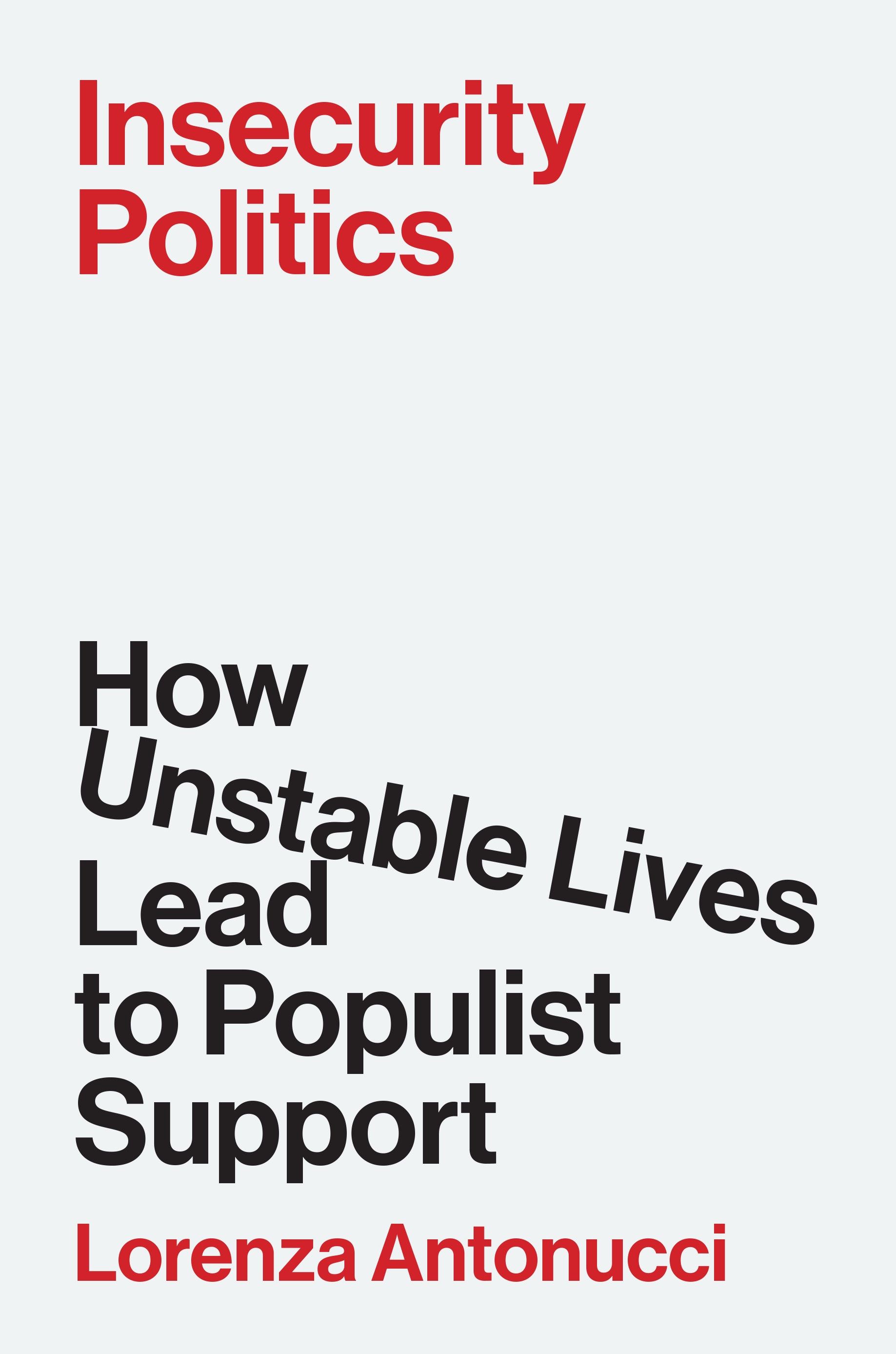
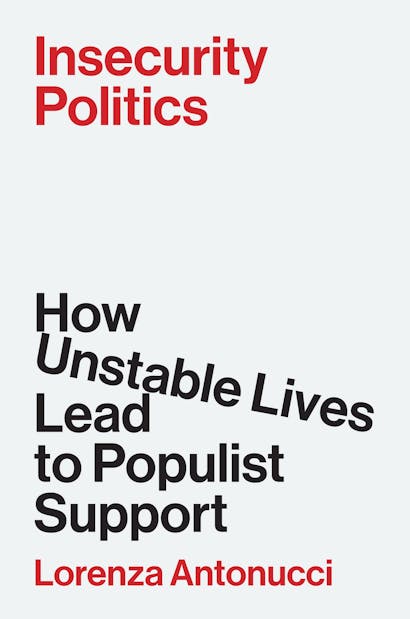
In Insecurity Politics, Lorenza Antonucci examines the lived, everyday experiences that underpin political disaffection. Countering the reductive portrayals of populist voters as left-behind outsiders, Antonucci focuses on the ordinary, yet increasingly precarious, realities of work and financial instability as key to understanding the surge in populist support in both right- and left-wing politics. Drawing on robust comparative quantitative and qualitative analyses across nine European countries, Insecurity Politics describes the microlevel material and cultural dynamics that drive anti-establishment politics. It finds that dissatisfaction with work and a growing sense of financial insecurity fuel populist sentiments.
Antonucci maps the evolving landscape of insecurity in contemporary Europe, tracing its roots to structural transformations of welfare states and deep-seated cultural shifts. Proposing an original framework that combines cultural and economic explanations, the book shows how economic, social, and political factors shape receptivity to anti-establishment politics. Moving beyond conventional wisdom that attributes today鈥檚 populism to cultural backlash or globalization, Antonucci addresses a critical blind spot in current research. But Insecurity Politics offers more than a mere diagnosis; it also argues that a nuanced understanding of populist attitudes could inform a renewed political agenda鈥攐ne more attuned to the complex realities of people’s lives.
Lorenza Antonucci is associate professor of sociology at the University of Cambridge and was the German Kennedy Memorial Fellow at the Center for European Studies at Harvard University from 2022 to 2023. Antonucci's work has been featured in The New York Times, The Guardian, and Le Monde and on the BBC.
“Insecurity Politics skillfully marries political and cultural analysis to offer a refreshing multidimensional analysis of the growing popularity of the rise of populist politics. Connecting symbolic boundaries and political cleavages with experiences of insecurity at the micro level, Antonucci sheds new light on the dynamics fostered by macrolevel structural changes. This important book should be read broadly by sociologists and political scientists alike.”—Mich猫le Lamont, past president of the American Sociological Association and author of The Dignity of Working Men
“Insecurity Politics is the most comprehensive study of its subject to date. Lorenza Antonucci explores the economic, social, and political dimensions of insecurity in nine European countries since the 1980s, illuminating the ways in which they have interacted to produce the populist politics of the past decade. Antonucci deploys a rich mix of intensive case studies and quantitative evidence to illuminate this most pressing phenomenon of our time. Of particular interest, Insecurity Politics shows how the policies adopted by mainstream parties have contributed to the politics that has eroded their support and that they now decry. It is essential reading for anyone who wants to understand today’s politics—and what to do about it.”—Ian Shapiro, author of After the Fall: From the End of History to the Crisis of Democracy, How Politicians Broke Our World
“Insecurity Politics is a much-needed addition to the literature on populism and the contemporary challenges facing democracies. Antonucci’s book provides an empirically grounded and theoretically sophisticated understanding of insecurity, showing that it is a fundamentally socioeconomic phenomenon: grounded in changing economic conditions but encompassing destabilizing social changes as well. By so doing, Insecurity Politics helps us better understand how economic, social, and cultural factors have interacted to create a breeding ground for a politics of discontent and division over the past decades.”—Sheri Berman, Barnard College
“Although precarity differs from insecurity, this book shows how insecurity is driving the world into right-wing populism and antidemocratic leaders. That insecurity breeds populism should not be surprising. What is most alarming is that mainstream politicians have done precious little to arrest it.”—Guy Standing, author of The Precariat: The New Dangerous Class
“Antonucci brilliantly integrates economic and cultural influences on population to clearly explain aspects of current European politics that many find confusing. Combining the new economic sociology with a sociological approach that focuses on the individual more than institutions, delving into people’s lives, and understanding the origins of the new insecurity, Antonucci presents a new way forward to better connect social concerns to politics—across Europe.”—Danny Dorling, University of Oxford
“This book offers a powerful way of making links between micro changes experienced by individuals and large-scale, society-wide macro changes—an arresting argument that will only gain more interest given events in the United States.”—Mike Savage, London School of Economics and Political Science
“A masterful and exciting new vision of the true nature of insecurity, the relationship between insecurity and populism, and the possibilities this paradigm holds for new political approaches.”—Chrystin Ondersma, Rutgers Law School
This publication has been produced to meet accepted Accessibility standards and contains various accessibility features including concise image descriptions, a table of contents, a page list to navigate to pages corresponding to the print source version, and elements such as headings for structured navigation. Appearance of the text and page layout can be modified according to the capabilities of the reading system.
Accessibility Features
-
WCAG v2.2
-
WCAG level AA
-
Table of contents navigation
-
Single logical reading order
-
Short alternative textual descriptions
-
Print-equivalent page numbering
-
Landmark navigation
-
Index navigation
-
Epub Accessibility Specification 1.1
-
ARIA roles provided
-
All non-decorative content supports reading without sight
-
No known hazards or warnings