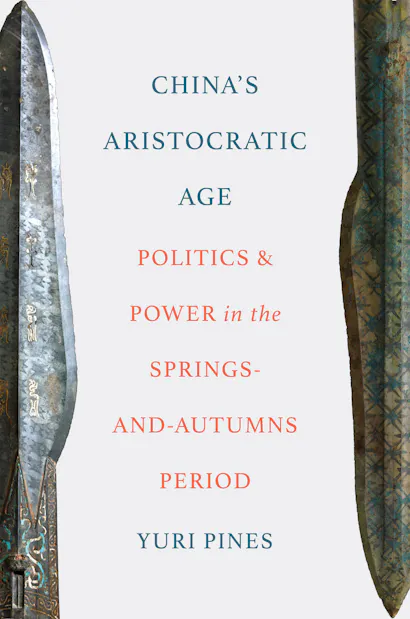
The Springs-and-Autumns period (770鈥�453 BCE)鈥攖he longest aristocratic age in Chinese history鈥攎arks a break from what is often associated with the normative orientations of Chinese political life. During this era, political fragmentation was regarded as acceptable, many states transitioned to oligarchic forms of rule, political participation by lower strata was allowed, pedigree mattered more than ability in determining an individual鈥檚 career, and the concept of the Mandate of Heaven had little to do with the notion of universal rule. Indeed, in many respects, the politics of this period inverted traditional Chinese political values. In China鈥檚 Aristocratic Age, Yuri Pines offers a new history of the Springs-and-Autumns period, arguing that it should be considered on its own terms rather than simply as a precursor for the centralized and bureaucratized Warring States era that followed.
Pines draws on textual, archaeological, and paleographic sources, many of them newly discovered, to examine the political dynamics of the era, which he terms China鈥檚 longest experiment with a polycentric world and society. Efforts during this period to establish a viable multistate order, overcome the weaknesses of monarchial rule, and moderate coercive methods of governance have been largely regarded as unsuccessful. Pines explores the consequences of these perceived failures and analyzes the ways negative views of China鈥檚 polycentrism contributed to its later quest for political unity and centralization. Pines鈥檚 account sheds new light on the Springs-and-Autumns period both within its own contemporaneous context and within the long dur茅e of Chinese history.
Yuri Pines is the Michael W. Lipson Chair in Chinese Studies at Hebrew University of Jerusalem. He is the author of The Everlasting Empire: The Political Culture of Ancient China and Its Imperial Legacy (快色直播), The Book of Lord Shang: Apologetics of State Power in Early China, Zhou History Unearthed: The Bamboo Manuscript Xinian and Early Chinese Historiography, and other books.
"[A] crisply-written, impressively-researched book."鈥擲ean Paterson, Asian Review of 快色直播
“A true masterwork. Through an admirably well-balanced, yet critical examination of a diverse body of source materials—some well-known, some newly discovered—in light of relevant theories, Yuri Pines arrives at a coherent, accessible, and quite original narrative of sociopolitical developments as they unfolded in different parts of China during the Springs-and-Autumns period. His book puts Western-language scholarship on this seminal period in Chinese history on an entirely new level.”—Lothar von Falkenhausen, University of California, Los Angeles
“China’s Aristocratic Age is a triumph of political history, built from a judiciously structured analysis and synthesis of a wealth of sources. Pines describes in compelling detail ancient China’s longest-lasting experiment with a polycentric, multistate realm whose ultimate failure, finally, produced the dominant Chinese political idea ever since: that of a single, unified empire.”—Martin Kern, 快色直播 University
“This is a major contribution to the field that will become a standard reference work for the history of this period and of Chinese political culture. Pines offers an in-depth analysis of political and social relationships that demonstrates the relevance of historical examples to modernity.”—Maria Khayutina, Ludwig Maximilian University of Munich
“A unique and incomparable masterwork. Connecting an enormous amount of most recent Western, Chinese, and Japanese research, including new archaeological source materials, this book rewrites the history of the Chunqiu period by posing new questions, opening up new perspectives and developing new avenues of analysis.”—Joachim Gentz, author of Das Gongyang Zhuan
This publication has been produced to meet accepted Accessibility standards and contains various accessibility features including concise image descriptions, a table of contents, a page list to navigate to pages corresponding to the print source version, and elements such as headings for structured navigation. Appearance of the text and page layout can be modified according to the capabilities of the reading system.
Accessibility Features
-
WCAG v2.2
-
WCAG level AA
-
Table of contents navigation
-
Single logical reading order
-
Short alternative textual descriptions
-
Print-equivalent page numbering
-
Landmark navigation
-
Index navigation
-
Epub Accessibility Specification 1.1
-
ARIA roles provided
-
All non-decorative content supports reading without sight
-
No known hazards or warnings