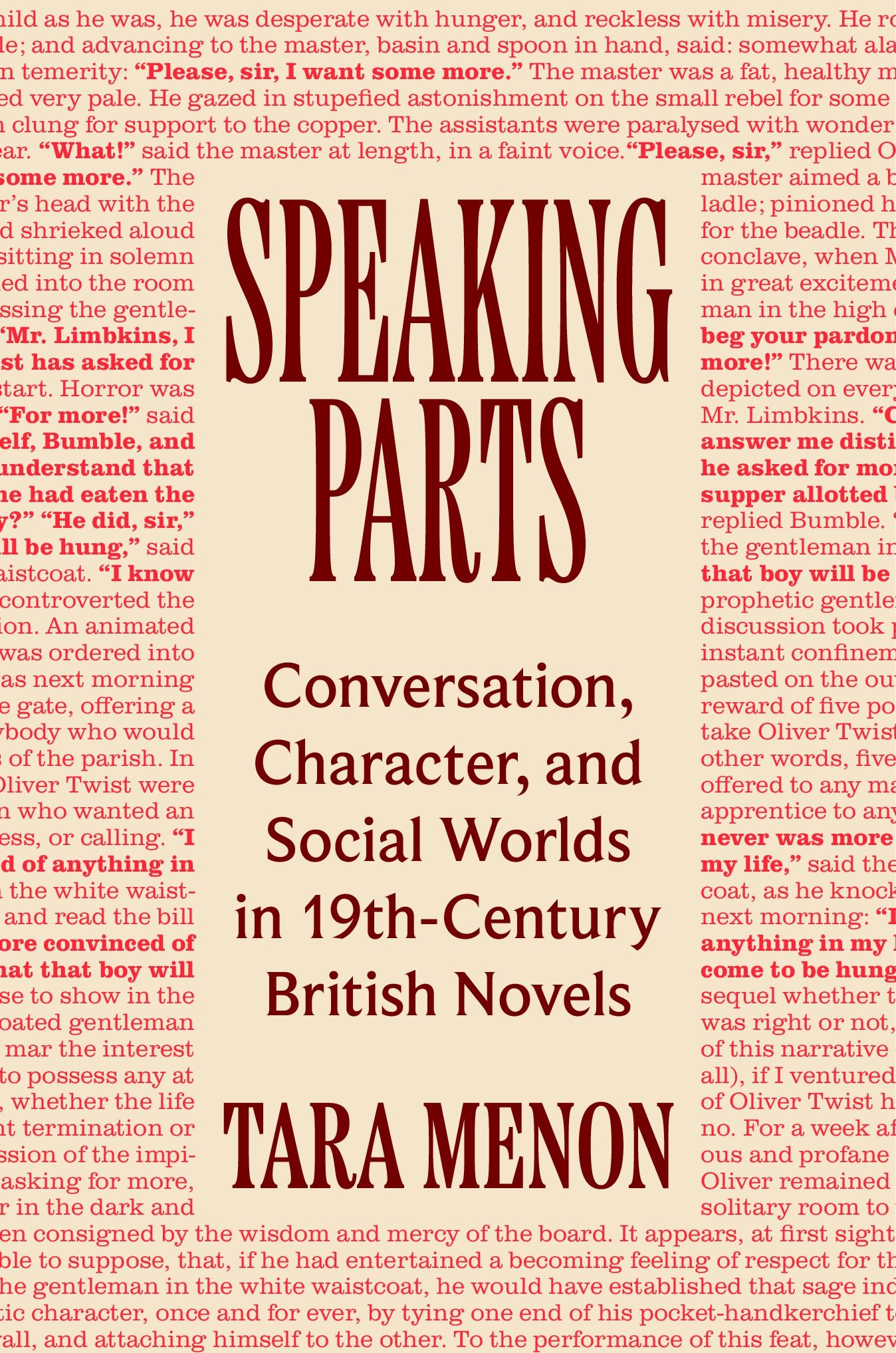
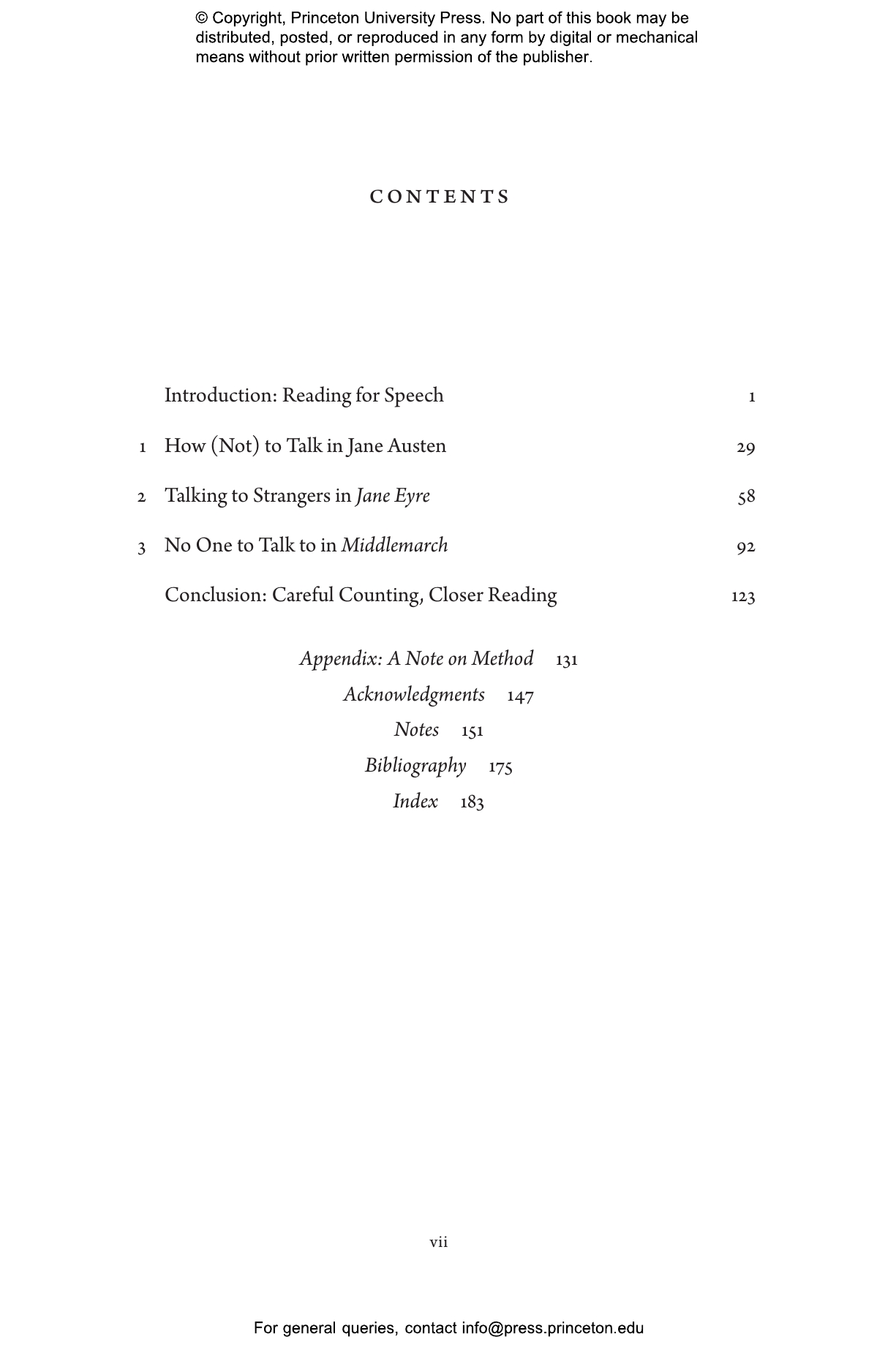
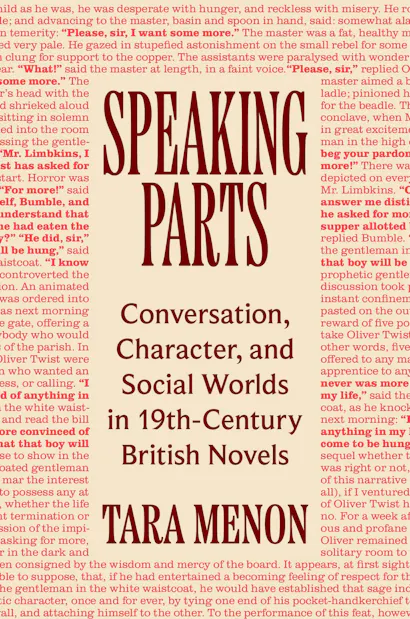
For many readers, to think of nineteenth-century fiction is to recall characters speaking: Elizabeth refusing Darcy in Pride and Prejudice; Jane excoriating Rochester in Jane Eyre; Dorothea and Celia discussing Mr. Casaubon in Middlemarch. And yet literary critics have had surprisingly little to say about the narrative effects of dialogue. In Speaking Parts, Tara Menon shows how direct speech鈥攚ords enclosed in quotation marks that appear to be the exact utterances of characters鈥攕hapes our understanding of fictional characters and the social worlds they inhabit. Combining computational tools and close literary analysis, Menon reinstates direct speech to its rightful place in narrative theory, worthy of the critical seriousness afforded to such other features of narrative as free indirect discourse.
After quantifying direct speech in nearly one thousand British novels written between 1789 and 1901, Menon turns her attention to several canonical nineteenth-century works of fiction by Jane Austen, Charlotte Bront毛, and George Eliot. She considers, among other things, the ways that Austen establishes sympathy for certain characters through her allotment of speech; the narrative significance of speaking characters not given proper names in Jane Eyre; and the social isolation of Dorothea in Middlemarch, as revealed by speech networks. Menon shows not only how the study of direct speech allows us to make new arguments about these well-known texts but also that data analysis of speech can change the way we think about characters, individual novels, and even genres.
Tara Menon is associate professor of English at Harvard University. She is the author of the novel Under Water.
“Direct speech stares out at us from the nineteenth-century novel—a defining structural feature of the genre. Yet novel theory has, strangely but quite persistently, turned its eyes away from this sprawling formal terrain. Tara Menon’s book, with unapologetic critical directness, looks squarely at the device—allowing the reader, too, to perceive it anew. The effect is to wrest an abiding dimension of prose fiction—seen but too rarely observed—into analytical visibility.”—Alex Woloch, author of The One vs. the Many: Minor Characters and the Space of the Protagonist in the Novel
“Speaking Parts is full of unexpected revelations about novels we think we know, written in a style that proves close and distant reading go hand in hand. Menon’s game-changing book asks us to count on direct speech—who speaks and how much—as often as other narratological features when we consider how characters, novels, and genres work. I imagine a new wave of narratological interest in direct speech will follow this breakthrough study, especially now, as one model of ‘character’ is being actively reshaped by how effectively it can chat.”—Meredith Martin, author of Poetry's Data: Digital Humanities and the History of Prosody
“I have no doubt that the insights and coinages of this work will immediately become part of the critical conversation in studies of the novel. The book demonstrates how computational approaches can yield new insights into the forms of narrative—even into novels with which we think we are familiar. Menon writes clearly, with patience and attention to detail.”—Laura Green, author of Literary Identification: From Charlotte Bront毛 to Tsitsi Dangarembga
“An original contribution to literary scholarship on the nineteenth-century novel, both methodologically and conceptually. Menon employs computational methods from the digital humanities in a rigorous and judicious way, balancing her statistical findings against established readings and critical debates.”—Amanda Anderson, author of Psyche and Ethos: Moral Life after Psychology
This publication has been produced to meet accepted Accessibility standards and contains various accessibility features including concise image descriptions, a table of contents, a page list to navigate to pages corresponding to the print source version, and elements such as headings for structured navigation. Appearance of the text and page layout can be modified according to the capabilities of the reading system.
Accessibility Features
-
WCAG v2.2
-
WCAG level AA
-
Table of contents navigation
-
Single logical reading order
-
Short alternative textual descriptions
-
Print-equivalent page numbering
-
Landmark navigation
-
Index navigation
-
Epub Accessibility Specification 1.1
-
ARIA roles provided
-
All non-decorative content supports reading without sight
-
No known hazards or warnings