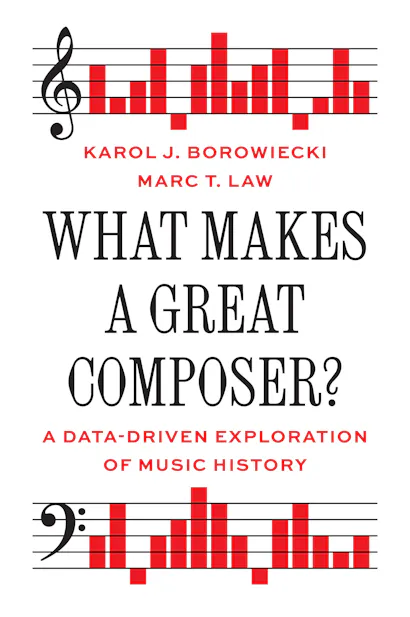
Why do we still listen to Mozart鈥檚 music but not Salieri鈥檚? Would Nadia Boulanger be better known as a composer than a teacher if she were a man? Why did so many composers move to Vienna, Paris, and London, despite the hardships of city life? In What Makes a Great Composer?, economists Karol J. Borowiecki and Marc T. Law offer a novel perspective on why some composers and their works have endured while others have not. Drawing on data-driven methods and economic theory rather than the usual anecdotes and received wisdom regarding the sources of musical genius, Borowiecki and Law uncover previously unnoticed patterns of creativity. Spanning nearly a millennium of musical history鈥攆ollowing composers from medieval courts and cathedrals to modern concert halls and conservatories鈥攖heir account shows how the creative lives of composers were molded by opportunity, constraint, talent, and temperament.
Borowiecki and Law consider not only celebrated masters but also forgotten voices, including female composers whose paths were blocked by structural barriers. They explore key determinants of success, including education, cities and migration, war and conflict, and economic incentives. Drawing on a wealth of data gathered over nearly twenty years, and using such metrics as expert rankings, the length of biographical entries, stylistic originality, influence on peers, and contemporary popularity, they uncover the forces that shaped composers鈥� creativity. By showing how composers lived, struggled, and sometimes transcended the worlds that formed them, Borowiecki and Law shed light not only on music history but also, more broadly, on the conditions that allow creativity to flourish.
Karol J. Borowiecki is professor of economics at the University of Southern Denmark and President of the Association for Cultural Economics International. He is the coauthor of The Economics of Art and Culture.
Marc T. Law is professor of economics at the University of Vermont and a member of the editorial board of the Journal of Cultural Economics.
“Karol J. Borowiecki and Marc T. Law go through the data and provide a new and fresh look at the history of classical music and the great classical composers. Who were the true all-time greats, and which forces shaped their careers? This book is a landmark achievement in understanding the glories of Western classical music.”—Tyler Cowen, coauthor of Talent: How to Identify Energizers, Creatives, and Winners Around the World
“This book certainly represents the most wide-ranging empirical treatment of the musical geniuses who created the Western classical repertoire. Like Brahms’s First Symphony, it was well worth the wait. I find the authors’ quantitative assessments of musical style, originality, and influence ingenious.”—Dean Keith Simonton, author of Greatness: Who Makes History and Why
“This number-driven history of success in musical composition underlines the central role of structural factors like education, location, and connection in the construction of genius. Borowiecki and Law offer a thought-provoking, often provocative interpretation of statistical data which will stimulate many discussions.”—Natasha Loges, author of Brahms and His Poets
“As a historical musicologist trained in a tradition that focuses on individual composers and their careers, I found it a revelation to encounter a data-driven study of composers spanning so many centuries. The book uncovers long-term trends that would otherwise remain hidden.”—Michael Fjelds酶e, coauthor of Carl Nielsen: A Cultural Biography
“This is a surprising, refreshing, and original account of the creative process in music. A truly interdisciplinary work that will be of interest to readers from both the humanities and the sciences.”—Gregory Clark, author of The Son Also Rises
“The book sheds new light on how music has been created over the centuries, how greatness arises, and the role that creativity plays in this process.”—Peter Tschmuck, author of The Economics of Music
“For two centuries we have approached musical genius the way we explain miracles—with awe, anecdote, and adulation. Borowiecki and Law bravely count and probe where others have fawned. This is a book of rare ambition. Across nearly a thousand years of music history, they offer fresh insights into the origins and trajectory of the greatest composers. The data do not deaden the narrative, and numbers do not dull the rhythm of the story. The book's creativity and reach sit comfortably beside the great compositions it analyzes. Economists will admire the book’s rigor, and music lovers the novelty of the insights and the intimate warmth the authors have for the art and artists. Genius is never born alone, but made, shaped, and sometimes broken by the world around it.”—Hans-Joachim Voth, University of Zurich
This publication has been produced to meet accepted Accessibility standards and contains various accessibility features including concise image descriptions, a table of contents, a page list to navigate to pages corresponding to the print source version, and elements such as headings for structured navigation. Appearance of the text and page layout can be modified according to the capabilities of the reading system.
Accessibility Features
-
WCAG v2.2
-
WCAG level AA
-
Table of contents navigation
-
Single logical reading order
-
Short alternative textual descriptions
-
Print-equivalent page numbering
-
Landmark navigation
-
Index navigation
-
Epub Accessibility Specification 1.1
-
ARIA roles provided
-
All non-decorative content supports reading without sight
-
No known hazards or warnings