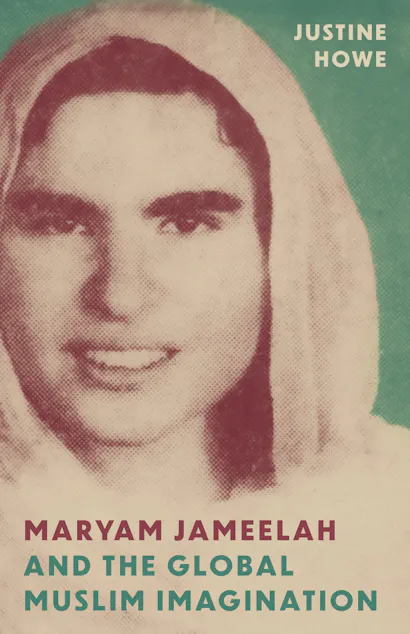
Maryam Jameelah (1934鈥�2012)鈥攂orn Margaret Marcus in White Plains, New York鈥攆ollowed an unlikely journey, from comfortable suburban childhood to influential voice of the twentieth-century global Islamic Revival. Jameelah鈥檚 more than twenty books and pamphlets, translated into a dozen languages, were notable for their unrelenting critique of modernity and arguments for the superiority of Islam in opposition to the West. In this exploration of her life and work, Justine Howe shows how Jameelah harnessed negative emotions鈥攚hat Howe calls an 鈥渁ntimodern affect鈥濃�攖o call attention to what she saw as the catastrophes wrought by materialism and secularism. For Jameelah, galvanizing these emotions formed the basis of global Muslim solidarity that could be mobilized for a reinvigorated Islamic future.
Tracing Jameelah鈥檚 successive incarnations鈥攆rom Reform Jew to highly mobile spiritual seeker and finally to fervent Muslim polemicist鈥擧owe analyzes how women, gender, and family became the central nodes of Jameelah鈥檚 vision. Projecting herself as an embodiment of Muslim femininity as she pursued a career as a public intellectual, Jameelah subverted the very boundaries and prescriptions she sought to impose on others. Howe鈥檚 exploration of the multivalent threads that animated Jameelah鈥檚 religious imagination reveals unexpected entanglements of American Judaism, global Islam, feminism, and anticolonialism.
Justine Howe is associate professor of religious studies at Case Western Reserve University. She is the author of Suburban Islam and the editor of the Routledge Handbook of Islam and Gender.
“This is a sophisticated and fascinating book. It should enjoy a wide readership in religious studies, Islamic studies, gender studies, and even in Jewish studies and nicely compliments other recent and forthcoming biographies of American Jewish political and religious thinkers.”—Shari Rabin, author of The Jewish South: An American History
“An erudite and nuanced study of an important figure in the Islamic Revival movement of the late twentieth century. The book is beautifully and clearly written. Howe’s theoretical approach to her sources is impressive. This book can serve well in methodology courses.”—Kambiz GhaneaBassiri, author of A History of Islam in America
“This is an original and illuminating book. By placing Maryam Jameelah at the center of a transnational history of religion and feeling, Justine Howe shows how modern Muslim identity took shape not only through global Islamic Revival but also through a complex engagement with American Jewish experience and identity. Richly textured and intellectually ambitious, this book will reshape conversations about affect, gender, and American and global religious history.”—Rachel Gordan, author of Postwar Stories: How 快色直播 Made Judaism American
“A profoundly engaging critical biography of a woman who defied expectations, and whose life connected the US and Pakistan, Reform Judaism and Islam, global Muslim revival movements and the American religious landscape of the twentieth century. Howe’s brilliant and accessible account, drawing on affect theory and gender analysis, is about much more than the life of one person.”—Juliane Hammer, author of Peaceful Families: American Muslim Efforts against Domestic Violence
This publication has been produced to meet accepted Accessibility standards and contains various accessibility features including concise image descriptions, a table of contents, a page list to navigate to pages corresponding to the print source version, and elements such as headings for structured navigation. Appearance of the text and page layout can be modified according to the capabilities of the reading system.
Accessibility Features
-
WCAG v2.2
-
WCAG level AA
-
Table of contents navigation
-
Single logical reading order
-
Short alternative textual descriptions
-
Print-equivalent page numbering
-
Landmark navigation
-
Index navigation
-
Epub Accessibility Specification 1.1
-
ARIA roles provided
-
All non-decorative content supports reading without sight
-
No known hazards or warnings