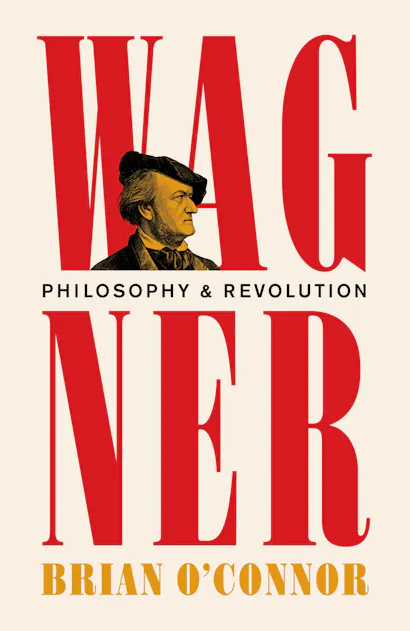
Forced into exile to avoid arrest after taking part in the failed Dresden Uprising in 1849, Richard Wagner turned to philosophical writing, producing in rapid succession three theoretical works. In this compelling study, Brian O鈥機onnor traces Wagner鈥檚 emergence in these texts as a radical political thinker with a distinctive revolutionary vision. O鈥機onnor describes Wagner鈥檚 transformation from publicly engaged commentator to active insurrectionist, showing how revolution鈥檚 failure redirected Wagner鈥檚 energies toward systematic philosophical reflection. For a crucial period, this theoretical work took precedence over musical composition.
At the heart of O鈥機onnor鈥檚 account is Wagner鈥檚 philosophical imagination. He explores Wagner鈥檚 conception of aesthetic spontaneity as a model of individual freedom and his belief in collective artistic creation as the foundation of a liberated society. By situating Wagner鈥檚 philosophy within the turbulent political and intellectual context of the time, O鈥機onnor challenges its marginalization in previous accounts, restoring it to its proper place in nineteenth-century political thought. He shows how Wagner reworked ideas drawn from the German philosopher Ludwig Feuerbach into an original and provocative form of aesthetic materialism, and examines the interplay between these ideas and Wagner鈥檚 dramatic works. O鈥機onnor also offers a straightforward treatment of the unavoidable subject of Wagner鈥檚 antisemitism, as expressed in an essay from 1850 about 鈥淛ewishness鈥� in music.
O鈥機onnor argues that Wagner鈥檚 philosophical writing is not only significant in its own right, but it also offers unique and invaluable insights into his music dramas鈥攑articularly the composer鈥檚 most celebrated work, the Ring Cycle鈥攊lluminating their themes, characters, and revolutionary affinities.
Brian O'Connor is professor of philosophy at University College Dublin. He is the author of Idleness: A Philosophical Essay (快色直播), Adorno, and Adorno’s Negative Dialectic.
“This contribution to the voluminous literature on Wagner amply justifies itself through genuine originality and careful argument, born in close study of the texts and their broader context. In its treatment of the trilogy of theoretical writings at its heart, it makes an excellent case both for their importance and that of the author’s particular interpretation and synthesis.”—Mark Berry, author of Treacherous Bonds and Laughing Fire: Politics and Religion in Wagner’s Ring
“There is no other work with this level of conceptual sophistication that is specifically focused on the theoretical ideas underpinning Wagner’s work, as set out in a trio of important writings from the 1840s and early 1850s. This book will be a landmark in the literature considering Wagner’s philosophical significance.”—Andrew Huddleston, author of Nietzsche on the Decadence and Flourishing of Culture
“Brian O’Connor’s new study of Wagner is a brilliant act of retrieval. Focusing on the neglected philosophical works, it illuminates Wagner’s sophisticated accounts of aesthetic value and revolution, inspired by the promise of 1848. At once probing and sympathetic, the book recovers fascinating dimensions of the creative life of an artistic genius.”—Richard Bourke, University of Cambridge
“Richard Wagner’s philosophical ideas are expressed in his music dramas, but also in several important, but not always well-structured, theoretical works. Brian O’Connor in his new book displays his characteristic erudition, acuity, hermeneutic skill and a scrupulous impartiality in uncovering, expounding and evaluating Wagner’s highly original philosophy, focusing on the prose treatises of the early period. This is the Wagner who is a philosopher of revolution, and O’Connor‘s book is an indispensable key to understanding what is one of the major emancipatory projects of modern culture.”—Raymond Geuss, University of Cambridge
“Before Wagner came under the influence of Schopenhauer and morphed into the music master of Bismarck's unified Germany, he was a fervent propagandist of revolution in politics, art and society. Brian O’Connor's most welcome study presents Wagner’s revolutionary writings from 1848 through 1852 with an innovative focus on Wagner’s key philosophical concepts and their continued importance in his four-part music drama, The Ring of the Nibelung.”—G眉nter Z枚ller, University of Munich
This publication has been produced to meet accepted Accessibility standards and contains various accessibility features including a table of contents, a page list to navigate to pages corresponding to the print source version, and elements such as headings for structured navigation. Appearance of the text and page layout can be modified according to the capabilities of the reading system.
Accessibility Features
-
WCAG v2.2
-
WCAG level AA
-
Table of contents navigation
-
Print-equivalent page numbering
-
Next / Previous structural navigation
-
Landmark navigation
-
Index navigation
-
Epub Accessibility Specification 1.1
-
ARIA roles provided
-
All non-decorative content supports reading without sight
-
No known hazards or warnings