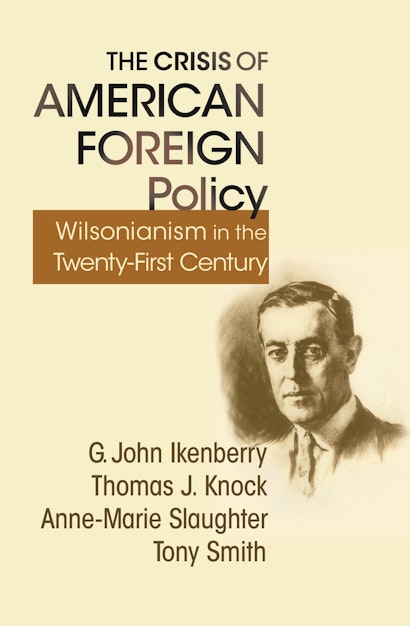
Was George W. Bush the true heir of Woodrow Wilson, the architect of liberal internationalism? Was the Iraq War a result of liberal ideas about America’s right to promote democracy abroad? In this timely book, four distinguished scholars of American foreign policy discuss the relationship between the ideals of Woodrow Wilson and those of George W. Bush. The Crisis of American Foreign Policy exposes the challenges resulting from Bush’s foreign policy and ponders America’s place in the international arena.
Led by John Ikenberry, one of today’s foremost foreign policy thinkers, this provocative collection examines the traditions of liberal internationalism that have dominated American foreign policy since the end of World War II. Tony Smith argues that Bush and the neoconservatives followed Wilson in their commitment to promoting democracy abroad. Thomas Knock and Anne-Marie Slaughter disagree and contend that Wilson focused on the building of a collaborative and rule-centered world order, an idea the Bush administration actively resisted. The authors ask if the United States is still capable of leading a cooperative effort to handle the pressing issues of the new century, or if the country will have to go it alone, pursuing policies without regard to the interests of other governments.
Addressing current events in the context of historical policies, this book considers America’s position on the global stage and what future directions might be possible for the nation in the post-Bush era.
Awards and Recognition
- On the list for The People's Choice: Carnegie Council Top Ten for 2009
"The Crisis of American Foreign Policy examines Wilson's resonance today. Four noted scholars鈥攖hree Wilson sympathizers and one caustic critic鈥攐ffer thoughtful essays on what Wilsons historical example might offer twenty-first-century leaders. . . . It is the combatitive essays by Tony Smith and Anne-Marie Slaughter that invigorate the collection. . . . For Smith, Wilsonianism is a distracting Kantian echo in an increasingly Hobbesian world. Slaughter offers a spirited defense of Woodrow Wilson. . . . This academic clash will resonate with progressives, for Smith's skepticism and Slaughter's optimism reside in many of us. And this same battle of ideas鈥攖he pragmatic versus the internationalist鈥攚ill likely be repeated during high-level debates in the Obama administration."鈥擠avid Milne, The Nation
"This slender volume by fout prominent foreign policy analysts offers a provocative and informative analysis of the impact of Woodrow Wilson's global vision on American foreign policy over the past century and its potential implications for the twenty-first century."鈥擩ames M. McCormick, Perspectives on Politics
"I recommend this book wholeheartedly on a number of levels: it provides an articulate account of Wilsonianism; the opportunity to see a substantive and expertly argued discourse among intellectual heavyweights is very much welcomed; and the added relevance鈥攑erhaps鈥攐f Slaughter's new position as director of policy planning at the State Department in the new Obama administration means US foreign policy could have a distinct Wilsonian flavour in the run-up to the centenary of Wilson's arrival in the White House."鈥擩. Simon Rofe, International Affairs
"Particularly timely. . . . The question the book addresses in four short essays is whether Mr Bush's policies鈥攎ost notably the Iraq invasion鈥攚ere 'Wilsonian' in inspiration and whether the reverses have weakened or doomed the tradition."鈥擠aniel Dombey, Financial Times
"This is not a j'accuse account of the Bush presidency. Rather, its focus is a discussion of the tradition of Wilsonianism in American foreign policy, and whether or not George W. Bush's presidency ought to be described as being part of this tradition. While the authors come to different conclusions, using different criteria, the debate is interesting and intelligent, offering plenty for students, historians and enthusiasts alike. The Crisis of American Foreign Policy is the most readable, balanced and lucid theory-based publication I've read in quite some time. Very highly recommended."鈥擲tefan Fergus, Civilian Reader
"This short book warrants close attention by anyone concerned about Obama's foreign policy and the meaning of his Inaugural Address. . . . [Slaughter] offers nothing less than a blueprint for 21st-century Wilsonianism."鈥擱ichard M. Gamble, The American Conservative
"Was George W. Bush the heir of Woodrow Wilson? That is the important question addressed by the four authors who created this short but lucid contribution to the U.S. foreign policy debate. The liberal Wilsonians Ikenberry and Slaughter want to answer with a resounding no but are serious and fair-minded enough to give a full airing to the contrary view. The resulting debate does not settle the issue, but it clarifies some of the conflicting and contradictory elements in the legacy that Wilson left."鈥擶alter Russell Mead, Foreign Affairs
"In The Crisis of American Foreign Policy . . . G. John Ikenberry, Thomas J. Knock, Tony Smith and Anne-Marie Slaughter debate whether George W. Bush channelled Woodrow Wilson or buried him. . . . [If] the American empire is still in its infancy, the debate articulated in The Crisis in American Foreign Policy is not only highly relevant but will remain so for the foreseeable future."鈥擠ennis Phillips, Australian Review of Public Affairs
"Debates both the Bush legacy and the prospects for reinvigorating American foreign policy and consequently American international leadership."鈥擳ara McCormack, Spiked Review of 快色直播
"Engages with the debate on the future of democratisation after the Bush era. . . . The various authors engage in a rather lively exchange on the Bush presidency's legacy."鈥擡miliano Alessandri, International Spectator
"[A] formidable contribution to the understanding of the differences between these two internationalisms. . . . Whatever one's views on the issues developed in this short book, the authors have done a wonderful job in demarcating their disagreements. Indeed, this book should be compulsory reading for students and practitioners of American foreign policy. Listening to Obama's UN speech, one might think that he also found it useful reading."鈥擲ergio Fabbrini, International Journal
"This collection of essays allows the reader to transcend simplistic notions of Wilsonianism, for which the authors should be applauded."鈥擬ark J. L. McClelland, Political Studies Review
"This slim volume (117 pages plus notes) is interesting on a couple of levels, and to at least two audiences. . . . Foreign policy specialists can salivate over the contest between the academic titans; the rest of us get a front-row seat at a sharp but civil and provocative exchange on foundational concepts underlying U.S. foreign policy."鈥擩erry Petr, Prairie Fire
"This collection makes a definite contribution. . . . [The essays] present comprehensive interpretations of Wilson's thought and of the approach of the Bush administration [as well as] analyzing the substance of the Bush policies and suggesting directions for the future of American policy."鈥擬ax J. Skidmore, European Legacy
"Is Woodrow Wilson's legacy still alive in American foreign policy? Has the Iraq War discredited intervention for liberal purposes? These are key questions for the next president and they are debated here by some of our best thinkers. This book makes a fascinating read."鈥擩oseph S. Nye, Harvard University
"Have American efforts to promote democracy and multilateralism been fatally tainted by the war of choice in Iraq? Has Wilsonianism become a poisoned chalice? In this provocative study, four leading scholars of international relations examine, with shrewd insight and passionate conviction, the benefits and perils of American global intervention in the name of its democratic principles."鈥擱onald Steel, University of Southern California
"Tightly argued and closely reasoned, this book is a searching and unflinching examination of the Wilsonian legacy and its influence on the Bush administration, raising questions that will haunt policymakers for years to come."鈥擶alter Russell Mead, Council on Foreign Relations
"In this book, four leading authorities have their say on Wilson, who remains, however interpreted and contested, the father of modern American foreign policy. We are all Wilsonians, whether we like it or not, and the authors suggest what this means. The Crisis of American Foreign Policy is timely, insightful, and provocative, and will promote further discussion."鈥擧. W. Brands, University of Texas, Austin
"The authors of this book make a lively, topical, and important contribution to the debate on the meaning and value of Wilsonianism. Whether the invasion and occupation of Iraq should be seen as a violation of the Wilsonian tradition of multilateralism, or an instance of liberal Wilsonian interventionism, is consequential for us all, including the opinion shapers who will confront similar challenges in the future."鈥擬ichael Doyle, Columbia University