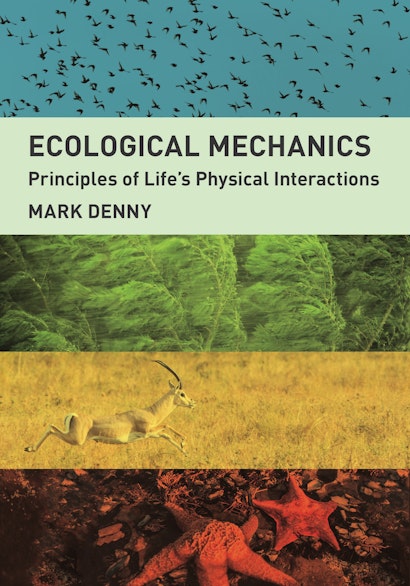
Plants and animals interact with each other and their surroundings, and these interactions鈥攚ith all their complexity and contingency鈥攃ontrol where species can survive and reproduce. In this comprehensive and groundbreaking introduction to the emerging field of ecological mechanics, Mark Denny explains how the principles of physics and engineering can be used to understand the intricacies of these remarkable relationships.
Denny opens with a brief review of basic physics before introducing the fundamentals of diffusion, fluid mechanics, solid mechanics, and heat transfer, taking care to explain each in the context of living organisms. Why are corals of different shapes on different parts of a reef? How can geckos climb sheer walls? Why can birds and fish migrate farther than mammals? How do desert plants stay cool? The answers to these and a host of similar questions illustrate the principles of heat, mass, and momentum transport and set the stage for the book’s central topic鈥攖he application of these principles in ecology. Denny shows how variations in the environment鈥攊n both space and time鈥攁ffect the performance of plants and animals. He introduces spectral analysis, a mathematical tool for quantifying the patterns in which environments vary, and uses it to analyze such subjects as the spread of invasive species. Synthesizing the book鈥檚 materials, the final chapters use ecological mechanics to predict the occurrence and consequences of extreme ecological events, explain the emergence of patterns in the distribution and abundance of organisms, and empower readers to explore further.
Ecological Mechanics offers new insights into the physical workings of organisms and their environment.
"Denny's opus features 24 chapters with 778 numbered equations and many illustrative graphs on more than 500 pages. Despite this wealth of information, it makes for an excellent and enjoyable read."鈥擥regor Kalinkat, Basic and Applied Ecology
"The author has written a truly magnificent book illustrating how physical principles affect organic form-function relationships across a broad spectrum of aquatic and terrestrial life forms. . . . Denny distinguishes himself as an excellent teacher as well as a superb scientist."鈥擪arl J. Niklas, Quarterly Review of Biology
"The blend of physics supported by the underlying maths, peppered with diverse biological examples, makes this book accessible reading and a most useful text. It will be valued by biologists seeking an understanding of mechanics and physical scientists applying their knowledge to large-scale living systems."鈥擜lexander Waller, The Biologist
"A leading scholar and researcher, Denny has produced a unique book that will interest a diverse audience, from biologists wanting to understand the physical and engineering principles underlying form and function, to physicists and engineers looking for applications of fundamental concepts. Building from essential physics to biological uses with dexterity, Denny's work is perfect course material and fascinating reading."鈥擲imon A. Levin, 快色直播 University
"The specific features of organisms come more from their physical situations than from biological interactions. But which aspects of physics matter鈥攁nd where, when, and how are they important? Moving beyond simplistic presentations, Mark Denny's latest work serves as a richly insightful guide. In particular, the book's range of examples, interwoven with the physical material, have contemporary ecological relevance for the biologist, engineer, or physicist."鈥擲teven Vogel, Duke University
"Denny's book provides an excellent introduction to the basics of transport processes鈥攎omentum, heat, and mass transfer鈥攁nd their application to organisms in natural and unnatural environments. The coverage of fluid and solid mechanics is strong. I particularly enjoyed the chapters on quantifying environmental variation in terms of scale, noise, and extremes鈥攖hese concepts are essential for understanding how organisms respond and adapt to variable and unpredictable surroundings."鈥擩oel Kingsolver, University of North Carolina, Chapel Hill
"Denny's lucid new book is a 鈥榯our de forces'鈥攖hat is, a tour of how diverse physical forces in the environment help govern the physiology, behavior, ecology, population biology, and even evolution of organisms. Deftly using physics principles and more to define the emerging field of ecological mechanics, this remarkable book forever changes and enriches our understanding of the dynamic biology of organisms in nature."鈥擱aymond B. Huey, University of Washington
"In defining the emerging field of ecomechanics, Denny builds on key principles from physics, fluid dynamics, and mechanics鈥攊nnovatively combined with concepts from the statistics of extremes, variability, and probability鈥攖o show how biomechanical and ecological approaches work together to provide tools for predicting future interactions of organisms and their environment. Denny writes effortlessly and with exceptional clarity to explain physical science concepts and their relevance to ecology for a general audience."鈥擜ndrew A. Biewener, Harvard University
"In this timely book, Denny posits that treating biomechanics and ecology separately leads to an incomplete understanding of nature. Their working together is key. Using engaging case studies and explaining in depth the physics underlying biomechanics, Denny takes readers through a vast amount of material and territory, and presents science that is relevant to actual and pressing problems. There is no other work like it."鈥擩茅r么me Casas, Institut Universitaire de France and University of Tours
"This is a landmark book, the best of its kind I've ever read. It manages to be beautifully detailed and broadly visionary at the same time. Denny sees connections among multiple phenomena and offers his insights with an authoritative, comprehensive, lucid, and entertaining style. I will certainly use this book, as will other professional biologists, graduate students, and advanced undergraduates in the field."鈥擜rt Woods, University of Montana
No known hazards or warnings
Accessibility Features
-
Inaccessible, or known limited accessibility
-
No known hazards or warnings