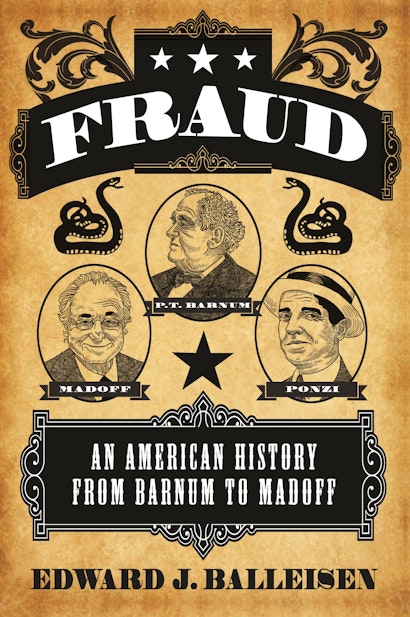
The United States has always proved an inviting home for boosters, sharp dealers, and outright swindlers. Worship of entrepreneurial freedom has complicated the task of distinguishing aggressive salesmanship from unacceptable deceit, especially on the frontiers of innovation. At the same time, competitive pressures have often nudged respectable firms to embrace deception. As a result, fraud has been a key feature of American business since its beginnings. In this sweeping narrative, Edward Balleisen traces the history of fraud in America鈥攁nd the evolving efforts to combat it鈥攆rom the age of P. T. Barnum through the eras of Charles Ponzi and Bernie Madoff.
Starting with an early nineteenth-century American legal world of 鈥渂uyer beware,鈥� this unprecedented account describes the slow, piecemeal construction of modern regulatory institutions to protect consumers and investors, from the Gilded Age through the New Deal and the Great Society. It concludes with the more recent era of deregulation, which has brought with it a spate of costly frauds, including the savings and loan crisis, corporate accounting scandals, and the recent mortgage-marketing debacle.
By tracing how Americans have struggled to foster a vibrant economy without enabling a corrosive level of fraud, this book reminds us that American capitalism rests on an uneasy foundation of social trust.
Awards and Recognition
- Winner of the 2018 Ralph Gomory Prize, Business History Conference
- Edward J. Balleisen, Winner of the 2018 Harold F. Williamson Prize, Business History Conference
"Balleisen's lucid, engagingly written mix of institutional and legal history, behavioral economics, and entertaining anecdotes illuminates this land of bilk and money."鈥�Publishers Weekly
"Balleisen casts a gimlet eye on the passing parade of hucksters and charlatans, peppering a narrative long on theory with juicy asides that build toward a comprehensive catalog of 鈥極ld Swindles in New Jargon'. . . . Ranging among the disciplines of history, economics, and psychology, Balleisen constructs a sturdy narrative of the many ways in which we have fallen prey to the swindler, and continue to do so, as well as of how American society and its institutions have tried to build protections against the con. But these protections eventually run up against accusations of violating 鈥榣ongstanding principles of due process,' since the bigger the con, the more lawyers arrayed behind it."鈥�Kirkus
"Meticulously researched and completely fascinating."鈥擬elissa Jacoby, Credit Slips
"An ambitious exploration of two centuries' worth of swindles, bogus stock schemes and corporate crime. [Balleisen鈥檚] keen insights and the breadth of his knowledge keep the reader engaged, and he introduces plenty of shady characters and ingenious fraudulent schemes to boot."鈥擠ean Jobb, Chicago Review of 快色直播
"Balleisen . . . provides a lively and informative account of chicanery in the United States in the past 200 years."鈥擥lenn C. Altschuler, Tulsa World
"Fraud: An American History from Barnum to Madoff lives up to its title as a chronicle of American con men and their brilliant, morally bankrupt schemes throughout history. . . . Researched with scholarly detail, yet thoroughly accessible to readers of all backgrounds, Fraud: An American History from Barnum to Madoff is as engrossing as it is educational! Highly recommended."鈥�Midwest Book Review
"Superb. . . . In chronicling a century-long tradition from caveat emptor to caveat venditor the author delivers not only an enjoyable romp through the history of fraud, with a fascinating case of characters . . . but delivers some fundamental lessons about social identity, reputation capital and trust. Utterly absorbing."鈥擠ave Birch, Financial World
"This is a story with many volumes still to come."鈥�Enlightened Economist
"The confidence scam, of course, is as old as American capitalism. In a new book, Fraud: An American History from Barnum to Madoff, the Duke University professor Edward J. Balleisen argues that fraud has been a central feature of our freewheeling economy from the start, making it hard to tell scams from legitimate businesses and hard to tell aggressive sales tactics from outright deception鈥攅specially in innovative industries."鈥擟arina Chocano, New York Times Magazine
"Balleisen provides a thoughtful, sweeping examination of fraudulent business activities and the often delayed responses to thwart it. He makes extensive use of newspapers and magazines and a number of institutional archives, such as those of the Better Business Bureau and the National Vigilance Committee, to depict in rich detail numerous fraudulent activities and how people responded."鈥�Choice
"Impressive. . . . Serious, intelligent, and rewarding. Although it has a sophistication that will satisfy specialists, it is also well written (the two do not always go together), which is to say that it will be accessible to educated non-specialists. Beach reading it is not, but anyone with an interest in business fraud, regulatory policy, business-state relations, or the seamier side of capitalism will find the time spent learning from Balleisen worth the effort invested."鈥擪atherine Epstein, American Interest
"At this political moment, few books could be more timely. . . . Other academics have documented the ways that the United States has been steeped in fraud . . . but Balleisen's book provides a far more sweeping view than its predecessors, offering a much-needed big-picture perspective. Balleisen never mentions Donald Trump, but effectively contextualizes his ascent by tracing centuries of grift, fraud, and con men in American history."鈥擝rooke Harrington, TheAtlantic.com
"Edward Balleisen is a first-rate historian who has produced a notable book."鈥擳yler Cowen, Times Literary Supplement
"A readable鈥攁nd enjoyable鈥攁ccount of how fraud as variously defined has shaped the very idea of free enterprise in America."鈥擱ichard A Booth, Regulation
"The most comprehensive historical treatment to date of the ways that business people in the U.S. have hood-winked their unsuspecting customers, investors, suppli- ers, and creditors, and the responses that the frauds have engendered in the business, regulatory, legal, and non- governmental sectors. . . . In its thoroughness and analytical rigor, Fraud: An American History from Barnum to Madoff is destined to become one of the authoritative texts on the subject."鈥擱owena Olegario, American Historical Review
"[A] dense but informative book that should become standard reading for anyone interested in understanding the strengths and shortcomings of public and private American regulatory mechanisms that target duplicity in the marketplace."鈥擝art J. Elmore, Journal of Southern History
"As anyone who knows Balleisen鈥檚 work would expect, Fraud is exceptionally researched, observant, thoughtful, and rendered in charming prose. Fraud spans the familiar legal silos to provide a sweeping history of different varieties of fraud, and their regulation. . . . It makes a remarkable contribution to our understanding of how fraud and its regulation have evolved thus far, and the conditions out of which our current regulatory models developed."鈥擟hristie Ford, Jotwell
"Exciting. . . . Balleisen provides historians and policymakers with a rich history of the machinery designed to stop and prevent it."鈥擜nne Fleming, Reviews in American History
"Spoiler Alert: You need this book."鈥擡lizabeth Cabraser, Western Legal History
"Not only is Fraud a careful and thoughtful exploration of the complicated relationship between business, the market, and policy. It is also a thought-provoking and engaging book."鈥擠an Ariely, author of Predictably Irrational
"In the end, capitalism is always a confidence game, so the problem of fraud is always with us. But the occurrence, perception, and regulation of fraud has a history, and Balleisen has now written the definitive account of it. A deeply researched and beautifully crafted book that follows the shape-shifting problem of deceit across the centuries, Fraud is nothing short of a new history of American capitalism."鈥擩on Levy, University of Chicago
"A huge achievement. This will be the authoritative history of fraud in the United States for many years to come. Edward Balleisen takes us on a fascinating and entertaining tour of the many ways that swindlers have consistently shadowed America's proudest innovations, sometimes even outdoing the originals for ingenuity and impact."鈥擶alter A. Friedman, Harvard Business School
"Often vivid and always thoughtful, this is a very important and impressive work by a rigorous, venturesome historian at the top of his game. When so much public debate about regulation is polemical and hyperbolic, Edward Balleisen has made a major contribution by writing a book that thoroughly, comprehensively, even-handedly, and engagingly examines the history of American fraud and its regulation from the early nineteenth century to today."鈥擠aniel R. Ernst, Georgetown University Law Center