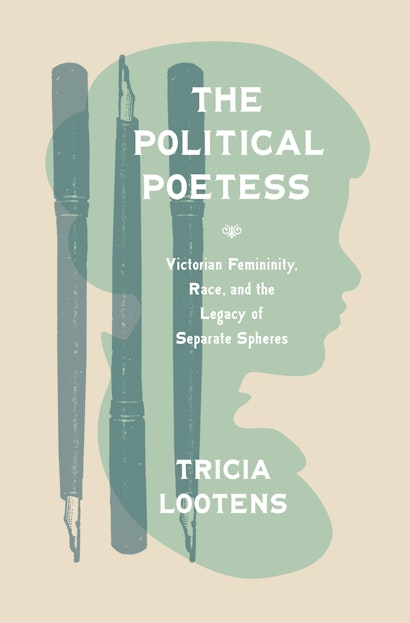
The Political Poetess challenges familiar accounts of the figure of the nineteenth-century Poetess, offering new readings of Poetess performance and criticism. In performing the Poetry of Woman, the mythic Poetess has long staked her claims as a creature of 鈥渟eparate spheres鈥濃�攐ne exempt from emerging readings of nineteenth-century women’s political poetics. Turning such assumptions on their heads, Tricia Lootens models a nineteenth-century domestic or private sphere whose imaginary, apolitical heart is also the heart of nation and empire, and, as revisionist histories increasingly attest, is traumatized and haunted by histories of slavery. Setting aside late Victorian attempts to forget the unfulfilled, sentimental promises of early antislavery victories, The Political Poetess restores Poetess performances like Julia Ward Howe鈥檚 鈥淏attle Hymn of the Republic鈥� and Emma Lazarus鈥檚 鈥淭he New Colossus鈥� to view鈥攁nd with them, the vitality of the Black Poetess within African-American public life.
Crossing boundaries of nation, period, and discipline to 鈥渃onnect the dots鈥� of Poetess performance, Lootens demonstrates how new histories and ways of reading position poetic texts by Felicia Dorothea Hemans, Elizabeth Barrett Browning, Dinah Mulock Craik, George Eliot, and Frances E. W. Harper as convergence points for larger engagements ranging from Germaine de Sta毛l to G.W.F. Hegel, Virginia Woolf, Elizabeth Bishop, Alice Walker, and beyond.
Tricia Lootens is associate professor of English and Josiah Meigs Distinguished Teaching Professor at the University of Georgia. She is the author of Lost Saints:聽 Silence, Gender, and Victorian Literary Canonization.
"It will be required reading for advanced scholars of Anglo-American poetry and women's writing."鈥�Choice
"Intellectual vibrant [and] important. . . . A politically committed, intellectually generous, and abundantly useful book."鈥擩ulia Hansen, Tulsa Studies in Women's Literature
"An unforgettable account of female poets as blazingly politically involved. Lootens turns the Poetess on her head in The Political Poetess: Victorian Femininity, Race, and the Legacy of Separate Spheres. No longer a pale, lovely, swooning maiden, Lootens鈥檚 Poetess is a person of color, a person deeply imbricated in transatlantic antislavery rhetoric, a woman who speaks for a nation. In bravura rereadings of well-known poems (and some not known at all), Lootens makes us see anew by interrogating 'how national sentimentality thinks.'"鈥擳alia Schaffer, Studies in English Literature
"Lootens marshals a considerable number of cultural sources, literary and not, to build a thorough case for her reexamination of the connections between racial and separate spheres ideology. . . . At its ambitious best, The Political Poetess suspends the boundaries that continue to haunt our current critical lives: between black and white, public and private, British and American, past and present."鈥擜manda Adams, Victorian Periodicals Review
"In all these ways, the Political Poetess becomes integral to the revisionist history of the female literary tradition emphasising national anxieties. . . . [Lootens] reads with acumen and diligently researches the historical circumstances of poetic production."鈥擥eorgia Gotsi, Historical Review
"Leaping and lingering through two centuries of Poetess poetics, Lootens traces the national, racial, and gender politics of a complex generic figure that still haunts our literary culture. Lootens is a brilliant reader of poems, always attuned to 鈥榯he click of the clich茅.' She has a wide-ranging command of critical debates in a field that is now transformed by the question she poses: What made the Poetess white? Written with gusto for students and scholars alike, The Political Poetess is a major contribution to Victorian studies, feminist theory, critical race studies, and historical poetics."鈥擸opie Prins, University of Michigan
"In this book, Lootens argues that from the late eighteenth century through recent times, the Poetess tradition has been predicated on the assumption of whiteness both in its practice and criticism. Lootens honors a tradition of feminist work on nineteenth-century women writers while throwing into question longstanding assumptions and showing a way to a more inclusive, politically engaged form of criticism. Compelling and persuasive, this is a landmark work."鈥擡liza Richards, University of North Carolina, Chapel Hill
"This is a brilliant and powerful book. Carving out important new territory and offering striking insights at every turn, it creates a vision of transatlantic Anglo-American studies that centers on the range of responses to slavery and provides a new chapter in the study of the Poetess, a figure of great interest across the nineteenth century鈥攁nd still today. The depth, range, and detail of the research exhibited here are all extraordinary."鈥擟arolyn Williams, Rutgers University
No known hazards or warnings
Accessibility Features
-
Inaccessible, or known limited accessibility
-
No known hazards or warnings