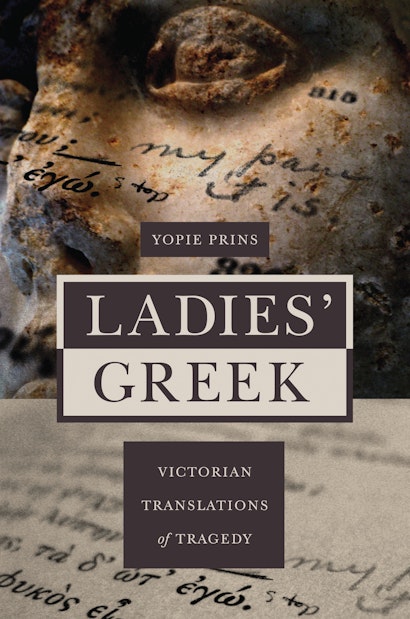
In Ladies鈥� Greek, Yopie Prins illuminates a culture of female classical literacy that emerged in the second half of the nineteenth century, during the formation of women’s colleges on both sides of the Atlantic. Why did Victorian women of letters desire to learn ancient Greek, a 鈥渄ead鈥� language written in a strange alphabet and no longer spoken? In the words of Elizabeth Barrett Browning, they wrote 鈥渟ome Greek upon the margin鈥攍ady’s Greek, without the accents.鈥� Yet in the margins of classical scholarship they discovered other ways of knowing, and not knowing, Greek. Mediating between professional philology and the popularization of classics, these passionate amateurs became an important medium for classical transmission.
Combining archival research on the entry of women into Greek studies in Victorian England and America with a literary interest in their translations of Greek tragedy, Prins demonstrates how women turned to this genre to perform a passion for ancient Greek, full of eros and pathos. She focuses on five tragedies鈥�Agamemnon, Prometheus Bound, Electra, Hippolytus, and The Bacchae鈥攖o analyze a wide range of translational practices by women and to explore the ongoing legacy of Ladies鈥� Greek. Key figures in this story include Barrett Browning and Virginia Woolf, Janet Case and Jane Harrison, Edith Hamilton and Eva Palmer, and A. Mary F. Robinson and H.D. The book also features numerous illustrations, including photographs of early performances of Greek tragedy at women’s colleges.
The first comparative study of Anglo-American Hellenism, Ladies鈥� Greek opens up new perspectives in transatlantic Victorian studies and the study of classical reception, translation, and gender.
Awards and Recognition
- Shortlisted for the 2017 London Hellenic Prize, London Hellenic Society
- Winner of the 2018 NAVSA Book Prize, North American Victorian Studies Association
- Winner of the 2018 Robert Lowry Patten Award, SEL Studies in English Literature 1500-1900
"The story of 'ladies' Greek', writes Yopie Prins in this fascinating academic study, goes hand in hand with that of the progress made in women鈥檚 education during the second half of the 19th century."鈥擣rancesca Wade, Daily Telegraph
"[A] splendid new study of late 19th- and early 20th-century female translators of ancient Greek tragedy. . . . Prins gives a fascinating account of the importance of Greek tragedy in translation and theatrical production in the colleges of higher education for women that emerged in this period."鈥擡mily Wilson, Guardian
"[An] excellent new book. . . . [Prins] brings a perspective combination of biographical insight and historical overview."鈥擩ohn Kerrigan, London Review of 快色直播
"In Yopie Prins' remarkably wide-ranging, even scandalously scholarly work, she has collected a series of vivid tableaux vivant featuring translations and performances of Greek tragedies by 19th- and early 20th-century women, both in Britain and America."鈥擬ary Townsend, Education & Culture Review
"Ladies' Greek has been nearly twenty years in preparation. . . . It's been worth the wait. This is a wonderful demonstration of archival research, literary history and close reading which takes the discipline of classical reception to a new level. Like the subjects she describes, Prins breathes new life into dead papers, her own dazzling writing dancing across the page. . . . An exhilarating intellectual ride."鈥擩ennifer Wallace, Modern Language Quarterly
"Prins has a gift for wordplay and turns of phrase . . . that can open up new speculative possibilities as we ask why women were so attracted to learning Greek. . . . [An] important study."鈥擡lizabeth Helsinger, Modern Philology
"Ladies鈥� Greek is an exceptional piece of work. Deftly written, insightful and expansive, the book demonstrates Prins鈥� excellence as a scholar. Prins has produced more than outstanding scholarship, though: her series of encounters with archival materials and the lives and works of past women they represent is both compelling and moving. I will confess that the book took some time to get through, but that is chiefly because I found myself re-reading some of the passages again and again as one might do a great piece of literature. . . . A triumph."鈥擠avid Bullen, Classical Review
"A wonderful demonstration of archival research, literary history, and close reading, Ladies鈥� Greek takes the discipline of classical reception to a new level. Like the subjects she describes, Prins breathes new life into dead papers, her own dazzling writing dancing across the page."鈥擩ennifer Wallace, Modern Language Quarterly
"Prins鈥� archival analysis unpicks such conflicting perceptions of increased access to women鈥檚 education. Engrossing and accessible, Ladies鈥� Greek reveals very different (self-)portraits of female classicists and paves the way for further studies of women鈥檚 encounters with classical antiquity."鈥擱achel Bryant Davies, Journal of Hellenic Studies 鈥嬧�嬧�嬧�嬧�嬧�嬧��
"Ladies' Greek is remarkable for its sensitive and subtle discussion of the controversial process of translating and performing dramatic texts written in a dead language whose study was at first available only to men."鈥擧elene P. Foley, Barnard College
"Combining revelatory archival work and close literary readings, Ladies' Greek tells a riveting story of desire and insecurity, scholarship and theater, friendship and poetry."鈥擲imon Goldhill, University of Cambridge
"Ladies' Greek is the resounding answer to Woolf鈥檚 鈥極n Not Knowing Greek.鈥� What was unleashed when women as well as men, on both sides of the Atlantic, came to intimately know their beloved Greek tragedies? Prins recreates the burgeoning culture of translation and re-enactment at women鈥檚 colleges, reviving enthusiasms of the forgotten and famous, from A. Mary F. Robinson to Elizabeth Barrett Browning. This is a definitive literary history that will influence future scholars, but any reader may binge on it like a beautiful BBC drama."鈥擜lison Booth, University of Virginia
"This original, elegant, and beautifully written book combines deep classical learning and superb transatlantic archival research to produce a wonderful account of Victorian women's intense love affair with ancient Greek. Yopie Prins's classical expertise helps scholars who cannot read Greek toward magnificent new literary interpretations."鈥擬ary Loeffelholz, Northeastern University
"Ladies' Greek is a highly anticipated, wide-ranging, and meticulously researched book. Its compelling and original conclusion makes a significant contribution to our understanding of Victorian Hellenism."鈥擫aura McClure, University of Wisconsin鈥揗adison
No known hazards or warnings
Accessibility Features
-
Inaccessible, or known limited accessibility
-
No known hazards or warnings