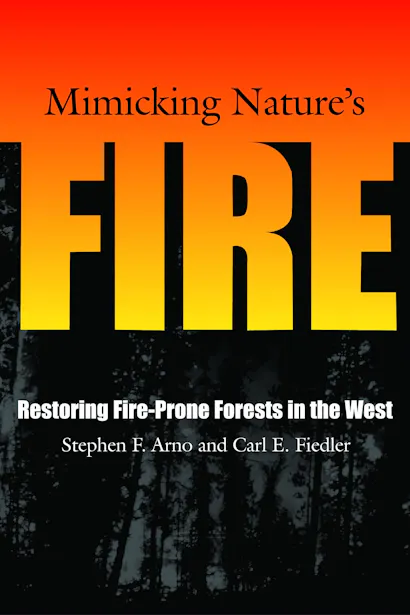
Mimicking Nature's Fire: Restoring Fire-Prone Forests In The West

Paperback
ebook (EPUB via app)
- Sale Price:
- $25.90/拢21.00
- Price:
-
$37.00/拢30.00 - ISBN:
- Published:
- Apr 10, 2013
- Copyright:
- 2005
30% off with code PUP30
ebook (PDF via app)
- Sale Price:
- $25.90/拢21.00
- Price:
-
$37.00/拢30.00 - ISBN:
- Published:
- Apr 10, 2013
- Copyright:
- 2005
30% off with code PUP30
-
Audio and ebooks (EPUB and PDF) purchased from this site must be accessed on the
快色直播 app. After purchasing, you will receive an email with
instructions to access your purchase.
About audio and ebooks - Request Exam Copy
The magnificent stands of old-growth trees that characterize the forests of western North America depend on periodic fires for their creation or survival. Deprived of that essential disturbance process eventually they die, leaving an overcrowded growth of smaller trees vulnerable to intense blazes and epidemics of insects and disease.
In Mimicking Nature’s Fire, forest ecologists Stephen Arno and Carl Fiedler present practical solutions to the pervasive problem of deteriorating forest conditions in western North America. Advocating a new direction in forest management, they explore the promise of 鈥渞estoration forestry鈥� — an ecologically based approach that seeks to establish forest structures in which fire can once again serve as a beneficial process rather than as a destructive aberration.
The book begins with an overview of fundamentals: why traditional forestry tried to exclude fire from forests, why that attempt failed, and why foresters and ecologists now recognize the need for management based on how natural ecosystems operate. Subsequent chapters consider: how fire’s historic role provides a foundation for designing restoration strategies; why a hands-off approach will not return forests to their historical condition; how management goals influence the strategies used in restoration forestry.
The second part of the book presents case studies of restoration projects in the western United States and Canada, representing different forest types, different historic fire regimes, and contrasting management goals. For each project, the authors describe why and how the project is being conducted, profile forest conditions, and describe methods of treatment. They also report what has been accomplished, identify obstacles to restoration, and offer their candid but understanding evaluation. Mimicking Nature’s Fire concludes by placing restoration forestry in the broad context of conserving forests worldwide and outlining factors critical for its success.