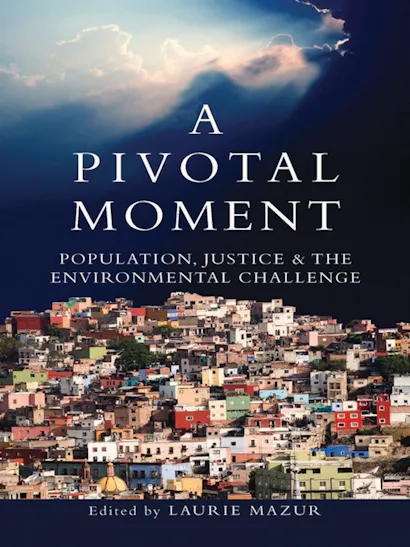
A Pivotal Moment: Population, Justice, and the Environmental Challenge
-
Contributions by
- Sandra Postel
- Steve Sinding
- Tim Wirth
- Tim Cohen
- Adrienne Germain
- Brian O'Neill
- Judith Bruce
- Elizabeth Malone
- Elizabeth Leahy Madsen
- Amy Coen
- Lynne Gaffikin
- John Harte
- Gordon McGranahan
- Rachel Nugent
- Lester R. Brown
- Walden Bello
- Eleanor Sterling
- Erin Vintinner
- Vicky Markham
- Julia Varshavsky
- Carmen Barroso
- John Bongaarts
- Frances Kissling
- Susana Chavex Alvarado
- Jacqueline Nolley Echegaray
- Ellen Chesler
- Roger-Mark De Souza
- James Gustave Speth
- Shira Saperstein
- Priscilla Huang
- James B. Martin-Schramm
- Ursula Goodenough
- Fred Sai
- Alex Steffen
- Adriana Varillas
- Malea Hoepf Young
- Charlotte Brody

Paperback
ebook (EPUB via app)
- Sale Price:
- $38.50/拢31.50
- Price:
-
$55.00/拢45.00 - ISBN:
- Published:
- Sep 26, 2012
- Copyright:
- 2010
- Size:
- 6 x 9 in.
- photos, figures, notes, index
30% off with code PUP30
ebook (PDF via app)
- Sale Price:
- $38.50/拢31.50
- Price:
-
$55.00/拢45.00 - ISBN:
- Published:
- Sep 26, 2012
- Copyright:
- 2010
- Size:
- 6 x 9 in.
- photos, figures, notes, index
30% off with code PUP30
-
Audio and ebooks (EPUB and PDF) purchased from this site must be accessed on the
快色直播 app. After purchasing, you will receive an email with
instructions to access your purchase.
About audio and ebooks - Request Exam Copy
Through a series of essays by leading demographers, environmentalists and reproductive health advocates, A Pivotal Moment offers a new perspective on the complex connection between population dynamics and environmental quality. It presents the latest research on the relationship between population growth and climate change, ecosystem health and other environmental issues. It surveys the new demographic landscape鈥攊n which population growth rates have fallen, but human numbers continue to increase. It looks back at the lessons learned from half a century of population policy鈥攁nd forward to propose twenty-first century population policies that are sustainable and just.
A Pivotal Moment puts forth the concept of 鈥減opulation justice,鈥� which is inspired by reproductive justice and environmental justice movements. Population justice holds that inequality is a root cause of both rapid population growth and environmental degradation. As the authors in this volume explain, to slow population growth and build a sustainable future, women and men need access to voluntary family planning and other reproductive health services. They need education and employment opportunities, especially for women. Population justice means tackling the deep inequities鈥攂oth gender and economic鈥攖hat are associated with rapid population growth and unsustainable resource consumption. Where family planning is available, where couples are confident their children will survive, where girls go to school, where young men and women have economic opportunity鈥攖here couples will have healthier and smaller families.