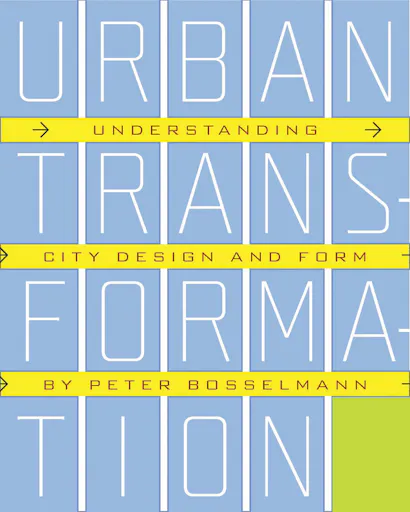
Urban Transformation: Understanding City Form and Design

Paperback
ebook (EPUB via app)
- Sale Price:
- $45.50/拢38.50
- Price:
-
$65.00/拢55.00 - ISBN:
- Published:
- Sep 26, 2012
- Copyright:
- 2008
- Size:
- 8 x 10 in.
- 326 photos and illustrations
30% off with code PUP30
ebook (PDF via app)
- Sale Price:
- $45.50/拢38.50
- Price:
-
$65.00/拢55.00 - ISBN:
- Published:
- Sep 26, 2012
- Copyright:
- 2008
- Size:
- 8 x 10 in.
- 326 photos and illustrations
30% off with code PUP30
-
Audio and ebooks (EPUB and PDF) purchased from this site must be accessed on the
快色直播 app. After purchasing, you will receive an email with
instructions to access your purchase.
About audio and ebooks - Request Exam Copy
How do cities transform over time? And why do some cities change for the better while others deteriorate? In articulating new ways of viewing urban areas and how they develop over time, Peter Bosselmann offers a stimulating guidebook for students and professionals engaged in urban design, planning, and architecture. By looking through Bosselmann鈥檚 eyes (aided by his analysis of numerous color photos and illustrations) readers will learn to 鈥渟ee鈥� cities anew.
Bosselmann organizes the book around seven 鈥渁ctivities鈥�: comparing, observing, transforming, measuring, defining, modeling, and interpreting. He introduces readers to his way of seeing by comparing satellite-produced 鈥渕aps鈥� of the world鈥檚 twenty largest cities. With Bosselmann鈥檚 guidance, we begin to understand the key elements of urban design. Using Copenhagen, Denmark, as an example, he teaches us to observe without prejudice or bias.
He demonstrates how cities transform by introducing the idea of 鈥渦rban morphology鈥� through an examination of more than a century of transformations in downtown Oakland, California. We learn how to measure quality-of-life parameters that are often considered immeasurable, including 鈥渧itality,鈥� 鈥渓ivability,鈥� and 鈥渂elonging.鈥� Utilizing the street grids of San Francisco as examples, Bosselmann explains how to define urban spaces. Modeling, he reveals, is not so much about creating models as it is about bringing others into public, democratic discussions. Finally, we find out how to interpret essential aspects of 鈥渓ife and place鈥� by evaluating aerial images of the San Francisco Bay Area taken in 1962 and those taken forty-three years later.
Bosselmann has a unique understanding of cities and how they 鈥渨ork.鈥� His hope is that, with the fresh vision he offers, readers will be empowered to offer inventive new solutions to familiar urban problems.