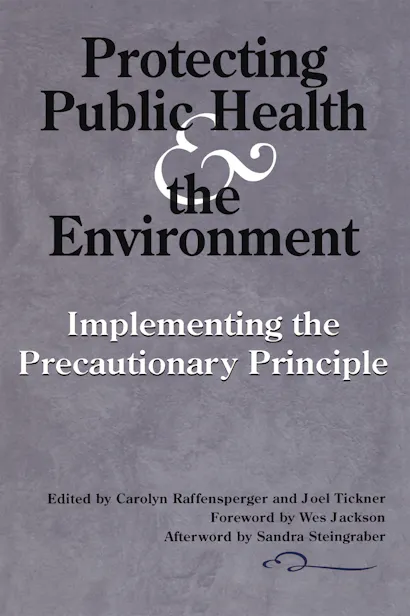
Protecting Public Health and the Environment: Implementing The Precautionary Principle
-
Foreword by
- Wes Jackson

Paperback
ebook (EPUB via app)
- Sale Price:
- $46.90/拢38.50
- Price:
-
$67.00/拢55.00 - ISBN:
- Published:
- Apr 10, 2013
- Copyright:
- 1999
- Size:
- 6 x 9 in.
30% off with code PUP30
ebook (PDF via app)
- Sale Price:
- $46.90/拢38.50
- Price:
-
$67.00/拢55.00 - ISBN:
- Published:
- Apr 10, 2013
- Copyright:
- 1999
- Size:
- 6 x 9 in.
30% off with code PUP30
-
Audio and ebooks (EPUB and PDF) purchased from this site must be accessed on the
快色直播 app. After purchasing, you will receive an email with
instructions to access your purchase.
About audio and ebooks - Request Exam Copy
When an activity raises threats of harm to human health or the environment, precautionary measures should be taken even if some cause and effect relationships are not fully established scientifically. This idea, known as the 鈥淧recautionary Principle,鈥� is seen by environmentalists and public health experts as the key to protecting ecological and human health.
In January 1998, the Science and Environmmental Health Network convened an international group of scientists, researchers, environmentalists, academics, and labor representatives to discuss ways of incorporating the precautionary approach into environmental and public health decision-making. Known as the Wingspread Conference on Implementing the Precautionary Principle, the workshop focused on understanding the contexts under which the principle developed, its basis, and how it could be implemented. Protecting Public Health and the Environment is an outgrowth of that conference. The book:
- describes the history, specific content, and scientific and philosophical foundations of the principle of precautionary action
- explains the functions of the principle in activities as diverse as agriculture and manufacturing
- explains how to know when precautionary action is needed and who decides what action will (or will not) be taken
- attempts to show how the burden of proof of environmental harm can be shifted to proponents of a potentially hazardous activity
- provides specific structures and mechanisms for implementing the precautionary principl.
Public health professionals and academics, policymakers, environmental lawyers, sustainable agriculture proponents, economists, and environmental activists will find the book an enlightening and thought-provoking guide to a new way of thinking about ecosystem and public health protection.